Bilateral deficit with China: why it’s a terrible headline metric
Bilateral deficits ignore supply chains and value-added. Here’s why they mislead—and what to use instead.
TL;DR
Bilateral deficits (with one country) are a weak measure of economic “fairness” because modern supply chains split production across many countries. The country of final assembly gets blamed for value created elsewhere.
The core problem: “Made in China” often means “Assembled in China”
A phone can be designed in one country, use chips from another, screens from a third, and be assembled in China. Customs statistics typically record the full import value against the final shipping country. That’s convenient for paperwork—and terrible for understanding where the value was created.
So a bilateral deficit can grow even if:
- The value-added share captured by the partner country is small,
- The real driver is your own demand for final goods,
- Or the supplier network is simply routing through the lowest-friction assembly hub.
Why it’s still politically irresistible
Bilateral numbers are emotionally neat: “We’re down X with them.” It’s an easy villain metric. It’s also a great way to avoid harder questions about domestic investment, skills, and industrial strategy.
What actually changes deficits
Bilateral deficits can swing because of:
- Exchange rates,
- Shipping and logistics costs,
- Trade rules and tariffs,
- Corporate reshoring/rerouting decisions,
- Or simply where multinationals route invoicing.
In other words: the number can move even when underlying competitiveness hasn’t.
What to use instead
If you want a metric that’s closer to reality, look at:
- Value-added trade measures (where available),
- Sectoral balances (e.g., electronics vs chemicals vs autos),
- Import dependence in critical inputs (chips, pharma precursors, rare materials),
- Domestic capacity indicators: capex, productivity, supply-chain depth.
Common misconception
“If we fix the deficit with China, we fix the trade problem.” Often the deficit just shifts to other countries as supply chains reroute -- a reality that becomes clearer when you look at The China Dependency Index. The issue isn’t the flag on the box—it’s the structure of production and demand.
Research that uses this concept
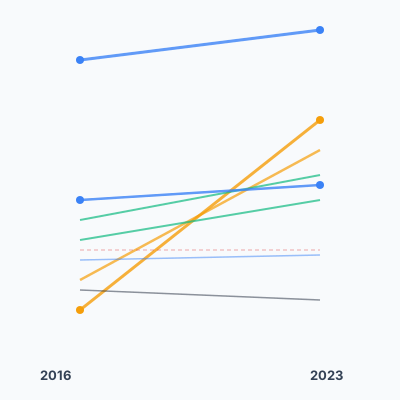
The China Dependency Index
When did China become your country's most important trade partner? For half the world, it already has. We mapped the dependency — and the risks.
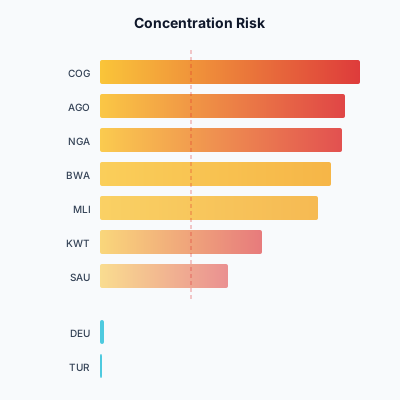
Concentration Risk
Some countries are one product away from crisis. We computed export concentration for every economy — the results are a map of global economic fragility.

The Debt-Trade Spiral
Persistent trade deficits and fiscal deficits compound into a debt spiral visible across decades. The data shows which countries are trapped — and which broke free.
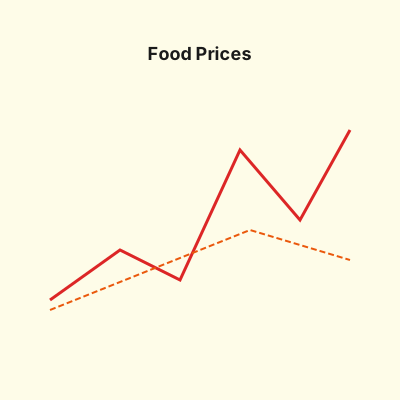
Agricultural Trade & Food Prices
The Arab Spring wasn't about politics. It started with the price of bread. We traced how global commodity spikes ripple into food crises — and who gets hit first.
Related explainers
“China is dumping”: What dumping actually means (and what it doesn’t)
Low prices aren’t automatically dumping. Dumping is a legal test tied to price discrimination and injury.

Carbon leakage
When strict climate policy in one country just pushes emissions across the border.

Comparative advantage
Why trade can benefit both sides even when one side is ‘better at everything’—and why that doesn’t settle policy debates.

Food security: It's not about growing everything yourself
Why food security depends on trade routes as much as farmland — and what actually breaks it.

Subsidies
Not all subsidies are equal: explicit vs implicit, production vs consumption, and why they matter for trade fights.

Tariffs 101: Who Actually Pays? (And why everyone argues about it)
A clear, non-slogan explanation of tariff incidence, pass-through, and why “they pay” is usually wrong.