Carbon leakage
When strict climate policy in one country just pushes emissions across the border.
TL;DR
Carbon leakage happens when climate regulations in one country raise production costs enough that businesses relocate to places with weaker rules, shifting emissions rather than reducing them. The planet doesn't care which side of a border the CO2 comes from.
What it means (plain English)
Say your country puts a serious price on carbon — $100 per ton. Steel production becomes expensive domestically. But a factory in a country with no carbon price can make the same steel cheaper. So the steel gets imported, the domestic plant shuts down, and the emissions still happen — just somewhere else.
This is the fundamental challenge of unilateral climate policy. You can regulate your own territory, but you can't regulate the atmosphere's response to emissions produced elsewhere to satisfy your demand. The Global Carbon Project tracks both territorial and consumption-based emissions, revealing the scale of this cross-border carbon shifting.
The EU's Carbon Border Adjustment Mechanism (CBAM) is the most prominent attempt to fix this: importers must buy carbon certificates matching the EU's carbon price, leveling the cost. It's controversial, messy, and incomplete — but it addresses a real problem.
Common misconception
"Carbon leakage is just a fossil-fuel industry talking point." It can be exaggerated, yes. But it's also empirically real in energy-intensive, trade-exposed sectors: steel, cement, aluminum, chemicals. Denying leakage doesn't help climate policy — it undermines it by ignoring a genuine weakness.
Headline translation
When you read: "Ambitious climate policy will cost jobs," translate it as: "Without border adjustments, carbon-intensive production may shift abroad — the emissions move, the jobs move, and global totals don't improve."
A concrete example
The EU prices carbon; India and Southeast Asia don't (or price it far lower). A European cement maker faces costs its competitors abroad don't. If the EU doesn't equalize at the border, either European cement gets outcompeted on price, or the producer moves operations. Either way, the CO2 still enters the same atmosphere.
If you only remember one thing...
Carbon leakage means well-intentioned climate policy can increase global emissions if it only makes dirty production someone else's problem. Border adjustments aren't protectionism — they're the logical complement to a carbon price.
Research that uses this concept
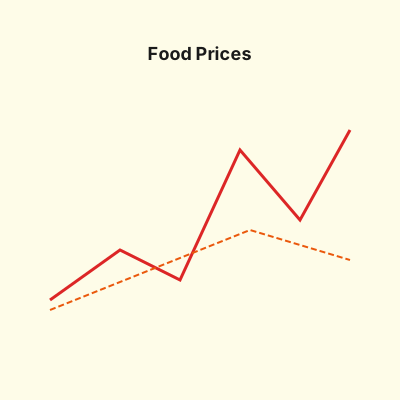
Agricultural Trade & Food Prices
The Arab Spring wasn't about politics. It started with the price of bread. We traced how global commodity spikes ripple into food crises — and who gets hit first.
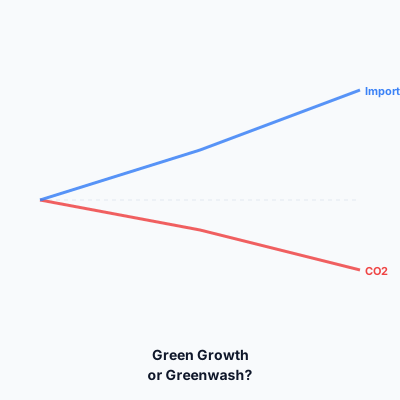
Green Growth or Greenwash
Europe's emissions fell 30%. Its manufactured imports rose 40%. Coincidence? We tested whether 'decoupling' is real or just offshored pollution.
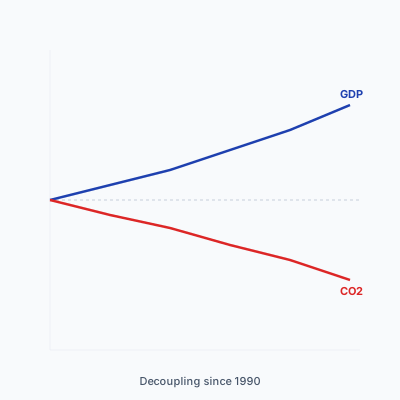
Carbon Cost of Growth
Can a country get richer without cooking the planet? Some have. Most haven't. We tracked GDP growth against CO2 emissions for 30 years — the decoupling story is real, but incomplete.
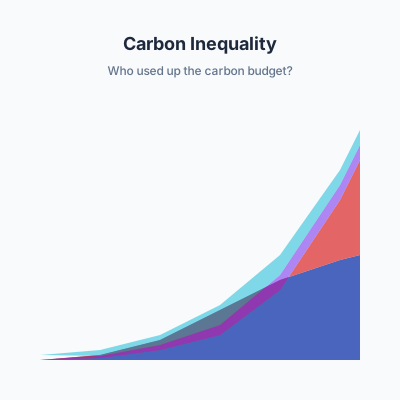
Carbon Inequality
The countries drowning in rising seas didn't cause the flood. We mapped who emitted what, when — and the per-capita gap is staggering.
Related explainers
“China is dumping”: What dumping actually means (and what it doesn’t)
Low prices aren’t automatically dumping. Dumping is a legal test tied to price discrimination and injury.

Bilateral deficit with China: why it’s a terrible headline metric
Bilateral deficits ignore supply chains and value-added. Here’s why they mislead—and what to use instead.

Capacity factor
Why a country with 10 GW of solar capacity doesn't actually get 10 GW of electricity.

Comparative advantage
Why trade can benefit both sides even when one side is ‘better at everything’—and why that doesn’t settle policy debates.

Consumption vs territorial emissions
The accounting trick that lets rich countries claim they're decarbonizing while importing carbon-heavy goods.
Dutch disease
How a resource windfall can hollow out the rest of your economy — and why the real disease is mismanagement.