Comparative advantage
Why trade can benefit both sides even when one side is ‘better at everything’—and why that doesn’t settle policy debates.
TL;DR
Comparative advantage means specializing in what you’re relatively better at, not absolutely best at. It explains why trade can raise total output and variety. It does not guarantee that every worker or region benefits without adjustment.
What it means (plain English)
Even if a country is more productive in many things, it still has opportunity costs. If it’s especially efficient in one sector, shifting resources there can make both countries better off when they trade.
The model is powerful for understanding gains from trade, but it assumes frictionless movement of labor and capital—which is not how real economies behave. The World Trade Organization publishes extensive data on how trade patterns align with — and deviate from — theoretical predictions.
Common misconception
”Comparative advantage says we must abandon manufacturing.”
No. It describes a tendency under certain conditions, not a moral instruction. (For a look at what happens when countries do shift away from manufacturing, see The Manufacturing Exodus.) Countries can pursue industrial policy for resilience, learning-by-doing, or national security—at a cost. The honest debate is about trade-offs.
Headline translation
When you read: “Trade is always good,” translate it as: “Trade can raise the pie, but distribution and adjustment costs matter.”
A concrete example
If one country can produce both cars and software more efficiently, but it’s much more efficient at software, specializing and trading can still increase total welfare—while still requiring serious policy for displaced workers.
If you only remember one thing…
Comparative advantage explains efficiency. Politics and policy are about who pays the adjustment bill.
Research that uses this concept
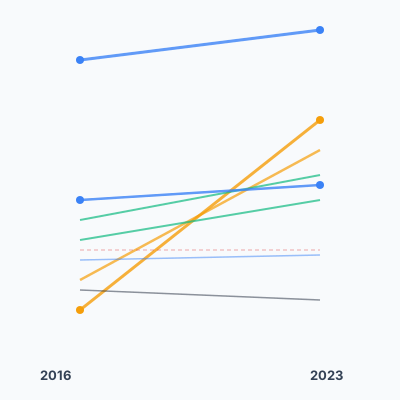
The China Dependency Index
When did China become your country's most important trade partner? For half the world, it already has. We mapped the dependency — and the risks.
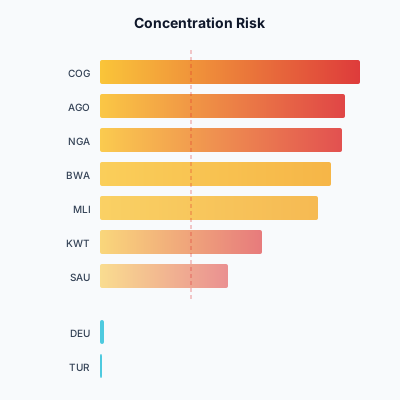
Concentration Risk
Some countries are one product away from crisis. We computed export concentration for every economy — the results are a map of global economic fragility.

The Debt-Trade Spiral
Persistent trade deficits and fiscal deficits compound into a debt spiral visible across decades. The data shows which countries are trapped — and which broke free.
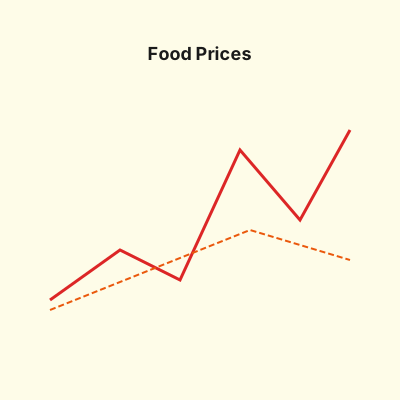
Agricultural Trade & Food Prices
The Arab Spring wasn't about politics. It started with the price of bread. We traced how global commodity spikes ripple into food crises — and who gets hit first.
Related explainers
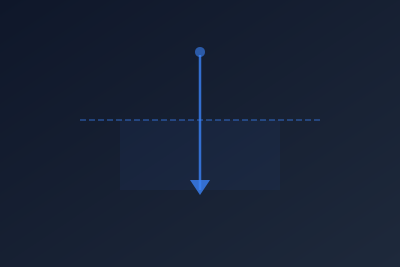
“China is dumping”: What dumping actually means (and what it doesn’t)
Low prices aren’t automatically dumping. Dumping is a legal test tied to price discrimination and injury.

Bilateral deficit with China: why it’s a terrible headline metric
Bilateral deficits ignore supply chains and value-added. Here’s why they mislead—and what to use instead.

Carbon leakage
When strict climate policy in one country just pushes emissions across the border.

Food security: It's not about growing everything yourself
Why food security depends on trade routes as much as farmland — and what actually breaks it.

Subsidies
Not all subsidies are equal: explicit vs implicit, production vs consumption, and why they matter for trade fights.

Tariffs 101: Who Actually Pays? (And why everyone argues about it)
A clear, non-slogan explanation of tariff incidence, pass-through, and why “they pay” is usually wrong.