Consumption vs territorial emissions
The accounting trick that lets rich countries claim they're decarbonizing while importing carbon-heavy goods.
TL;DR
Territorial emissions count CO2 released within a country's borders. Consumption-based emissions count the CO2 embedded in everything a country's residents actually use, including imports. The gap between the two reveals who's outsourcing their pollution.
What it means (plain English)
When Germany imports steel from India, the CO2 from smelting that steel shows up in India's territorial emissions — not Germany's. But the steel ends up in a German car bought by a German consumer. Consumption-based accounting assigns that carbon to Germany.
Neither measure is "wrong." They answer different questions (the Global Carbon Project publishes both series annually):
- Territorial: Who is physically emitting? Useful for regulation.
- Consumption-based: Whose demand is driving emissions? Useful for responsibility.
The difference matters because wealthy nations have spent decades shifting carbon-intensive production offshore while congratulating themselves on falling domestic emissions.
Common misconception
"Europe has decarbonized faster than developing countries." By territorial accounting, partly true. By consumption-based accounting, the picture is far less flattering. A significant share of Europe's apparent progress comes from importing goods whose carbon cost was paid elsewhere.
Headline translation
When you read: "Country X cut emissions 30% since 1990," translate it as: "Country X cut emissions within its borders — check whether its consumption footprint tells the same story."
A concrete example
The UK's territorial emissions fell roughly 40% between 1990 and 2020. Its consumption-based emissions fell too — but by considerably less. The gap is the carbon embedded in imported goods: electronics from China, chemicals from South Asia, materials from everywhere. The production moved; the demand didn't.
If you only remember one thing...
Territorial emissions measure where smokestacks are. Consumption-based emissions measure whose lifestyle those smokestacks serve. Any serious climate accounting needs both.
Research that uses this concept
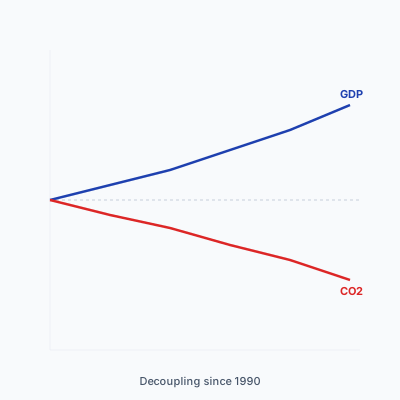
Carbon Cost of Growth
Can a country get richer without cooking the planet? Some have. Most haven't. We tracked GDP growth against CO2 emissions for 30 years — the decoupling story is real, but incomplete.
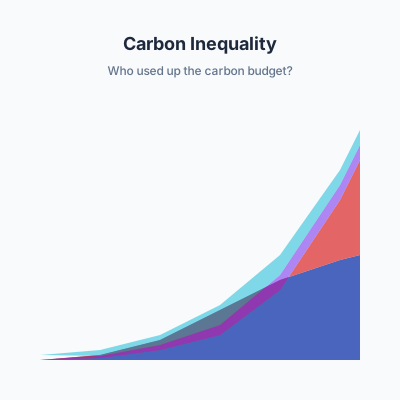
Carbon Inequality
The countries drowning in rising seas didn't cause the flood. We mapped who emitted what, when — and the per-capita gap is staggering.

Climate Vulnerability vs Emissions
Chad emits less CO2 in a year than a US state does in a day. Chad is also one of the most climate-vulnerable countries on Earth. The injustice is measurable.
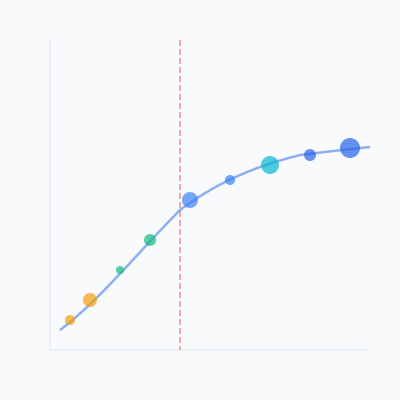
The Energy-Prosperity Ladder
There is a clear energy consumption threshold countries must cross for human development. Below ~4,000 kWh per capita, every additional kilowatt-hour transforms lives. Above 10,000, you're just heating empty rooms.
Related explainers

Capacity factor
Why a country with 10 GW of solar capacity doesn't actually get 10 GW of electricity.

Carbon leakage
When strict climate policy in one country just pushes emissions across the border.

Dutch disease
How a resource windfall can hollow out the rest of your economy — and why the real disease is mismanagement.

Energy intensity
How much energy it takes to produce a dollar of GDP — and why the trend can mislead you.
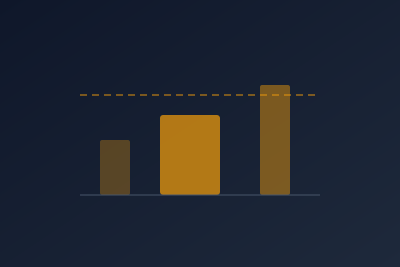
Fiscal breakeven: the price that keeps the lights on
Every petrostate has a magic number — the oil price needed to balance the budget. It almost always goes up.