Debt sustainability: why the number that matters isn't the debt level
Japan survives at 250% debt-to-GDP. Argentina collapses at 60%. The difference is everything.
TL;DR
Debt sustainability isn't about how much you owe — it's about whether your economy grows faster than your interest bill. The key variable is the interest-growth differential (r minus g). When growth exceeds interest rates, debt ratios shrink on autopilot. When it doesn't, even modest debt becomes a trap.
What it means (plain English)
Governments borrow constantly. The question isn't whether they should — it's whether the debt is on a stable path. Three things determine that:
- Debt-to-GDP ratio: the stock of debt relative to the size of the economy. This is the headline number, but it's the least informative on its own.
- Primary balance: government revenue minus spending, excluding interest payments. If you're running a primary surplus, you're generating cash to service debt. If not, you're borrowing to pay interest — which compounds.
- Interest-growth differential (r - g): if the interest rate on your debt (r) is lower than your GDP growth rate (g), the debt ratio naturally falls over time even without surpluses. If r exceeds g, you need ever-larger surpluses just to stabilize. The IMF's World Economic Outlook publishes fiscal projections that let you track r-g dynamics across countries.
Common misconception
"Any country with debt above 100% of GDP is in trouble." Japan has been above 200% for years and borrows at near-zero rates because it has a captive domestic savings pool, its own central bank, and debt denominated in its own currency. Meanwhile, countries borrowing in dollars with volatile growth and thin domestic savings can blow up at 40%. Context is everything. The Debt-Trade Spiral shows how external deficits accelerate this dynamic.
Headline translation
When you read: "Country X's debt hits record high," ask: what's happening to r minus g? A rising debt ratio during a growth boom with low rates is very different from a rising ratio during stagnation with rising rates. The trajectory matters more than the snapshot.
A concrete example
Italy's debt-to-GDP has hovered around 140% for years. When ECB rates were near zero and nominal growth was positive, the debt ratio was roughly stable — uncomfortable but manageable. The moment rates rose faster than growth, Italy needed primary surpluses just to keep the ratio from exploding. The arithmetic is mechanical and merciless — you can compare Italy and Japan's fiscal trajectories on MacroVedia. Aging Economies explains why demographics make this calculus harder over time.
The variables that actually matter
- Currency denomination: borrowing in your own currency means you can't technically default (you can always print). Borrowing in someone else's currency means you can.
- Maturity structure: long-dated debt gives you time. Short-dated debt means you're constantly rolling over at whatever rate markets demand.
- Who holds it: domestic savers are sticky. Foreign portfolio investors are not.
- Growth prospects: a country that can plausibly grow 5% has more room than one stuck at 1%.
If you only remember one thing...
Don't look at the debt level. Look at r minus g. That single differential tells you more about fiscal sustainability than any headline number ever will.
Research that uses this concept
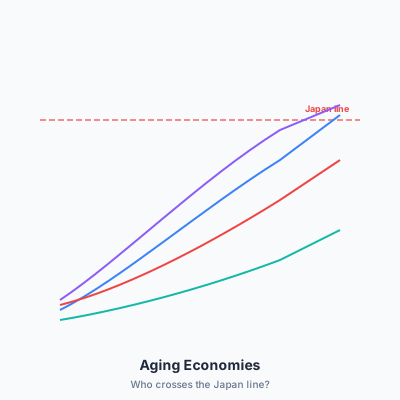
Aging Economies
Japan is the future — and most countries aren't ready. Population aging will break budgets, shrink workforces, and reshape economies. The timeline is visible in the data.

The Debt-Trade Spiral
Persistent trade deficits and fiscal deficits compound into a debt spiral visible across decades. The data shows which countries are trapped — and which broke free.
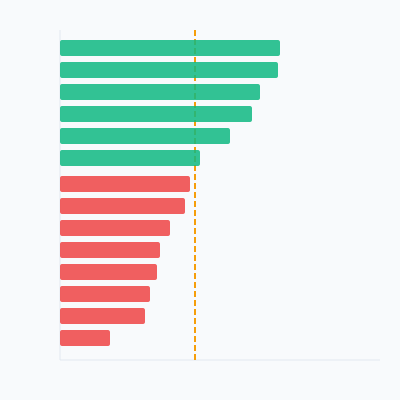
Who Funds Their Own Defense
Who's actually paying for Western security? We mapped NATO defense spending against the 2% target. The free-riding is measurable — and the dollar gap is enormous.

Guns vs Butter in Numbers
Every dollar spent on tanks is a dollar not spent on teachers. We mapped military, education, and health spending for every country — the priorities are stark.
Related explainers

Capital account / financial account
The mirror image of the current account: how deficits get financed and why ‘money leaving’ is often backwards.

Exchange-rate pass-through
How currency moves translate into domestic prices—and why it’s rarely one-for-one.
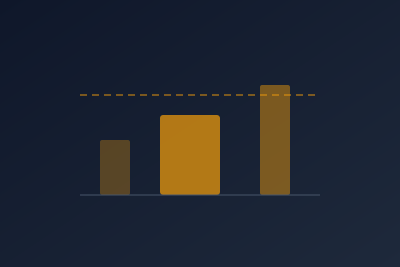
Fiscal breakeven: the price that keeps the lights on
Every petrostate has a magic number — the oil price needed to balance the budget. It almost always goes up.

Purchasing power parity: why $1 isn't $1 everywhere
Nominal exchange rates lie about living standards. PPP is the correction — and it changes the global picture dramatically.

The “Strong Dollar” explanation that doesn’t insult your intelligence
Why the dollar strengthens, who it helps/hurts, and why ‘good for America’ is too simple.
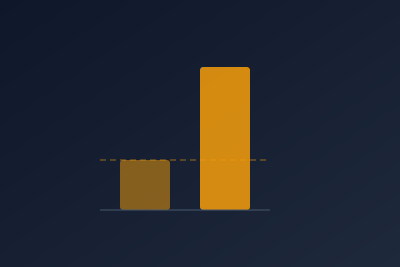
Base effects
Why year-over-year numbers can look dramatic simply because last year was weird.