Demographic transition
The four-stage model that explains why populations explode, stabilize, and then shrink — and why most of global economics follows from it.
TL;DR
The demographic transition is a four-stage model describing how societies move from high birth and death rates to low birth and death rates. The messy middle — where deaths drop but births haven't caught up — is where population explosions happen. The end stage, where births fall below replacement, is where population collapse begins.
What it means (plain English)
Every country that has industrialized has followed roughly the same path:
- Stage 1 — Pre-industrial. High birth rates, high death rates. Population barely grows. Famine, disease, and infant mortality keep the numbers in check. Almost no country is still here.
- Stage 2 — Early transition. Medicine, sanitation, and food security arrive. Death rates plummet. Birth rates stay high because culture, economics, and contraception access haven't caught up. Population explodes. Much of sub-Saharan Africa is here now.
- Stage 3 — Late transition. Urbanization, education (especially for women), and rising incomes drive birth rates down. Population growth slows. India, Bangladesh, and parts of Southeast Asia are in this stage.
- Stage 4 — Post-industrial. Birth and death rates are both low. Population stabilizes or begins to shrink. Europe, Japan, South Korea, and China are firmly here — some with fertility rates so far below replacement that aging economies are the defining policy challenge. The UN World Population Prospects provides the most comprehensive country-level data on where each nation sits in this transition.
The transition from Stage 2 to Stage 3 is where the demographic dividend lives: a bulge of young workers enters the labor force with fewer children to support. If governance and jobs are there, growth accelerates. If they aren't, you get instability instead.
The link between urbanization and productivity is central to this story — cities drive the cultural and economic shifts that pull birth rates down.
Common misconception
"Population growth is the problem." Stage 2 population growth is temporary and self-correcting. The real challenge is what comes after: Stage 4 societies with fertility rates of 1.0-1.3 face workforce collapse within a generation. South Korea's fertility rate of 0.7 is not a future problem — it is a present emergency.
Headline translation
When you read: "Africa's population will double by 2050," translate it as: "Africa is in the same demographic stage Europe was in 150 years ago — what matters is whether it transitions to Stage 3 fast enough to capture the dividend."
A concrete example
South Korea went from Stage 2 to Stage 4 in about 40 years (1960-2000), the fastest demographic transition in history. The result: a spectacular economic boom powered by a young workforce in the 1970s-90s, followed by what is now the world's lowest fertility rate and a population projected to halve by 2100.
If you only remember one thing…
Most of sub-Saharan Africa is in Stage 2-3 while Europe and East Asia are deep in Stage 4. This single fact explains roughly half of global economic dynamics over the next 30 years.
Research that uses this concept
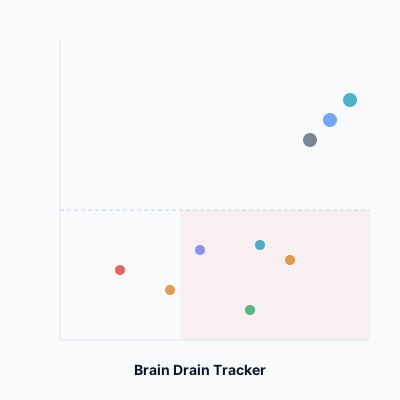
Brain Drain Tracker
Nigeria trains doctors. Britain employs them. We tracked the global brain drain — who loses talent, who gains it, and whether remittances make up the difference.
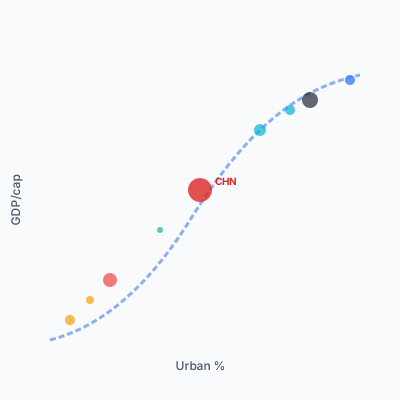
Urbanization vs Productivity
Cities make countries rich — until they don't. We mapped the urbanization-productivity curve for every country. The S-curve is clear, and so are the outliers.
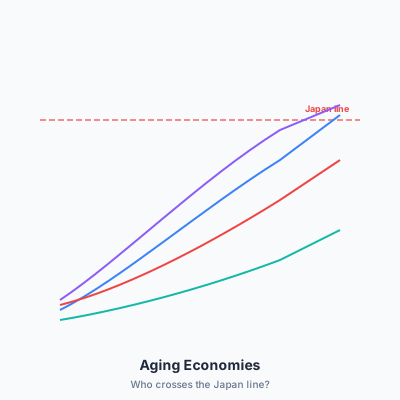
Aging Economies
Japan is the future — and most countries aren't ready. Population aging will break budgets, shrink workforces, and reshape economies. The timeline is visible in the data.
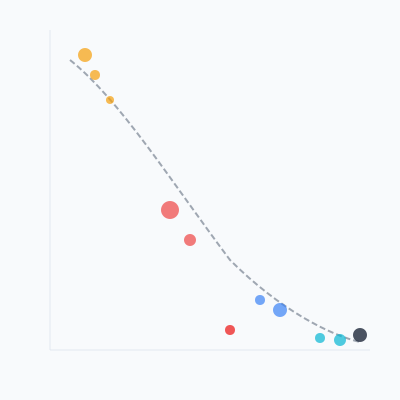
Child Survival & National Income
If you could know only one number about a country, it should be under-5 mortality. It captures income, health, education, water, and women's empowerment in a single statistic.
Related explainers

Dependency ratio
The ratio that tells you how many workers are carrying how many non-workers — and why it's the ticking clock behind every pension crisis.

Food security: It's not about growing everything yourself
Why food security depends on trade routes as much as farmland — and what actually breaks it.

Purchasing power parity: why $1 isn't $1 everywhere
Nominal exchange rates lie about living standards. PPP is the correction — and it changes the global picture dramatically.

The Human Development Index: one number for 'is life getting better?'
HDI packs life expectancy, education, and income into a single score. It's useful — until it isn't.