“China is dumping”: What dumping actually means (and what it doesn’t)
Low prices aren’t automatically dumping. Dumping is a legal test tied to price discrimination and injury.
TL;DR
“Dumping” is not a synonym for “cheap.” It’s a legal concept: selling abroad at prices below “normal value” (often home-market prices) in a way that causes material injury to domestic industry. Many cheap imports are cheap for ordinary reasons.
Why the term is abused
“Dumping” is rhetorically useful: it implies cheating. But low prices can come from:
- Higher productivity,
- Economies of scale,
- Lower input costs,
- Exchange-rate moves,
- Or a temporary inventory glut.
Calling all of that “dumping” turns analysis into tribal signaling.
What anti-dumping cases actually examine
In simplified terms, investigations look at:
- Export price vs a benchmark (“normal value”),
- Evidence of injury to domestic producers,
- Causality (was the price behavior the reason for injury?),
- And remedies (duties) calibrated to the “margin.”
It’s technical, slow, and full of methodological debates—because it sits at the intersection of law, economics, and politics.
The real policy question
Even when dumping is proven, you still have to ask:
- Is the domestic industry strategically important?
- Would targeted subsidies/training be better than duties?
- Are consumers and downstream industries harmed by higher input costs?
- Is the problem dumping—or a competitiveness gap?
What to track
- Domestic capacity utilization and margins,
- Import penetration by product category,
- Price trends vs input costs and FX,
- Downstream effects (industries using the inputs).
Common misconception
“Dumping explains deindustrialization.” Sometimes it contributes in specific sectors. But broad industrial decline usually has bigger drivers: technology, demand shifts, investment cycles, and policy choices at home. Meanwhile, the growth of South-South trade is reshaping where competitive pricing pressure comes from.
Research that uses this concept
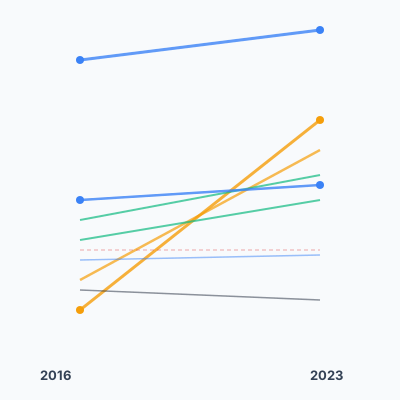
The China Dependency Index
When did China become your country's most important trade partner? For half the world, it already has. We mapped the dependency — and the risks.
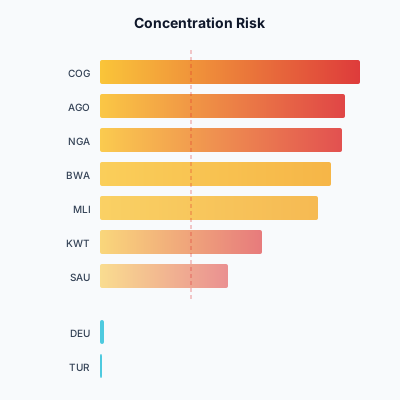
Concentration Risk
Some countries are one product away from crisis. We computed export concentration for every economy — the results are a map of global economic fragility.

The Debt-Trade Spiral
Persistent trade deficits and fiscal deficits compound into a debt spiral visible across decades. The data shows which countries are trapped — and which broke free.
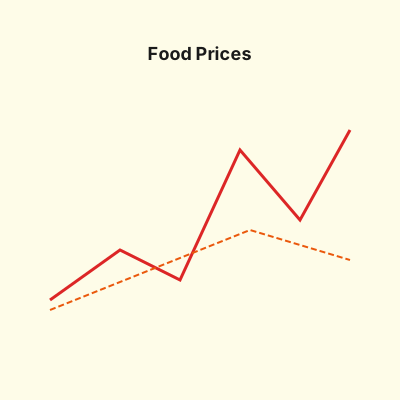
Agricultural Trade & Food Prices
The Arab Spring wasn't about politics. It started with the price of bread. We traced how global commodity spikes ripple into food crises — and who gets hit first.
Related explainers

Bilateral deficit with China: why it’s a terrible headline metric
Bilateral deficits ignore supply chains and value-added. Here’s why they mislead—and what to use instead.

Carbon leakage
When strict climate policy in one country just pushes emissions across the border.

Comparative advantage
Why trade can benefit both sides even when one side is ‘better at everything’—and why that doesn’t settle policy debates.

Food security: It's not about growing everything yourself
Why food security depends on trade routes as much as farmland — and what actually breaks it.

Subsidies
Not all subsidies are equal: explicit vs implicit, production vs consumption, and why they matter for trade fights.

Tariffs 101: Who Actually Pays? (And why everyone argues about it)
A clear, non-slogan explanation of tariff incidence, pass-through, and why “they pay” is usually wrong.