Dutch disease
How a resource windfall can hollow out the rest of your economy — and why the real disease is mismanagement.
TL;DR
Dutch disease is what happens when a booming resource sector strengthens the currency and draws capital and labor away from other industries, making manufacturing and agriculture less competitive. The economy gets rich in one sector and weaker in everything else.
What it means (plain English)
Imagine you discover massive oil reserves. Foreign buyers need your currency to pay for the oil. That demand pushes your exchange rate up. Now your non-oil exports — textiles, electronics, food — are suddenly more expensive on world markets. Factories close. Workers move to the oil sector or into services that support it. Your economy narrows.
The name comes from the Netherlands in the 1960s, after North Sea gas discoveries caused the Dutch manufacturing sector to shrink. But the pattern repeats everywhere: petrostates that can't diversify, mineral-rich nations trapped in extraction, and commodity exporters vulnerable to price swings.
Common misconception
"The resource itself is the curse." No. Norway has oil and a world-class sovereign wealth fund. The disease isn't the resource — it's the failure to sterilize the windfall, invest countercyclically, and protect non-resource sectors. The resource curse is a governance failure, not a geological one.
Headline translation
When you read: "Oil-rich nation struggles with unemployment," translate it as: "Resource wealth concentrated the economy; when the boom faded, nothing else was ready to absorb the workforce."
A concrete example
Nigeria earns the bulk of its export revenue from oil — the dominance is visible in its trade profile. When oil prices are high, the naira strengthens (or should, absent capital controls), making Nigerian agriculture and manufacturing less competitive internationally. When oil prices crash, the government faces a fiscal crisis because it built budgets around resource revenue. The non-oil economy never developed the depth to compensate. This is the trap.
If you only remember one thing...
Dutch disease is not about having resources. It's about what you do with the money — and whether you let a single sector devour the rest of your economy.
Research that uses this concept
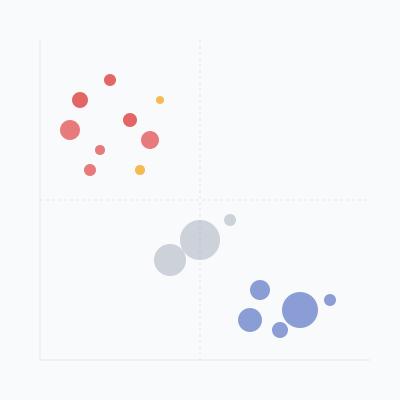
Climate Vulnerability vs Emissions
Chad emits less CO2 in a year than a US state does in a day. Chad is also one of the most climate-vulnerable countries on Earth. The injustice is measurable.
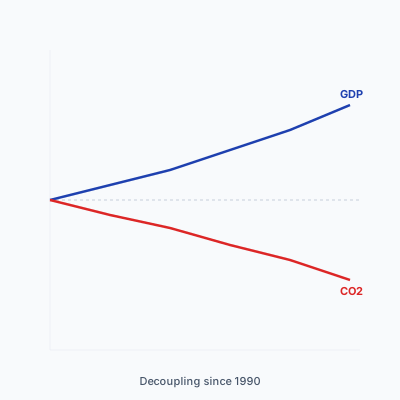
Carbon Cost of Growth
Can a country get richer without cooking the planet? Some have. Most haven't. We tracked GDP growth against CO2 emissions for 30 years — the decoupling story is real, but incomplete.
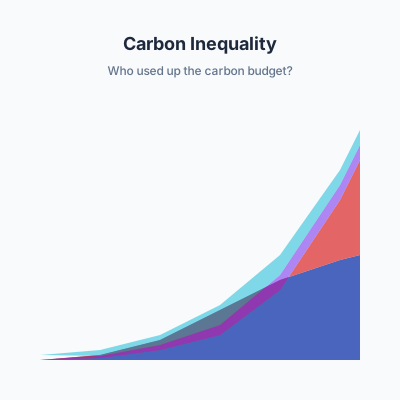
Carbon Inequality
The countries drowning in rising seas didn't cause the flood. We mapped who emitted what, when — and the per-capita gap is staggering.
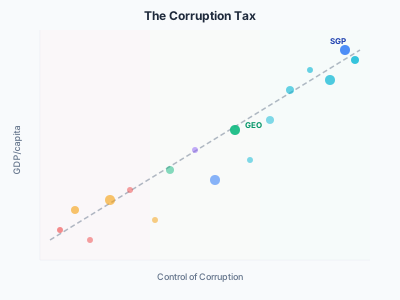
Corruption Tax
Corruption isn't a moral issue — it's a tax, and we can estimate the rate. Countries with worse governance attract less investment, grow slower, and develop less. The data quantifies the cost.
Related explainers
Capacity factor
Why a country with 10 GW of solar capacity doesn't actually get 10 GW of electricity.

Carbon leakage
When strict climate policy in one country just pushes emissions across the border.

Consumption vs territorial emissions
The accounting trick that lets rich countries claim they're decarbonizing while importing carbon-heavy goods.
Economic sanctions: what they are, what they aren’t, and how they leak
Sanctions are financial plumbing and export controls—not magic. They bite through chokepoints and leak via detours.
Energy intensity
How much energy it takes to produce a dollar of GDP — and why the trend can mislead you.
Fiscal breakeven: the price that keeps the lights on
Every petrostate has a magic number — the oil price needed to balance the budget. It almost always goes up.