Exchange-rate pass-through
How currency moves translate into domestic prices—and why it’s rarely one-for-one.
TL;DR
Exchange-rate pass-through describes how much a currency move changes domestic prices. It’s usually partial, because firms adjust margins, contracts are sticky, and competition limits price changes.
What it means (plain English)
If your currency weakens, imports become more expensive in local currency. But do prices jump immediately by the full amount? Not always. Reasons pass-through is partial:
- Importers may absorb some costs in margins,
- Exporters may cut their price in foreign currency to keep market share,
- Contracts are fixed for months,
- Retail pricing is “sticky” and delayed.
Pass-through can also be asymmetric: prices rise faster when costs increase than they fall when costs decrease. This price transmission mechanism is especially visible during commodity supercycles, when raw-material swings ripple through import prices.
Common misconception
“Currency down 10% means prices up 10%.”
That’s the naive version. The real effect depends on product category, competitive dynamics, invoicing currency, and how concentrated the market is.
Headline translation
When you read: “Currency collapse will explode inflation,” translate it as: “Inflation risk rises; the magnitude depends on pass-through and policy response.”
A concrete example
A retailer importing electronics faces a weaker currency. It may raise prices 5%, accept 3% margin hit, and renegotiate with suppliers for 2%. That’s pass-through in action.
If you only remember one thing…
Pass-through is about behavior, not arithmetic.
Research that uses this concept
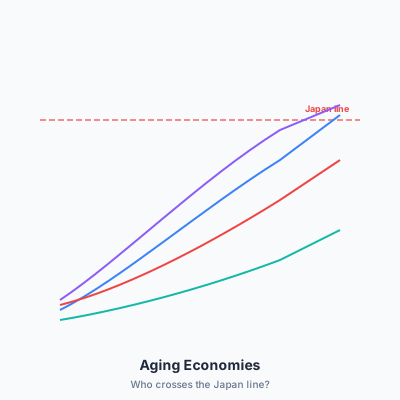
Aging Economies
Japan is the future — and most countries aren't ready. Population aging will break budgets, shrink workforces, and reshape economies. The timeline is visible in the data.
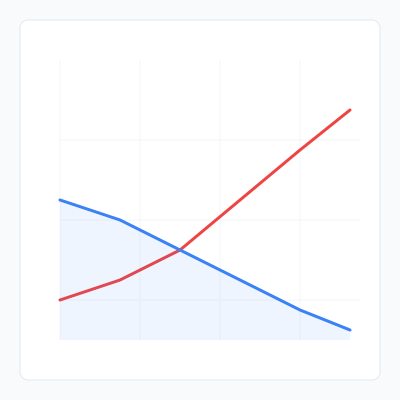
The Debt-Trade Spiral
Persistent trade deficits and fiscal deficits compound into a debt spiral visible across decades. The data shows which countries are trapped — and which broke free.
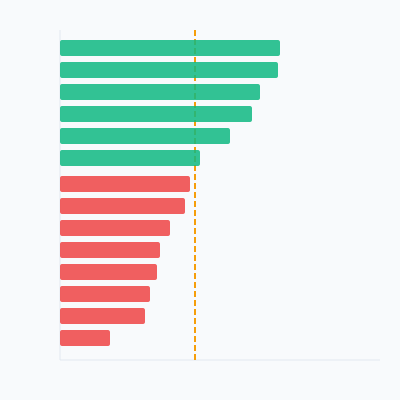
Who Funds Their Own Defense
Who's actually paying for Western security? We mapped NATO defense spending against the 2% target. The free-riding is measurable — and the dollar gap is enormous.
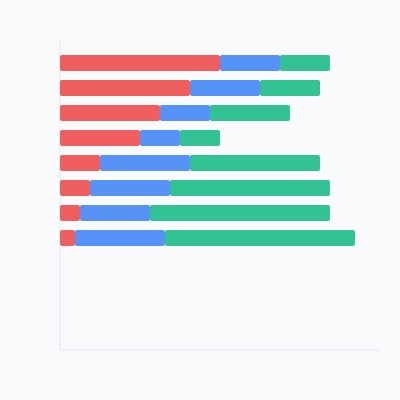
Guns vs Butter in Numbers
Every dollar spent on tanks is a dollar not spent on teachers. We mapped military, education, and health spending for every country — the priorities are stark.
Related explainers
Capital account / financial account
The mirror image of the current account: how deficits get financed and why ‘money leaving’ is often backwards.
Debt sustainability: why the number that matters isn't the debt level
Japan survives at 250% debt-to-GDP. Argentina collapses at 60%. The difference is everything.
Fiscal breakeven: the price that keeps the lights on
Every petrostate has a magic number — the oil price needed to balance the budget. It almost always goes up.
Purchasing power parity: why $1 isn't $1 everywhere
Nominal exchange rates lie about living standards. PPP is the correction — and it changes the global picture dramatically.

The “Strong Dollar” explanation that doesn’t insult your intelligence
Why the dollar strengthens, who it helps/hurts, and why ‘good for America’ is too simple.
Base effects
Why year-over-year numbers can look dramatic simply because last year was weird.