Capital account / financial account
The mirror image of the current account: how deficits get financed and why ‘money leaving’ is often backwards.
TL;DR
If the current account is negative (a deficit), the financial account is typically positive: capital is flowing in to finance it. In macro accounting, “imports exceed exports” usually means “someone is buying your assets” or lending to you.
What it means (plain English)
Countries don’t settle trade gaps with a wheelbarrow of cash. They settle through financial flows:
- foreigners buy bonds, stocks, real estate, or companies,
- banks extend credit,
- investors hold deposits or other claims.
In the accounts, the current account and financial account largely offset. That’s why you’ll hear: a deficit is matched by capital inflows.
Common misconception
“A trade deficit means money is leaving the country.”
Often the opposite: a deficit can coincide with net capital entering the country because foreigners want its assets (or its currency). The risk is not “money leaving,” but whether inflows are financing productive investment or a fragile consumption boom (see The Debt-Trade Spiral for how this can become self-reinforcing).
Headline translation
When you read: “Deficit means we’re drained,” translate it as: “Deficit means we’re absorbing foreign capital; ask what kind and why.”
A concrete example
A fast-growing economy imports machinery and consumer goods (trade deficit). Foreign investors fund factories and buy local bonds (capital inflow). The question becomes: are those inflows stable and productive?
If you only remember one thing…
A deficit is not a cash leak. It’s a trade-off: goods now, claims/assets later.
Research that uses this concept
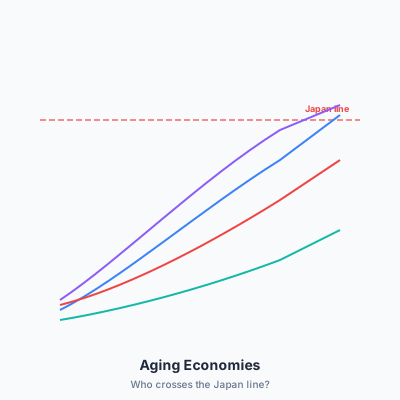
Aging Economies
Japan is the future — and most countries aren't ready. Population aging will break budgets, shrink workforces, and reshape economies. The timeline is visible in the data.
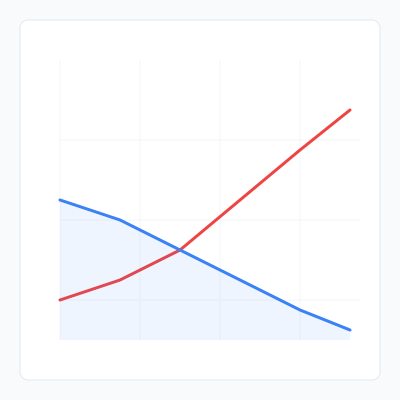
The Debt-Trade Spiral
Persistent trade deficits and fiscal deficits compound into a debt spiral visible across decades. The data shows which countries are trapped — and which broke free.
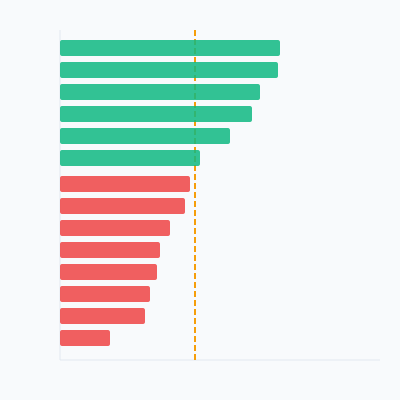
Who Funds Their Own Defense
Who's actually paying for Western security? We mapped NATO defense spending against the 2% target. The free-riding is measurable — and the dollar gap is enormous.
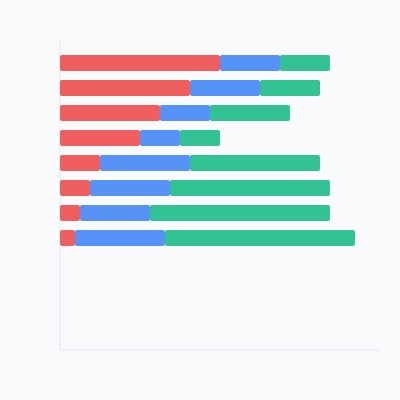
Guns vs Butter in Numbers
Every dollar spent on tanks is a dollar not spent on teachers. We mapped military, education, and health spending for every country — the priorities are stark.
Related explainers
Debt sustainability: why the number that matters isn't the debt level
Japan survives at 250% debt-to-GDP. Argentina collapses at 60%. The difference is everything.

Exchange-rate pass-through
How currency moves translate into domestic prices—and why it’s rarely one-for-one.
Fiscal breakeven: the price that keeps the lights on
Every petrostate has a magic number — the oil price needed to balance the budget. It almost always goes up.
Purchasing power parity: why $1 isn't $1 everywhere
Nominal exchange rates lie about living standards. PPP is the correction — and it changes the global picture dramatically.

The “Strong Dollar” explanation that doesn’t insult your intelligence
Why the dollar strengthens, who it helps/hurts, and why ‘good for America’ is too simple.
Base effects
Why year-over-year numbers can look dramatic simply because last year was weird.