Fiscal breakeven: the price that keeps the lights on
Every petrostate has a magic number — the oil price needed to balance the budget. It almost always goes up.
TL;DR
Fiscal breakeven is the commodity price a resource-dependent country needs to balance its government budget. For oil exporters, it's the price per barrel that covers spending. The problem: breakevens tend to ratchet upward because governments expand during booms and can't cut during busts. This is why petrostates are structurally fragile.
What it means (plain English)
If you're Saudi Arabia and oil revenue funds 60% of your budget, there's a specific oil price at which revenue equals spending. Below that price, you run a deficit. Above it, you run a surplus. That price is the fiscal breakeven.
It's a brutally simple concept, but it exposes a brutal reality: governments treat windfalls as permanent income. When oil hits $100, spending expands — public wages rise, subsidies grow, infrastructure projects launch. When oil falls to $50, those commitments don't vanish. You can't un-hire a civil service or un-build a city.
Common misconception
"Countries with sovereign wealth funds have solved this problem." Sovereign wealth funds help — they're a buffer. But they don't change the underlying political economy. Norway is the exception, not the rule. Most petrostates draw down reserves during downturns rather than cut spending, which means the fund buys time but doesn't fix the structural dependency. See Petrostates Under Pressure for how this plays out in practice.
Headline translation
When you read: "Oil prices fall below key levels," translate it as: "Check which countries just went into deficit." The Oil Price & Fiscal Breakeven analysis maps exactly who's underwater at each price point. The answers shift every year as spending creeps up.
A concrete example
In 2014, Saudi Arabia's fiscal breakeven was around $90/barrel. After the oil price crash, the kingdom embarked on austerity, subsidy cuts, and VAT introduction — painful reforms that brought the breakeven down to roughly $75 by 2020. Then COVID spending, then Vision 2030 megaprojects, and the breakeven climbed back up. The ratchet effect in action: you can push it down with political pain, but it naturally drifts back up.
Why the ratchet matters
The ratchet effect means that every boom sows the seeds of the next fiscal crisis:
- Boom: revenues surge, spending expands, breakeven rises.
- Bust: revenues collapse, deficits open, reserves drain.
- Adjustment: painful cuts bring breakeven down — but never to where it was before.
- Next boom: the cycle repeats at a higher baseline.
This is why resource-dependent economies are structurally more volatile than diversified ones, regardless of how large their reserves are.
If you only remember one thing...
Fiscal breakevens almost always go up. That's not bad luck — it's the predictable result of governments spending windfalls as though they'll last forever. The commodity price needed to keep the lights on quietly rises until one day it's higher than the market will deliver.
Research that uses this concept
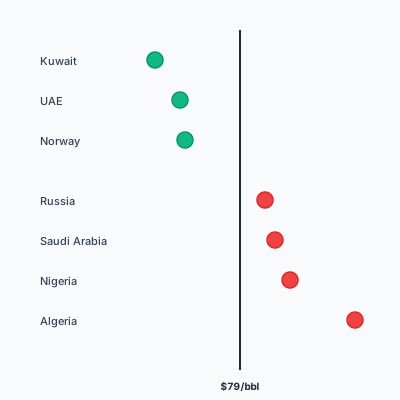
Oil Price & Fiscal Breakeven
Saudi Arabia needs $80 oil to pay its bills. It didn't always. We estimated fiscal breakeven prices for every major oil producer — and tracked how they rose.
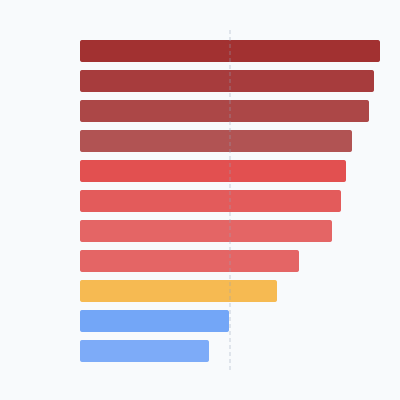
Petrostates Under Pressure
What happens when the world stops buying your only product? We mapped oil dependency, fiscal breakevens, and diversification progress for every petrostate. Most aren't ready.
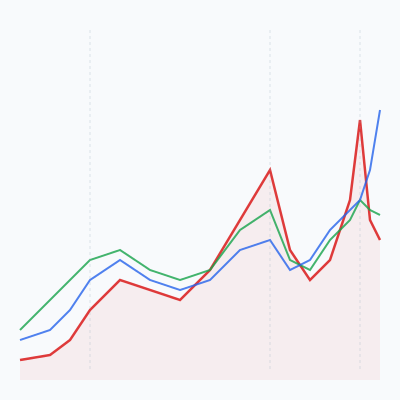
Commodity Supercycles & Inflation
Every inflation crisis in 50 years was foreshadowed by commodity markets. We traced the supercycles — and what they tell us about where we are now.
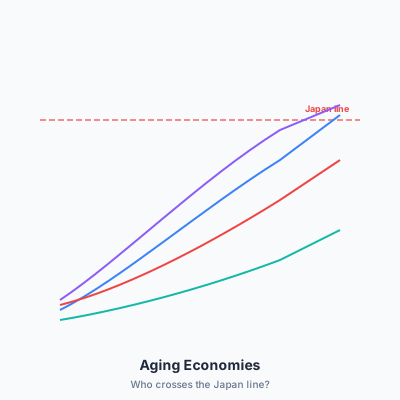
Aging Economies
Japan is the future — and most countries aren't ready. Population aging will break budgets, shrink workforces, and reshape economies. The timeline is visible in the data.
Related explainers

Capacity factor
Why a country with 10 GW of solar capacity doesn't actually get 10 GW of electricity.

Capital account / financial account
The mirror image of the current account: how deficits get financed and why ‘money leaving’ is often backwards.

Carbon leakage
When strict climate policy in one country just pushes emissions across the border.

Consumption vs territorial emissions
The accounting trick that lets rich countries claim they're decarbonizing while importing carbon-heavy goods.

Debt sustainability: why the number that matters isn't the debt level
Japan survives at 250% debt-to-GDP. Argentina collapses at 60%. The difference is everything.

Dutch disease
How a resource windfall can hollow out the rest of your economy — and why the real disease is mismanagement.