Food security: It's not about growing everything yourself
Why food security depends on trade routes as much as farmland — and what actually breaks it.
TL;DR
Food security has four dimensions: availability, access, utilization, and stability. A country can grow plenty of food and still have food insecurity. A country that imports most of its calories can be perfectly food-secure — if the supply lines are reliable and people can afford what's on the shelf.
What it means (plain English)
The UN's framework breaks food security into four parts, and they all have to work at once:
- Availability: Is there enough food in the country? This includes domestic production plus imports minus exports.
- Access: Can people actually afford it and get to it? A warehouse full of grain doesn't help if prices are beyond what families earn.
- Utilization: Is the food nutritious and safe? Calories alone don't cut it — micronutrient deficiencies are a form of food insecurity too.
- Stability: Do the first three hold up over time, or do they collapse every drought, every conflict, every price spike? The FAO's FAOSTAT database tracks food production, trade, and security indicators across all four dimensions.
Most political debates fixate on availability — "we should grow our own food." But access failures cause more hunger than production shortfalls. People starve not because food doesn't exist, but because they can't buy it.
Common misconception
"Food self-sufficiency equals food security." It doesn't. North Korea is largely self-sufficient in food. It is not food-secure. Meanwhile, Singapore imports over 90% of its food and is among the most food-secure nations on earth. The difference is purchasing power, diversified trade partners, and functioning logistics. Caloric self-sufficiency is one input, not the whole answer. We break down who's actually vulnerable in Food Import Vulnerability.
Headline translation
When you read: "Country X depends on food imports," translate it as: "We need to check whether they have diversified suppliers, adequate reserves, and the foreign exchange to keep buying — not panic about the import share alone."
A concrete example
Egypt imports roughly half its wheat, much of it historically from Russia and Ukraine. When the 2022 war disrupted Black Sea grain shipments, Egypt didn't face a production problem — it faced an access and stability problem. Prices spiked, alternative suppliers were slower, and the government's bread subsidy budget exploded. The farmland was irrelevant to the crisis. What mattered was trade route resilience and fiscal capacity. For more on how agricultural trade shocks ripple into food prices, see Agricultural Trade & Food Prices.
If you only remember one thing...
Food security isn't about growing everything yourself. It's about whether you can reliably access enough food — which means trade policy, logistics, and household income matter just as much as how many acres you plant.
Research that uses this concept
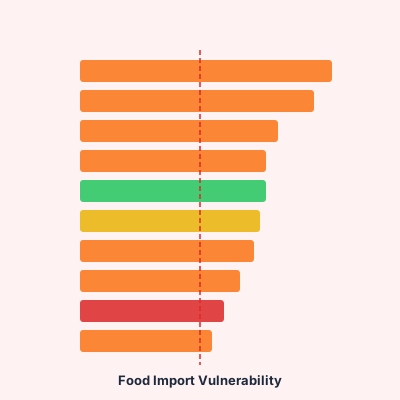
Food Import Vulnerability
40 countries can't feed themselves — and the list is growing. We mapped food import dependency against arable land, population growth, and income. The vulnerable are easy to identify.
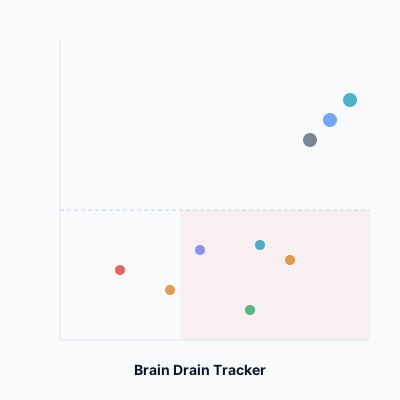
Brain Drain Tracker
Nigeria trains doctors. Britain employs them. We tracked the global brain drain — who loses talent, who gains it, and whether remittances make up the difference.
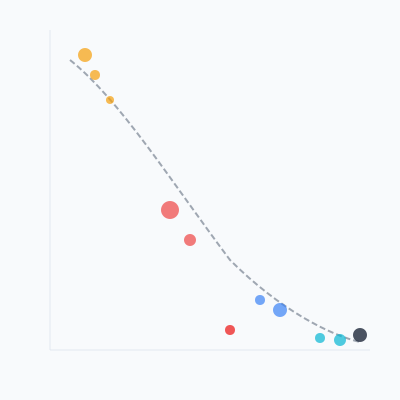
Child Survival & National Income
If you could know only one number about a country, it should be under-5 mortality. It captures income, health, education, water, and women's empowerment in a single statistic.
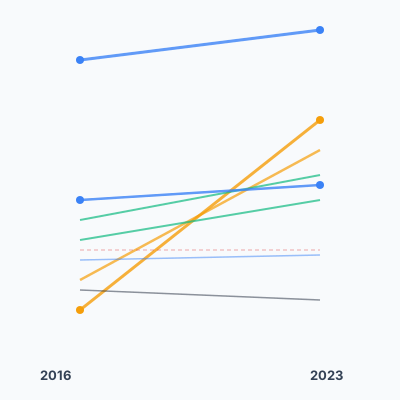
The China Dependency Index
When did China become your country's most important trade partner? For half the world, it already has. We mapped the dependency — and the risks.
Related explainers
“China is dumping”: What dumping actually means (and what it doesn’t)
Low prices aren’t automatically dumping. Dumping is a legal test tied to price discrimination and injury.

Bilateral deficit with China: why it’s a terrible headline metric
Bilateral deficits ignore supply chains and value-added. Here’s why they mislead—and what to use instead.

Carbon leakage
When strict climate policy in one country just pushes emissions across the border.
Comparative advantage
Why trade can benefit both sides even when one side is ‘better at everything’—and why that doesn’t settle policy debates.

Demographic transition
The four-stage model that explains why populations explode, stabilize, and then shrink — and why most of global economics follows from it.
Purchasing power parity: why $1 isn't $1 everywhere
Nominal exchange rates lie about living standards. PPP is the correction — and it changes the global picture dramatically.