Governance indicators
What the World Bank's Worldwide Governance Indicators actually measure — and why you should trust the trends more than the rankings.
TL;DR
The World Bank's Worldwide Governance Indicators (WGI) measure six dimensions of governance across 200+ countries. They are perception-based composites built from surveys, expert assessments, and NGO reports — not objective measurements. They're useful for tracking trends over time but misleading when used to rank countries with false precision.
What it means (plain English)
The WGI covers six dimensions, each scored roughly from -2.5 (worst) to +2.5 (best):
- Voice and Accountability — Can citizens participate in selecting their government? Is there free media?
- Political Stability and Absence of Violence — How likely is the government to be destabilized by unconstitutional means or violence?
- Government Effectiveness — How competent is the civil service? How good is policy implementation?
- Regulatory Quality — Does the government create regulations that permit and promote private sector development?
- Rule of Law — Do people trust and abide by the rules? How strong are property rights, courts, and police?
- Control of Corruption — To what extent is public power exercised for private gain?
These scores are built by aggregating dozens of underlying data sources — business surveys, think tank assessments, NGO ratings. No one goes out with a clipboard and measures "rule of law." The scores reflect what informed observers perceive. The full methodology and country-level data are available from the World Bank's Worldwide Governance Indicators project.
This matters because perception and reality diverge. A country with effective but quiet corruption may score well. A country undergoing visible anti-corruption campaigns may temporarily score worse because the problem is now salient. The corruption tax on economic growth is real, but measuring it precisely is harder than the clean decimal scores suggest.
These indicators also intersect with big questions about whether democratic governance pays off economically and why resource-rich countries often score poorly despite their wealth.
Common misconception
"Country A scored 0.3 and Country B scored 0.4, so B has better governance." The margins of error on WGI scores are wide enough that a 0.1 difference is meaningless. You cannot reliably distinguish between countries that are close in score. What you can do is spot big gaps (Denmark vs. Somalia) and meaningful trends (a country improving or deteriorating over a decade).
Headline translation
When you read: "Country X ranked 87th in governance," translate it as: "A composite of perception surveys placed Country X somewhere in the middle, give or take 20 positions."
A concrete example
Russia's "Control of Corruption" score declined steadily from about -0.5 in 2000 to -1.0 by 2022. You can't say precisely how corrupt Russia is from that number, but you can say with confidence that informed observers perceived a significant deterioration over two decades. That's a useful signal — just don't pretend the second decimal place means anything.
If you only remember one thing…
Governance indicators measure perceptions, not facts. Trust the direction, not the decimal. A country moving from -0.8 to -0.2 over a decade is genuinely improving. A country ranked 43rd vs. 47th is a coin flip.
Research that uses this concept
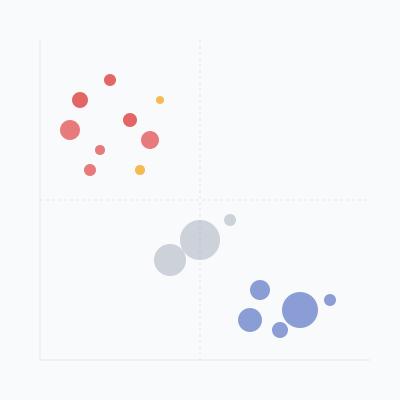
Climate Vulnerability vs Emissions
Chad emits less CO2 in a year than a US state does in a day. Chad is also one of the most climate-vulnerable countries on Earth. The injustice is measurable.
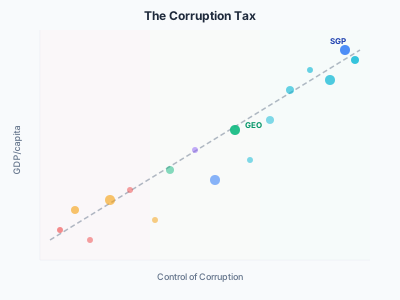
Corruption Tax
Corruption isn't a moral issue — it's a tax, and we can estimate the rate. Countries with worse governance attract less investment, grow slower, and develop less. The data quantifies the cost.
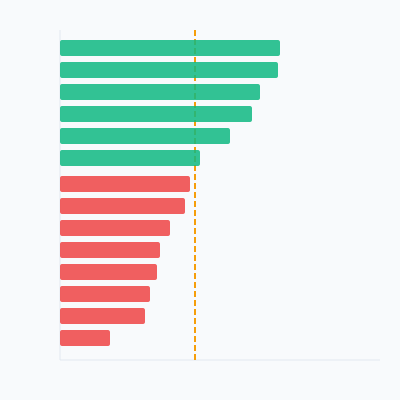
Who Funds Their Own Defense
Who's actually paying for Western security? We mapped NATO defense spending against the 2% target. The free-riding is measurable — and the dollar gap is enormous.
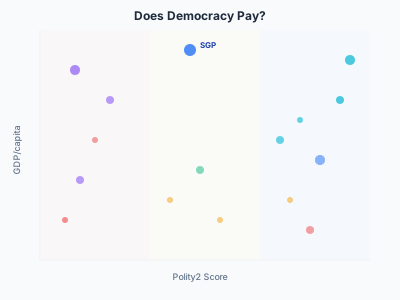
Does Democracy Pay?
Democracies are richer — but did democracy make them rich? The relationship between governance and growth is more complicated than any slogan. We let the data speak.
Related explainers
Dutch disease
How a resource windfall can hollow out the rest of your economy — and why the real disease is mismanagement.
Economic sanctions: what they are, what they aren’t, and how they leak
Sanctions are financial plumbing and export controls—not magic. They bite through chokepoints and leak via detours.
Industrial policy
The spectrum of policies used to shape what an economy produces—and why the design matters more than the ideology.