The Herfindahl Index: How concentrated is your economy?
The simplest number that tells you whether a country is one bad year away from a crisis.
TL;DR
The Herfindahl-Hirschman Index (HHI) measures how concentrated a country's exports are. You square each sector's share and add them up. A high score means a few products dominate — and that makes the economy fragile.
What it means (plain English)
Take a country's exports. Break them into product categories. For each category, calculate its percentage share of total exports, then square that number. Sum the squares. That's the HHI. UNCTAD trade statistics track export concentration for most countries, making it straightforward to compute and compare.
The scale runs from near zero (perfectly diversified) to 1.0 (literally one product). In practice, anything above 0.25 signals heavy concentration, and above 0.50 you're looking at a one-trick economy.
Why square instead of just adding shares? Because squaring punishes lopsidedness. If you have ten products at 10% each, the HHI is 0.10 — comfortable. If one product is 90% and nine others split the remaining 10%, the HHI jumps to 0.82. The math captures what intuition already tells you: putting most of your eggs in one basket is risky.
Common misconception
"Concentration is only a problem for oil exporters." Not true. Countries that depend heavily on a single agricultural commodity, a single mineral, or even a single manufactured good (like semiconductors) face the same structural risk. When that one thing drops in price or demand, the whole economy feels it. See Petrostates Under Pressure for the oil version of this story, but the logic applies to copper, cocoa, and chips alike.
Headline translation
When you read: "Country X has a diversified export base," translate it as: "Their HHI is low enough that no single sector crashing would wreck the national budget."
A concrete example
Norway's oil and gas sector has historically dominated its exports. That gives Norway a high HHI — but Norway also built a sovereign wealth fund specifically because it recognized the concentration risk. Compare that to a country with similar concentration but no buffer: one commodity slump becomes a fiscal emergency, a currency crisis, and a political crisis, all at once. We dig into this pattern in Concentration Risk.
If you only remember one thing...
A high HHI is the simplest measure of economic fragility. It tells you that one bad year in one sector can crash an entire economy — and no amount of optimistic GDP headlines changes that math.
Research that uses this concept
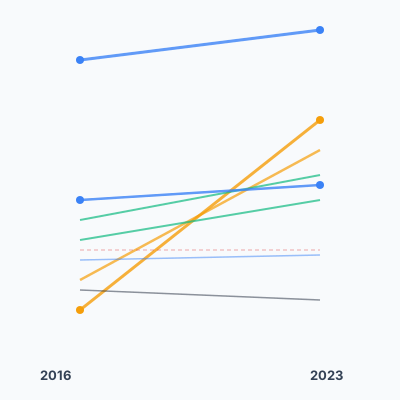
The China Dependency Index
When did China become your country's most important trade partner? For half the world, it already has. We mapped the dependency — and the risks.
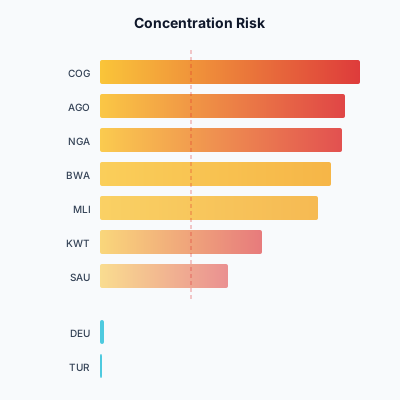
Concentration Risk
Some countries are one product away from crisis. We computed export concentration for every economy — the results are a map of global economic fragility.
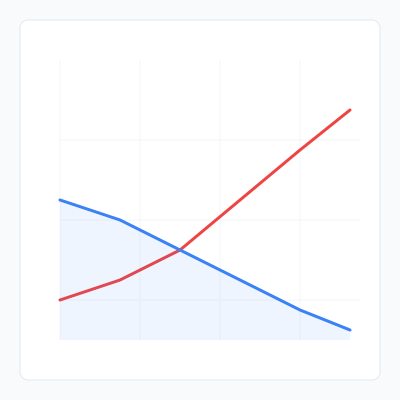
The Debt-Trade Spiral
Persistent trade deficits and fiscal deficits compound into a debt spiral visible across decades. The data shows which countries are trapped — and which broke free.
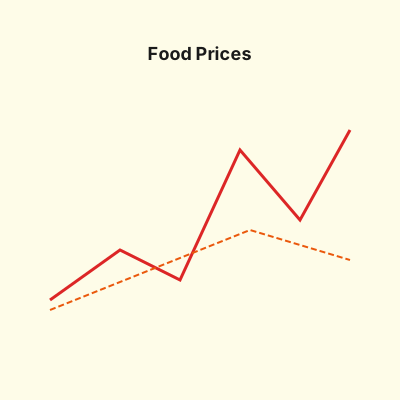
Agricultural Trade & Food Prices
The Arab Spring wasn't about politics. It started with the price of bread. We traced how global commodity spikes ripple into food crises — and who gets hit first.
Related explainers
“China is dumping”: What dumping actually means (and what it doesn’t)
Low prices aren’t automatically dumping. Dumping is a legal test tied to price discrimination and injury.

Bilateral deficit with China: why it’s a terrible headline metric
Bilateral deficits ignore supply chains and value-added. Here’s why they mislead—and what to use instead.

Carbon leakage
When strict climate policy in one country just pushes emissions across the border.

Comparative advantage
Why trade can benefit both sides even when one side is ‘better at everything’—and why that doesn’t settle policy debates.

Food security: It's not about growing everything yourself
Why food security depends on trade routes as much as farmland — and what actually breaks it.

Subsidies
Not all subsidies are equal: explicit vs implicit, production vs consumption, and why they matter for trade fights.