The Human Development Index: one number for 'is life getting better?'
HDI packs life expectancy, education, and income into a single score. It's useful — until it isn't.
TL;DR
The Human Development Index (HDI) combines life expectancy, years of schooling, and gross national income per capita into a single 0-to-1 score. It's the best quick answer to "how well are people doing in country X" — but it hides inequality within countries and ignores sustainability entirely.
What it actually measures (plain English)
HDI has three dimensions, each equally weighted:
- Health: life expectancy at birth.
- Education: mean years of schooling for adults, plus expected years for children entering school.
- Income: GNI per capita in PPP dollars, log-transformed so that going from $2,000 to $4,000 matters more than going from $40,000 to $42,000.
The geometric mean of the three dimension indexes gives you the final score. A country scoring 0.80 or above is "very high human development." Below 0.55 is "low." The UNDP Human Development Reports publish annual rankings, methodology details, and the inequality-adjusted variants.
Common misconception
"High HDI means the country is rich." Not necessarily. Cuba has an HDI above 0.75 despite modest income, because its health and education scores punch well above its weight. Conversely, some Gulf states have high GNI but lower-than-expected HDI because education or health outcomes lag. Income is only one-third of the story. For more on how energy access and income interact, see The Energy-Prosperity Ladder.
Headline translation
When you read: "Country X improved its HDI ranking," ask: which dimension moved? A jump in GNI from an oil boom tells you something very different from a jump in life expectancy from better healthcare.
A concrete example
Between 1990 and 2020, Bangladesh's HDI rose from 0.39 to 0.66 — driven overwhelmingly by health and education gains, not income. That's a story about vaccines, girls' schooling, and family planning, not about GDP growth alone. Meanwhile, countries with stagnant HDI despite rising income are often losing ground on health or governance. Does Democracy Pay? explores why institutional quality shapes these outcomes.
What HDI doesn't tell you
- Inequality: the UNDP publishes an inequality-adjusted HDI (IHDI), and the drops can be brutal. South Africa's HDI falls by roughly 30% after adjustment.
- Sustainability: a country can have high HDI while burning through natural capital. HDI says nothing about whether the gains last.
- Distribution: national averages hide regional and gender gaps that matter enormously.
If you only remember one thing...
HDI is the best single number we have for "is life getting better." But single numbers are always lossy compression. Check what's underneath.
Research that uses this concept
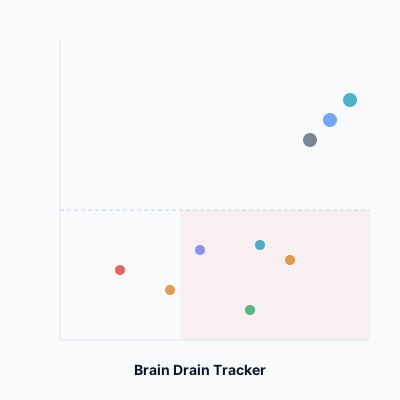
Brain Drain Tracker
Nigeria trains doctors. Britain employs them. We tracked the global brain drain — who loses talent, who gains it, and whether remittances make up the difference.
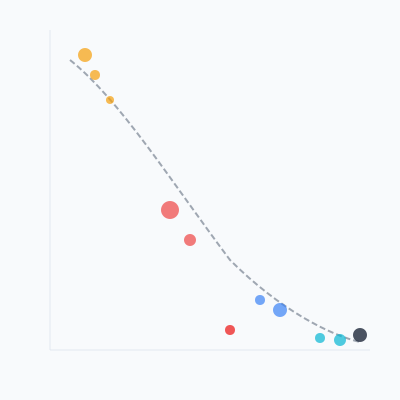
Child Survival & National Income
If you could know only one number about a country, it should be under-5 mortality. It captures income, health, education, water, and women's empowerment in a single statistic.
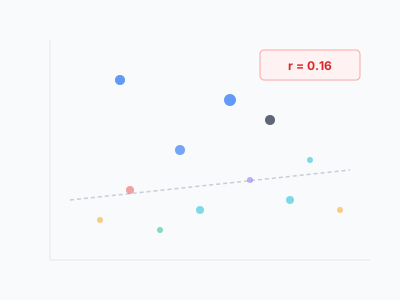
Education Spending vs Innovation Output
Some countries spend billions on education and produce no patents. Others spend less and lead the world in innovation. The missing ingredient isn't money — it's R&D.
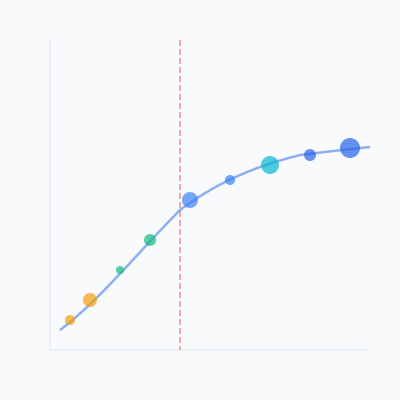
The Energy-Prosperity Ladder
There is a clear energy consumption threshold countries must cross for human development. Below ~4,000 kWh per capita, every additional kilowatt-hour transforms lives. Above 10,000, you're just heating empty rooms.
Related explainers
Demographic transition
The four-stage model that explains why populations explode, stabilize, and then shrink — and why most of global economics follows from it.
Food security: It's not about growing everything yourself
Why food security depends on trade routes as much as farmland — and what actually breaks it.
Purchasing power parity: why $1 isn't $1 everywhere
Nominal exchange rates lie about living standards. PPP is the correction — and it changes the global picture dramatically.