Industrial policy
The spectrum of policies used to shape what an economy produces—and why the design matters more than the ideology.
TL;DR
Industrial policy is the deliberate use of government tools to influence the structure of the economy—what gets built, where capacity forms, and which technologies scale. It can succeed or fail depending on design, governance, and feedback loops.
What it means (plain English)
Industrial policy isn’t one thing. It can include:
- subsidies, tax credits, or cheap financing,
- public procurement (“buy local”),
- R&D support and standards (UNESCO's Institute for Statistics tracks R&D spending as a share of GDP across countries),
- training pipelines,
- infrastructure that enables clusters,
- export promotion or targeted protections.
The goal might be resilience (chips, energy), strategic advantage (advanced tech), or regional development. For a data-driven look at how countries are deploying these tools in clean energy, see the Renewable Transition Scoreboard.
Common misconception
“Industrial policy is always corruption / always socialism.”
It can be captured and wasteful—but it can also be disciplined and performance-based. The key question is: are incentives tied to measurable outcomes, and can they be withdrawn when they fail?
Headline translation
When you read: “Government picks winners,” translate it as: “Government is shaping incentives; watch governance, metrics, and exit rules.”
A concrete example
A tax credit for domestic battery production can build capacity. But if inputs (materials, components) remain imported, the policy may create assembly without a full ecosystem -- a pattern visible across The Manufacturing Exodus. Good industrial policy invests in supplier depth and workforce too.
If you only remember one thing…
Industrial policy is a tool. The debate shouldn’t be “for or against,” but which design minimizes waste and maximizes learning.
Research that uses this concept

Climate Vulnerability vs Emissions
Chad emits less CO2 in a year than a US state does in a day. Chad is also one of the most climate-vulnerable countries on Earth. The injustice is measurable.
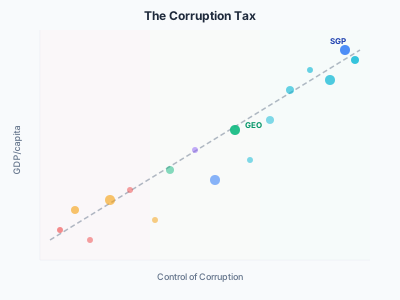
Corruption Tax
Corruption isn't a moral issue — it's a tax, and we can estimate the rate. Countries with worse governance attract less investment, grow slower, and develop less. The data quantifies the cost.
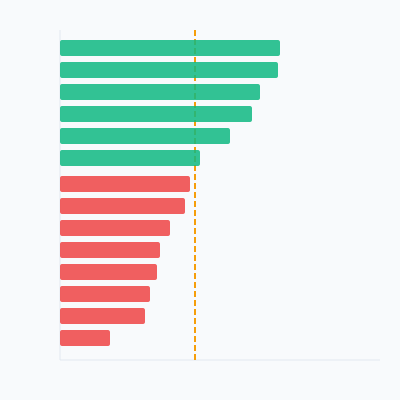
Who Funds Their Own Defense
Who's actually paying for Western security? We mapped NATO defense spending against the 2% target. The free-riding is measurable — and the dollar gap is enormous.
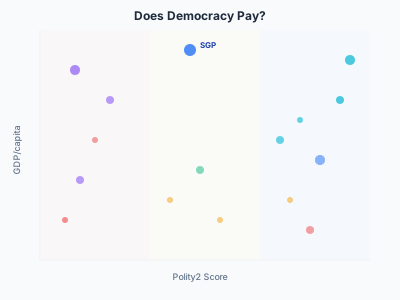
Does Democracy Pay?
Democracies are richer — but did democracy make them rich? The relationship between governance and growth is more complicated than any slogan. We let the data speak.
Related explainers
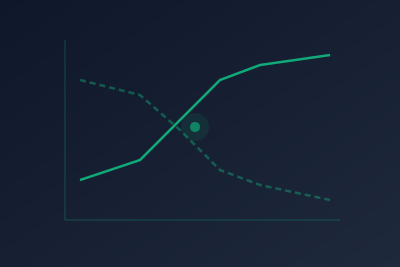
Dutch disease
How a resource windfall can hollow out the rest of your economy — and why the real disease is mismanagement.
Economic sanctions: what they are, what they aren’t, and how they leak
Sanctions are financial plumbing and export controls—not magic. They bite through chokepoints and leak via detours.

Governance indicators
What the World Bank's Worldwide Governance Indicators actually measure — and why you should trust the trends more than the rankings.