Purchasing power parity: why $1 isn't $1 everywhere
Nominal exchange rates lie about living standards. PPP is the correction — and it changes the global picture dramatically.
TL;DR
Purchasing power parity (PPP) adjusts for the fact that prices differ across countries. A dollar buys far more in Dhaka than in Zurich. When you compare economies at market exchange rates, you systematically overstate rich-country output and understate poor-country output. PPP fixes that — and it reshuffles the global leaderboard.
What it means (plain English)
Imagine you earn $5,000 a year in rural India. At market exchange rates, that looks desperate by American standards. But rent is $40/month, a meal is $0.50, and a doctor visit is $2. Your actual living standard — what your money buys — is far higher than the dollar figure suggests.
PPP conversion factors estimate how many units of local currency buy the same basket of goods that one dollar buys in the United States. When you convert GDP or income using PPP instead of market exchange rates, poor countries get substantially richer and the global distribution compresses.
Common misconception
"PPP is just a fancy way to make poor countries look better." No — it's a fancy way to measure what people can actually afford. Market exchange rates reflect capital flows, speculation, and trade in tradable goods. They tell you nothing about the price of a haircut, a bus ride, or a bag of rice. PPP does. That matters enormously for understanding health outcomes and child survival.
Headline translation
When you read: "India's economy is now the third largest," ask: PPP or nominal? At PPP, India has been third for years. At market exchange rates, the ranking shifts. Both are "true" — they just answer different questions. PPP answers "how much stuff does this economy produce?" Market rates answer "how much can this economy buy on world markets?"
A concrete example
In 2024, China's nominal GDP was roughly $18 trillion — about 65% of America's. At PPP, China's GDP was over $35 trillion — larger than America's. Same country, same year, wildly different story depending on which conversion you use. You can compare the two economies side by side on MacroVedia.
The limits
- PPP works best for broad comparisons, not precise rankings. The underlying price surveys are imperfect and infrequent.
- It breaks down for tradable goods. A Toyota costs roughly the same everywhere — PPP adjustment doesn't help there.
- Within-country price variation (rural vs urban) can be as large as between-country differences.
If you only remember one thing...
Nominal GDP makes poor countries look poorer than they are and rich countries richer. If you want to compare living standards, use PPP. If you want to compare geopolitical purchasing power on world markets, use nominal. Know which question you're asking.
Research that uses this concept
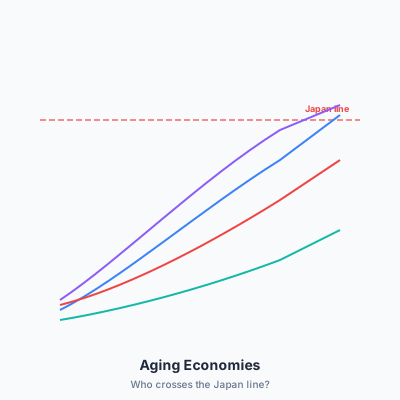
Aging Economies
Japan is the future — and most countries aren't ready. Population aging will break budgets, shrink workforces, and reshape economies. The timeline is visible in the data.
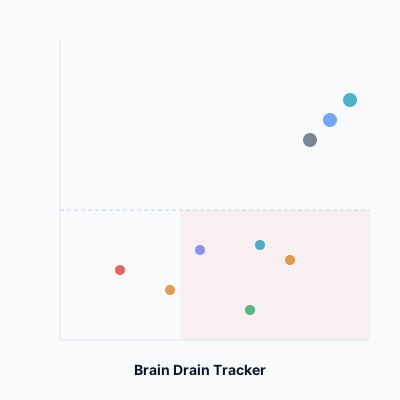
Brain Drain Tracker
Nigeria trains doctors. Britain employs them. We tracked the global brain drain — who loses talent, who gains it, and whether remittances make up the difference.
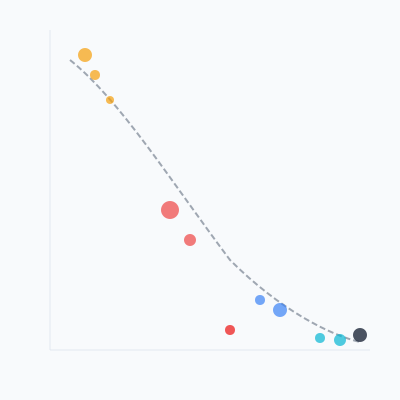
Child Survival & National Income
If you could know only one number about a country, it should be under-5 mortality. It captures income, health, education, water, and women's empowerment in a single statistic.

The Debt-Trade Spiral
Persistent trade deficits and fiscal deficits compound into a debt spiral visible across decades. The data shows which countries are trapped — and which broke free.
Related explainers

Capital account / financial account
The mirror image of the current account: how deficits get financed and why ‘money leaving’ is often backwards.

Debt sustainability: why the number that matters isn't the debt level
Japan survives at 250% debt-to-GDP. Argentina collapses at 60%. The difference is everything.

Demographic transition
The four-stage model that explains why populations explode, stabilize, and then shrink — and why most of global economics follows from it.

Exchange-rate pass-through
How currency moves translate into domestic prices—and why it’s rarely one-for-one.

Fiscal breakeven: the price that keeps the lights on
Every petrostate has a magic number — the oil price needed to balance the budget. It almost always goes up.

Food security: It's not about growing everything yourself
Why food security depends on trade routes as much as farmland — and what actually breaks it.