Why “bringing manufacturing back” is harder than it sounds
Reshoring isn’t a speech; it’s capex, labor, suppliers, permits, and time. Here’s the reality check.
TL;DR
Manufacturing isn’t a single factory you can “move back.” It’s an ecosystem: suppliers, skills, logistics, energy, standards, and financing. The constraints are often labor, permitting, and upstream inputs—not patriotism.
The invisible parts of a factory
When people picture reshoring, they picture a building. The real challenge is everything around it:
- Specialized suppliers (parts, chemicals, tooling),
- Skilled technicians and engineers,
- Reliable power and infrastructure,
- Quality control systems and certifications,
- Shipping networks and inventory management.
If even one critical upstream input still comes from abroad, you might simply be reshoring the final assembly step — China's trade profile shows just how deep these supply chains run. (For the scale of this problem, see The China Dependency Index.)
Time-to-build is the enemy of slogans
Large industrial projects have multi-year timelines: site selection, permitting, equipment lead times, workforce training, and process tuning. Politically, people expect instant results. Industrial reality doesn’t care.
The labor constraint is often the bottleneck
Even with incentives, companies ask: can we hire enough people with the right skills at the right wages? If not, you get:
- Wage pressure and churn,
- Lower quality,
- Or automation-heavy plants with fewer jobs than expected.
What actually works
Reshoring is more plausible when:
- The product is high value-to-weight (shipping costs matter less),
- Quality control and IP are strategic,
- Supply chain risk is high (chips, defense, pharma -- see The Manufacturing Exodus for the trends driving this),
- Or incentives cover the full ecosystem (training, suppliers, infrastructure).
What to track
Instead of “jobs announcements,” track:
- Capex and plant construction starts,
- Supplier co-location (tier-2 and tier-3 depth),
- Output and productivity, not just headcount,
- Import dependence for key inputs.
Common misconception
“Reshoring fixes vulnerability.” It can reduce risk, but it can also create new chokepoints if the upstream ecosystem isn’t rebuilt. Resilience comes from depth and redundancy—not just geography.
Research that uses this concept
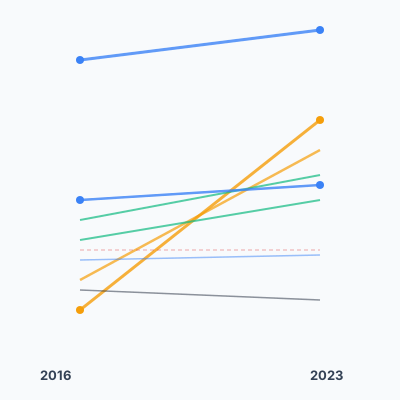
The China Dependency Index
When did China become your country's most important trade partner? For half the world, it already has. We mapped the dependency — and the risks.
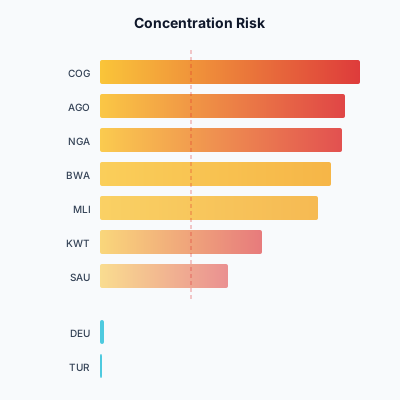
Concentration Risk
Some countries are one product away from crisis. We computed export concentration for every economy — the results are a map of global economic fragility.

The Debt-Trade Spiral
Persistent trade deficits and fiscal deficits compound into a debt spiral visible across decades. The data shows which countries are trapped — and which broke free.

Agricultural Trade & Food Prices
The Arab Spring wasn't about politics. It started with the price of bread. We traced how global commodity spikes ripple into food crises — and who gets hit first.
Related explainers

“China is dumping”: What dumping actually means (and what it doesn’t)
Low prices aren’t automatically dumping. Dumping is a legal test tied to price discrimination and injury.

Bilateral deficit with China: why it’s a terrible headline metric
Bilateral deficits ignore supply chains and value-added. Here’s why they mislead—and what to use instead.

Carbon leakage
When strict climate policy in one country just pushes emissions across the border.

Comparative advantage
Why trade can benefit both sides even when one side is ‘better at everything’—and why that doesn’t settle policy debates.

Food security: It's not about growing everything yourself
Why food security depends on trade routes as much as farmland — and what actually breaks it.

Subsidies
Not all subsidies are equal: explicit vs implicit, production vs consumption, and why they matter for trade fights.