Economic sanctions: what they are, what they aren’t, and how they leak
Sanctions are financial plumbing and export controls—not magic. They bite through chokepoints and leak via detours.
TL;DR
Sanctions work by restricting finance, trade, and technology access through chokepoints (banks, insurers, shipping, advanced inputs). They rarely “stop” an economy; they raise costs, reduce capability, and reshape trade routes—while creating incentives to evade.
The main types
- Financial sanctions: limits on banking, payments, reserve assets.
- Trade sanctions: bans/restrictions on certain imports/exports.
- Export controls: blocking advanced technology, equipment, or know-how.
- Secondary sanctions: penalizing third parties that do business with the target.
The most powerful ones usually hit finance and advanced technology, because those are hard to replace quickly.
Why sanctions leak
Evasion is not an edge case; it’s a predictable response. Leakage happens through:
- Transshipment via third countries,
- Re-labeling and re-routing supply chains,
- Grey-market intermediaries,
- Alternative payment channels,
- And domestic substitution where possible (resource-rich targets often have more options here; see The Resource Curse Mapped).
The “effectiveness” depends on enforcement capacity, coalition breadth, and how replaceable the targeted goods/services are.
What sanctions are not
They are not instant regime-change buttons. They’re pressure tools that often:
- Hurt households more than elites,
- Create black markets,
- Push the target toward alternative alliances,
- And generate long-run de-dollarization incentives (sometimes).
What to watch
- Trade diversion patterns by product and country (you can explore Russia's shifting trade flows on TradeVedia),
- Shipping/insurance constraints,
- FX reserves and payment system access,
- Domestic production substitution in critical inputs,
- Enforcement actions (they signal seriousness).
Common misconception
“Sanctions failed because trade didn’t go to zero.” Trade rarely goes to zero. The real question is: did costs rise, capability shrink, and strategic options narrow?
Research that uses this concept
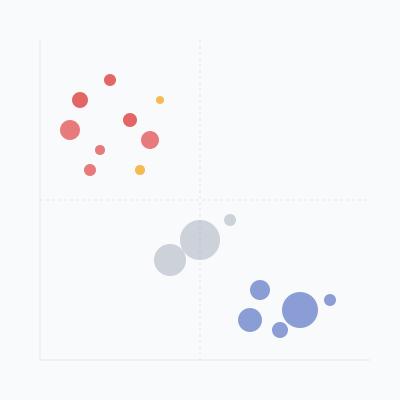
Climate Vulnerability vs Emissions
Chad emits less CO2 in a year than a US state does in a day. Chad is also one of the most climate-vulnerable countries on Earth. The injustice is measurable.
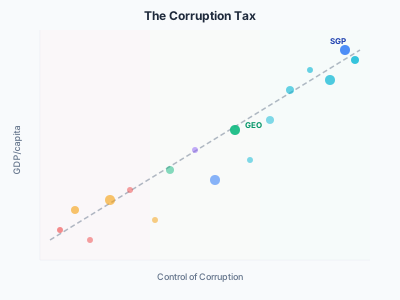
Corruption Tax
Corruption isn't a moral issue — it's a tax, and we can estimate the rate. Countries with worse governance attract less investment, grow slower, and develop less. The data quantifies the cost.
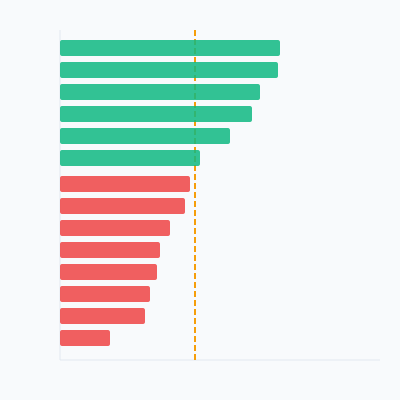
Who Funds Their Own Defense
Who's actually paying for Western security? We mapped NATO defense spending against the 2% target. The free-riding is measurable — and the dollar gap is enormous.
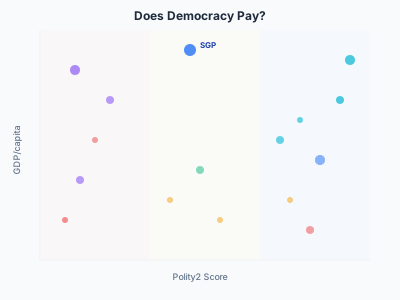
Does Democracy Pay?
Democracies are richer — but did democracy make them rich? The relationship between governance and growth is more complicated than any slogan. We let the data speak.
Related explainers
Dutch disease
How a resource windfall can hollow out the rest of your economy — and why the real disease is mismanagement.

Governance indicators
What the World Bank's Worldwide Governance Indicators actually measure — and why you should trust the trends more than the rankings.
Industrial policy
The spectrum of policies used to shape what an economy produces—and why the design matters more than the ideology.