Subsidies
Not all subsidies are equal: explicit vs implicit, production vs consumption, and why they matter for trade fights.
TL;DR
A subsidy is support that lowers costs or raises revenue for a buyer or producer. Subsidies can be explicit (cash, tax credits) or implicit (cheap energy, favorable finance). The impact depends on who receives it and what behavior it changes.
What it means (plain English)
Subsidies show up in many forms:
- direct payments,
- tax breaks,
- below-market loans or guarantees,
- discounted inputs (land, electricity),
- procurement preferences.
They can target producers (to expand capacity) or consumers (to lower prices). They can help build strategic industries—or distort markets and provoke retaliation. The IMF's subsidy tracking estimates that global fossil fuel subsidies alone exceed $7 trillion annually when implicit costs are included.
Common misconception
“Subsidies are always unfair.”
Sometimes they are. Sometimes they correct market failures (R&D spillovers), accelerate learning curves (as in the Renewable Transition Scoreboard), or provide resilience in strategic sectors. The real question is whether the subsidy creates durable capability or just temporary price manipulation -- a tension explored in Green Growth or Greenwash.
Headline translation
When you read: “Country X is subsidizing,” translate it as: “Costs are being shifted—ask who pays, what output changes, and whether rivals retaliate.”
A concrete example
If electricity is priced below cost for aluminum smelters, the subsidy may not appear as a check, but it materially lowers production costs and can fuel export competitiveness—often triggering trade disputes.
If you only remember one thing…
Subsidies aren’t just “money given.” They’re incentives embedded in the system.
Research that uses this concept
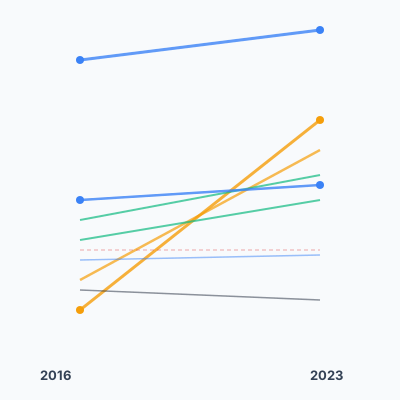
The China Dependency Index
When did China become your country's most important trade partner? For half the world, it already has. We mapped the dependency — and the risks.
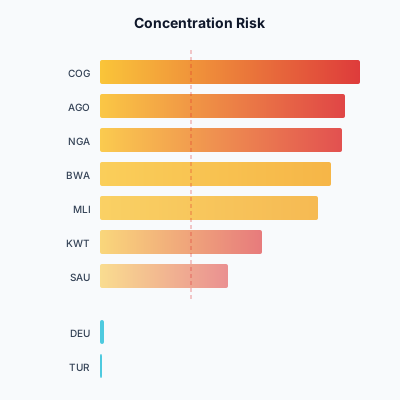
Concentration Risk
Some countries are one product away from crisis. We computed export concentration for every economy — the results are a map of global economic fragility.

The Debt-Trade Spiral
Persistent trade deficits and fiscal deficits compound into a debt spiral visible across decades. The data shows which countries are trapped — and which broke free.
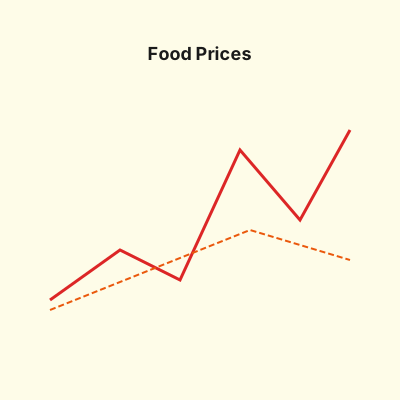
Agricultural Trade & Food Prices
The Arab Spring wasn't about politics. It started with the price of bread. We traced how global commodity spikes ripple into food crises — and who gets hit first.
Related explainers
“China is dumping”: What dumping actually means (and what it doesn’t)
Low prices aren’t automatically dumping. Dumping is a legal test tied to price discrimination and injury.

Bilateral deficit with China: why it’s a terrible headline metric
Bilateral deficits ignore supply chains and value-added. Here’s why they mislead—and what to use instead.

Carbon leakage
When strict climate policy in one country just pushes emissions across the border.

Comparative advantage
Why trade can benefit both sides even when one side is ‘better at everything’—and why that doesn’t settle policy debates.

Food security: It's not about growing everything yourself
Why food security depends on trade routes as much as farmland — and what actually breaks it.

Tariffs 101: Who Actually Pays? (And why everyone argues about it)
A clear, non-slogan explanation of tariff incidence, pass-through, and why “they pay” is usually wrong.