Tariffs 101: Who Actually Pays? (And why everyone argues about it)
A clear, non-slogan explanation of tariff incidence, pass-through, and why “they pay” is usually wrong.
TL;DR
A tariff is paid at the border by an importer, but the economic cost is shared between foreign producers, domestic firms, and consumers. Who “pays” depends on market power, substitutes, currency moves, and timing.
The mechanics in plain English
A tariff is a tax on an imported good. The customs bill is typically paid by the importing firm (or its broker). After that, the real question becomes: who absorbs the cost? There are only a few places it can go:
- Consumers (higher shelf prices),
- Domestic firms (lower margins),
- Foreign exporters (lower prices to stay competitive),
- Some mix of all three.
In the short run, prices often move faster than supply chains. Firms can raise prices, switch suppliers, shrink package sizes, or quietly reduce quality. Over the medium run, contracts roll off, competitors reposition, and supply chains reroute—so the incidence can change over time. The WTO's tariff and trade data provide applied tariff rates and trade flow changes that help trace these dynamics.
Why the “China pays” line keeps showing up
People confuse who remits the tariff with who bears it. (For a deeper look at how dependent importers actually are on Chinese goods, see The China Dependency Index.) Remitting is an accounting fact. Bearing the cost is an economic outcome. Politicians like the remitting story because it’s simple and emotionally satisfying.
The big swing factors
- Substitutes: If buyers can switch easily, exporters eat more of the cost.
- Market concentration: Powerful brands can pass costs through more easily.
- Exchange rates: A currency move can offset or amplify a tariff shock.
- Timing: Immediate spikes can fade as rerouting ramps up.
What to track instead of slogans
If you want to know what’s happening, watch:
- Import unit values / consumer prices for the targeted categories,
- Domestic producer margins in affected sectors,
- Trade diversion (same product from new source countries),
- Currency moves and shipping costs during the period.
Common misconception
“Tariffs create free money from foreigners.” They don’t. They rearrange who pays—and the bill rarely lands exactly where the slogan says.
Research that uses this concept
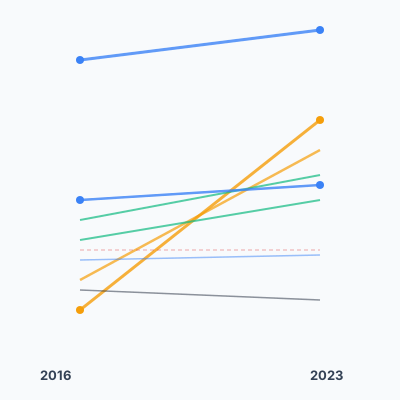
The China Dependency Index
When did China become your country's most important trade partner? For half the world, it already has. We mapped the dependency — and the risks.
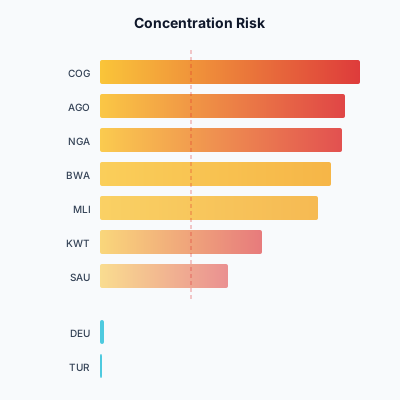
Concentration Risk
Some countries are one product away from crisis. We computed export concentration for every economy — the results are a map of global economic fragility.
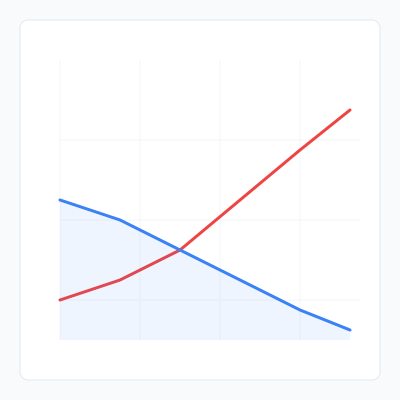
The Debt-Trade Spiral
Persistent trade deficits and fiscal deficits compound into a debt spiral visible across decades. The data shows which countries are trapped — and which broke free.
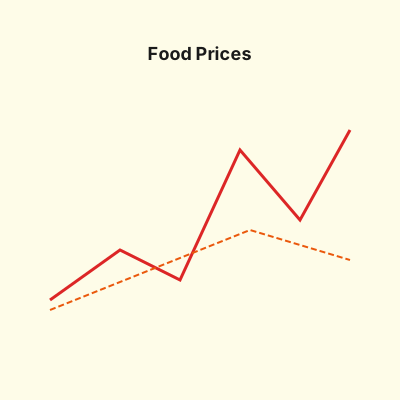
Agricultural Trade & Food Prices
The Arab Spring wasn't about politics. It started with the price of bread. We traced how global commodity spikes ripple into food crises — and who gets hit first.
Related explainers
“China is dumping”: What dumping actually means (and what it doesn’t)
Low prices aren’t automatically dumping. Dumping is a legal test tied to price discrimination and injury.
Bilateral deficit with China: why it’s a terrible headline metric
Bilateral deficits ignore supply chains and value-added. Here’s why they mislead—and what to use instead.

Carbon leakage
When strict climate policy in one country just pushes emissions across the border.
Comparative advantage
Why trade can benefit both sides even when one side is ‘better at everything’—and why that doesn’t settle policy debates.

Food security: It's not about growing everything yourself
Why food security depends on trade routes as much as farmland — and what actually breaks it.
Subsidies
Not all subsidies are equal: explicit vs implicit, production vs consumption, and why they matter for trade fights.