Trade balance vs current account
Why the trade balance is only part of the picture—and how the current account changes the story.
TL;DR
The trade balance is exports minus imports (goods and services). The current account is broader: it includes the trade balance plus cross-border income (like interest/dividends) and transfers. You can misunderstand an economy fast if you treat them as the same.
What it means (plain English)
Think of the trade balance as “stuff and services traded.” The current account adds:
- Primary income: dividends, interest, profits from abroad,
- Secondary income: remittances, aid, and other transfers.
So a country can run a goods trade deficit while having a healthier current account if it earns lots of income abroad (or vice versa).
Common misconception
“Trade deficit = country is broke.”
Not necessarily. A deficit can reflect strong domestic demand, investment inflows, or a reserve-currency role. The sustainability question is about how it’s financed and what the economy is building -- a dynamic explored in The Debt-Trade Spiral.
Headline translation
When you read: “Country is losing money on trade,” translate it as: “Country is importing more than exporting; check the current account and financing.”
A concrete example
A country imports more than it exports (trade deficit), but owns foreign assets that pay large dividends and interest (income surplus). The current account can be much closer to balance than the trade line alone suggests.
If you only remember one thing…
Trade balance is a slice. Current account is closer to the “net external position over time” story.
Research that uses this concept
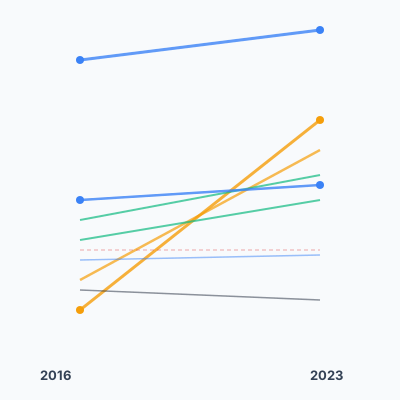
The China Dependency Index
When did China become your country's most important trade partner? For half the world, it already has. We mapped the dependency — and the risks.
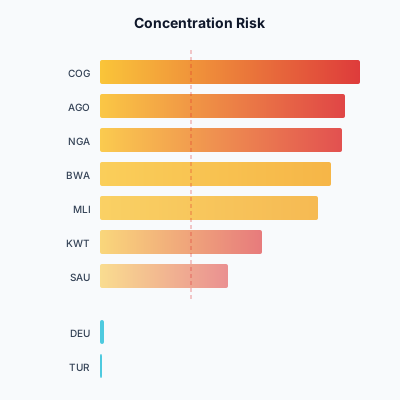
Concentration Risk
Some countries are one product away from crisis. We computed export concentration for every economy — the results are a map of global economic fragility.
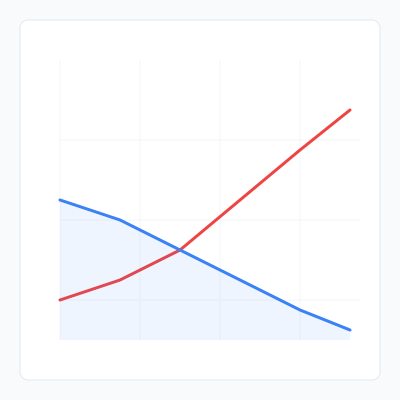
The Debt-Trade Spiral
Persistent trade deficits and fiscal deficits compound into a debt spiral visible across decades. The data shows which countries are trapped — and which broke free.
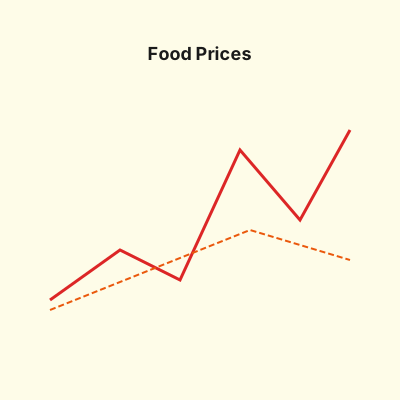
Agricultural Trade & Food Prices
The Arab Spring wasn't about politics. It started with the price of bread. We traced how global commodity spikes ripple into food crises — and who gets hit first.
Related explainers
“China is dumping”: What dumping actually means (and what it doesn’t)
Low prices aren’t automatically dumping. Dumping is a legal test tied to price discrimination and injury.

Bilateral deficit with China: why it’s a terrible headline metric
Bilateral deficits ignore supply chains and value-added. Here’s why they mislead—and what to use instead.

Carbon leakage
When strict climate policy in one country just pushes emissions across the border.

Comparative advantage
Why trade can benefit both sides even when one side is ‘better at everything’—and why that doesn’t settle policy debates.

Food security: It's not about growing everything yourself
Why food security depends on trade routes as much as farmland — and what actually breaks it.

Subsidies
Not all subsidies are equal: explicit vs implicit, production vs consumption, and why they matter for trade fights.