Trade Deficit vs “Losing”: Why the scoreboard analogy breaks
Why a trade deficit isn’t a national loss counter—and what it actually tells you (and doesn’t).
TL;DR
A trade deficit is not a national “loss.” It’s a bookkeeping identity: you imported more goods/services than you exported. It can signal problems—or reflect strong domestic demand, investment inflows, or a reserve-currency role.
What the trade balance actually measures
The trade balance is exports minus imports (goods and services). If it’s negative, you bought more from the world than you sold to it.
That sounds like a scoreboard until you remember: countries aren’t households. Imports are not “points against you.” Imports are stuff you chose to buy—inputs for factories, cheaper consumer goods, energy, components, medicines, software services, you name it.
The part headline writers skip
A deficit often pairs with capital inflows: foreigners buying your assets, funding investment, or holding your currency. That’s not always good (bubbles exist), but it’s not automatically “losing.”
Also: the trade balance is not the same as jobs, wages, or industrial capacity. You can run deficits and still have high employment; you can run surpluses and still have weak household demand.
When deficits can be a warning
Deficits can matter when they reflect:
- Unsustainable consumption financed by fragile debt (see The Debt-Trade Spiral for how this feedback loop plays out),
- A hollowing-out of specific supply chains that are strategically important,
- A currency regime that’s misaligned with fundamentals,
- Or a sudden shock (energy import spike, commodity price surge).
Better questions to ask
Instead of “Are we winning?” ask:
- Which sectors are shrinking or growing, and why?
- Is investment rising (new plants, capex, productivity)?
- What’s happening to real wages and labor force participation?
- Is the deficit driven by consumer goods, energy, or capital equipment?
Common misconception
“A deficit means we’re sending money away.” In macro accounting, flows have counterparts. The world can’t “take your money” without also giving you goods/services—or buying your assets. The real issue is whether that trade-off is healthy.
Research that uses this concept
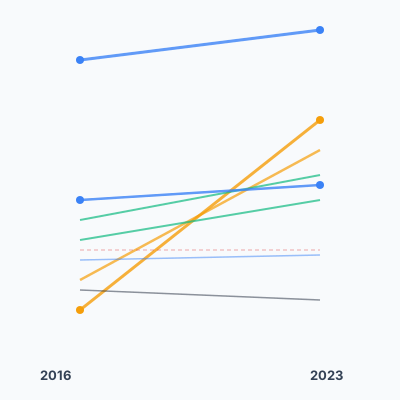
The China Dependency Index
When did China become your country's most important trade partner? For half the world, it already has. We mapped the dependency — and the risks.
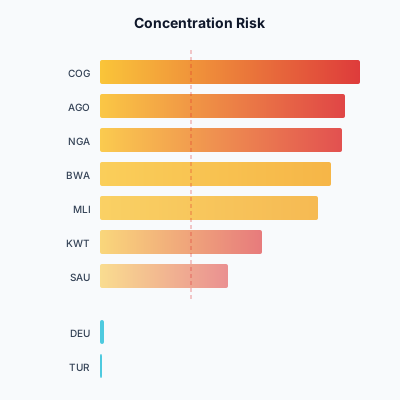
Concentration Risk
Some countries are one product away from crisis. We computed export concentration for every economy — the results are a map of global economic fragility.
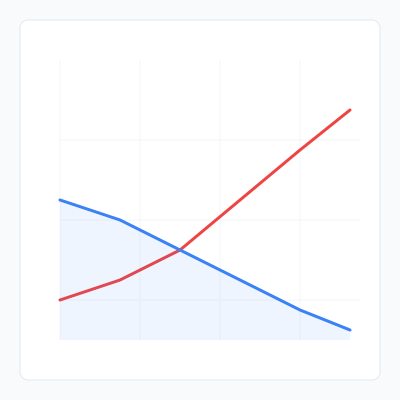
The Debt-Trade Spiral
Persistent trade deficits and fiscal deficits compound into a debt spiral visible across decades. The data shows which countries are trapped — and which broke free.
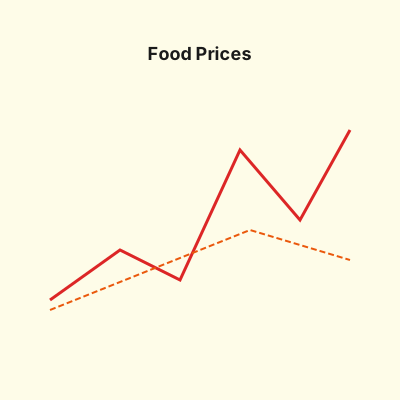
Agricultural Trade & Food Prices
The Arab Spring wasn't about politics. It started with the price of bread. We traced how global commodity spikes ripple into food crises — and who gets hit first.
Related explainers
“China is dumping”: What dumping actually means (and what it doesn’t)
Low prices aren’t automatically dumping. Dumping is a legal test tied to price discrimination and injury.

Bilateral deficit with China: why it’s a terrible headline metric
Bilateral deficits ignore supply chains and value-added. Here’s why they mislead—and what to use instead.

Carbon leakage
When strict climate policy in one country just pushes emissions across the border.

Comparative advantage
Why trade can benefit both sides even when one side is ‘better at everything’—and why that doesn’t settle policy debates.

Food security: It's not about growing everything yourself
Why food security depends on trade routes as much as farmland — and what actually breaks it.

Subsidies
Not all subsidies are equal: explicit vs implicit, production vs consumption, and why they matter for trade fights.