What a “Trade War” is in practice (not in slogans)
Trade wars aren’t just tariffs. They’re a bundle of tools that reshape supply chains, prices, and alliances.
TL;DR
A “trade war” is rarely one weapon. It’s a sequence: tariffs, quotas, export controls, sanctions, subsidies, procurement rules, and regulatory pressure—plus retaliation. The real outcome is usually supply-chain rerouting, not a clean “win.”
The toolkit (what it actually looks like)
In the real world, escalation tends to use:
- Tariffs (broad or targeted),
- Quotas / licensing (who can import and how much),
- Export controls (chips, advanced equipment, dual-use tech),
- Sanctions / financial restrictions (payments, banking access),
- Subsidies and tax incentives (to build domestic capacity),
- Procurement rules (“buy national” clauses),
- Standards/regulation that can function as barriers.
Each tool hits a different bottleneck. Tariffs hit prices; export controls hit capability; subsidies hit investment decisions.
What “winning” usually means
The headline goal is often “reduce the deficit” or “bring jobs back.” The real goals are usually:
- Force bargaining leverage,
- Slow a competitor’s technological climb,
- Secure supply chains for strategic goods,
- Signal resolve to allies and domestic voters.
The most common real outcome: diversion
Supply chains don’t disappear; they reroute. Trade flows shift to third countries, components get reclassified, and “friend-shoring” expands. That’s why you’ll often see:
- Imports from the target fall,
- Imports from alternative suppliers rise,
- Prices rise (somewhere),
- And compliance costs grow.
How to judge results
Measure outcomes with:
- Sector-specific prices and margins,
- Investment and capacity buildout timelines,
- Export-control compliance and leakage,
- Trade diversion patterns by product category,
- Productivity and wage growth in targeted industries.
Common misconception
“A trade war is just tough talk.” It’s administrative machinery that reshapes incentives. Once it starts, even a truce leaves behind new rules, new suppliers, and higher friction.
Research that uses this concept
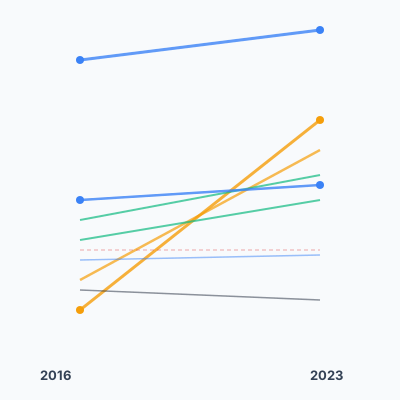
The China Dependency Index
When did China become your country's most important trade partner? For half the world, it already has. We mapped the dependency — and the risks.
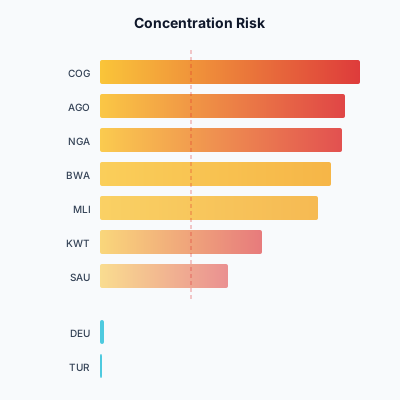
Concentration Risk
Some countries are one product away from crisis. We computed export concentration for every economy — the results are a map of global economic fragility.
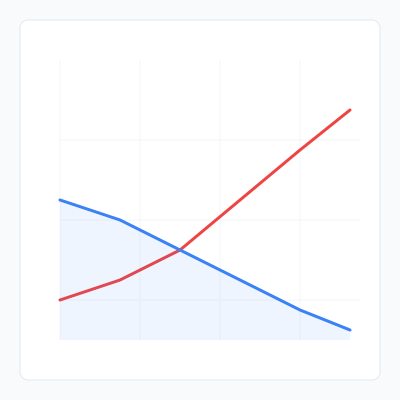
The Debt-Trade Spiral
Persistent trade deficits and fiscal deficits compound into a debt spiral visible across decades. The data shows which countries are trapped — and which broke free.
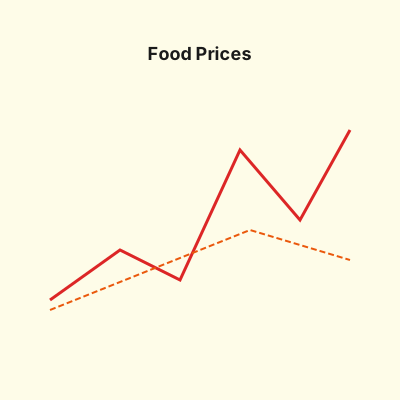
Agricultural Trade & Food Prices
The Arab Spring wasn't about politics. It started with the price of bread. We traced how global commodity spikes ripple into food crises — and who gets hit first.
Related explainers
“China is dumping”: What dumping actually means (and what it doesn’t)
Low prices aren’t automatically dumping. Dumping is a legal test tied to price discrimination and injury.

Bilateral deficit with China: why it’s a terrible headline metric
Bilateral deficits ignore supply chains and value-added. Here’s why they mislead—and what to use instead.
Carbon leakage
When strict climate policy in one country just pushes emissions across the border.

Comparative advantage
Why trade can benefit both sides even when one side is ‘better at everything’—and why that doesn’t settle policy debates.

Food security: It's not about growing everything yourself
Why food security depends on trade routes as much as farmland — and what actually breaks it.

Subsidies
Not all subsidies are equal: explicit vs implicit, production vs consumption, and why they matter for trade fights.