Carbon Cost of Growth
Can a country get richer without cooking the planet? Some have. Most haven't. We tracked GDP growth against CO2 emissions for 30 years — the decoupling story is real, but incomplete.
Can a Country Get Richer Without Cooking the Planet?
The standard environmentalist narrative says no. Economic growth means more factories, more cars, more power plants, more CO2. Get richer, burn more. The only path to lower emissions is degrowth -- accepting less so the planet survives.
The standard economist narrative says the opposite. Technology solves everything. Richer countries clean up after themselves. Growth is the cure, not the disease.
Both stories are too simple. We pulled three decades of data -- CO2 emissions from the Global Carbon Project (maintained by the Global Carbon Project research initiative), GDP per capita from the World Bank, and manufacturing output as a share of GDP -- for 12 countries spanning the spectrum from post-industrial Europe to industrializing Asia. The answer is more interesting than either camp admits: some countries have genuinely broken the link between growth and carbon. But the way they did it raises uncomfortable questions.
The Evidence: GDP Up, CO2 Down
Start with the United Kingdom. Between 1990 and 2023, British GDP per capita rose 59.5% -- from $33,000 to $52,600 in PPP terms. Over the same period, its territorial CO2 emissions fell 48.0%, from 602 million tonnes to 313 million tonnes. The lines on the chart below cross dramatically: GDP climbing steadily while emissions drop almost as steeply. Select different countries from the dropdown to see how the pattern varies.
Germany shows a similar pattern: GDP per capita up 47.9%, CO2 down 45.7%. France -- which started with lower emissions thanks to its nuclear fleet -- cut CO2 by 33.1% while growing 41.8%. Japan managed a 16.7% CO2 reduction on 30.7% GDP growth. Even the United States, not exactly known for climate ambition, reduced emissions by 4.4% while GDP per capita surged 70.1%.
This is what economists call "absolute decoupling" -- the economy grows while emissions shrink in absolute terms. It is real. It is measurable. And it is not a statistical artifact.
Now switch the dropdown to China. GDP per capita has risen a staggering 1,331% since 1990 -- from $1,667 to $23,833. CO2 emissions rose 395%, from 2,484 to 12,295 million tonnes. Both lines shoot upward, though GDP climbs faster. That is "relative decoupling" -- the economy is getting less carbon-intensive per unit of output, but total emissions keep rising because the economy is growing so fast.
India is worse: CO2 up 453%, GDP per capita up 346%. Emissions are actually growing faster than income. No decoupling at all.
The Decoupling Map: Who is Below the Line?
The scatter chart below plots every country with data. The x-axis is GDP per capita growth since 1990. The y-axis is CO2 change over the same period. The dashed diagonal is the no-decoupling line -- if you are on it, your emissions grew exactly as fast as your economy. Below the line means some degree of decoupling. Below zero on the y-axis means absolute decoupling.
The pattern is striking. Almost all wealthy Western nations sit below the x-axis: their emissions actually fell while they got richer. The UK, Germany, France, and Japan all achieved absolute decoupling. The US barely squeaks below zero. Russia shows a large CO2 drop, but that is mostly the 1990s economic collapse rather than green policy -- its emissions bottomed out in 1998 and have since partially recovered.
The fast-growing Asian economies cluster in the upper right: massive GDP growth, massive emissions growth. South Korea is relatively decoupled -- emissions up 133% on 283% GDP growth -- but still adding CO2 at a punishing rate. Indonesia, India, and China are all in the coupled zone, though China and Korea at least fall well below the diagonal.
Brazil is an interesting outlier: CO2 up 121% on only 55.6% GDP growth. Its emissions grew more than twice as fast as its economy. Much of this comes from land-use change and deforestation rather than industrial growth, which makes the Brazilian emissions story fundamentally different from the Asian one.
The Offshoring Question
Here is where the optimistic narrative gets complicated. The UK's emissions fell 48%. Impressive. But what happened to its manufacturing sector? In 1990, manufacturing was 16.6% of UK GDP. By 2022, it was 8.0%. The UK did not stop consuming manufactured goods -- it just stopped making them. British consumers still buy steel, cement, electronics, and chemicals. Those goods are now produced in China, India, and Southeast Asia, and the emissions show up in those countries' ledgers, not Britain's. See the UK's trade breakdown and the import dependency is plain.
The data on consumption-based CO2 -- which counts the emissions embedded in imported goods -- is revealing. In 2022, the UK's territorial emissions were about 331 million tonnes. Its consumption-based emissions were 503 million tonnes -- 61.6% higher. That gap represents the emissions the UK has effectively outsourced. France shows a similar pattern: territorial emissions of 299 Mt versus consumption-based emissions of 437 Mt, a 48.1% gap.
Germany's gap is smaller at 25.6% -- it maintained a larger manufacturing base (18.3% of GDP in 2022) while still decoupling. This suggests that Germany's decoupling is more "real" in the sense that it reflects genuine efficiency gains and energy transition rather than pure deindustrialization.
The United States has a consumption gap of about 10.1%. Smaller than Europe's, partly because America still has a substantial manufacturing sector and partly because it is a net energy producer.
China, predictably, has the reverse pattern. Its consumption-based CO2 is about 11% lower than its territorial emissions. China is a net emissions exporter -- it makes the goods that the rest of the world consumes and bears the carbon cost. Explore China's export profile to see just how much of the world's manufacturing flows through its factories.
China and India: Still Coupled, But at What Level?
It would be easy to point at China's 12,295 million tonnes of annual CO2 and declare it the villain. But context matters enormously.
China has lifted 800 million people out of poverty since 1990. Its GDP per capita went from $1,667 to $23,834. At the same income level that the UK was at in the early 1990s (~$33,000 per capita), China's per-capita emissions are significantly lower than Britain's were. China's carbon intensity -- CO2 per dollar of GDP -- has dropped from 0.73 kg/$ in the 1990s to 0.44 in the 2020s, a 40% improvement. It is getting more efficient fast, even as total emissions keep rising.
India is even more striking. GDP per capita is still only about $9,500 -- roughly where China was in 2010. India's emissions are rising faster than its income, which is concerning, but its per-capita emissions remain around 2.1 tonnes -- one-seventh of America's, one-quarter of Europe's average. Demanding that India cap its emissions at current levels is asking 1.4 billion people to stay poor so that countries that already got rich on fossil fuels can hit their climate targets.
The uncomfortable truth is that carbon-intensive growth is how every currently wealthy country got wealthy. The UK burned coal for 200 years. The US built its economy on cheap oil. Germany industrialized on lignite. Asking developing nations to skip that stage is reasonable only if you are willing to finance the alternative -- and so far, the rich world's record on climate finance is dismal.
Carbon Intensity: Everyone is Getting Better
Despite the grim headlines, there is genuine good news in the carbon intensity data. The heatmap below shows CO2 per dollar of GDP across four decades for our focus countries. Green means efficient; red means carbon-heavy.
Every single country in our sample has reduced its carbon intensity since the 1990s. Russia -- which started at a staggering 1.38 kg per international dollar in the 1990s, the legacy of Soviet-era heavy industry -- has cut intensity by roughly two-thirds. China has dropped from 0.73 to 0.44. The UK went from 0.40 to 0.14. France, already efficient thanks to nuclear power, dropped from 0.24 to 0.11.
This matters. Carbon intensity improvement means that a unit of economic growth today produces less CO2 than it did a generation ago. The global economy is approximately 40% less carbon-intensive than in 1990. That is not fast enough -- total emissions kept rising because the economy grew faster than intensity fell. But the direction is right, and the rate of improvement is accelerating as renewable energy costs plunge.
The question is whether intensity improvements can outpace growth quickly enough to bring absolute global emissions down. In Western Europe and Japan, they already have. In China and India, they have not -- yet. China's emissions growth rate has slowed dramatically since 2013, and some analysts expect its emissions to peak before 2030. India's peak is further off.
The Honest Answer
Can a country get richer without cooking the planet? Yes. The UK, Germany, France, Japan, and -- barely -- the United States have done it. Their economies are larger than in 1990 and their emissions are meaningfully lower. That is a genuine achievement, and dismissing it helps nobody.
But two caveats are essential.
First, some of this decoupling is accounting fiction. When the UK's consumption-based emissions are 62% higher than its territorial emissions, a significant chunk of its "progress" is really China's and India's problem. Not all of it -- the UK has genuinely shifted to cleaner energy, improved building efficiency, and reduced coal use to near zero. But stripping out the offshoring effect would cut the UK's apparent decoupling roughly in half. Germany's story holds up better because it kept more of its industry.
Second, the countries that have decoupled are the ones that already industrialized. They got rich on fossil fuels first, and now they are cleaning up. The countries where emissions are still rising -- China, India, Indonesia, Brazil -- are the ones still in the process of industrialization. They have every moral right to that process, and every practical incentive to pursue it. Climate policy that ignores this distinction is not just unfair; it is doomed to fail, because developing countries will not accept perpetual poverty for the sake of a climate crisis they did not cause.
The real story of decoupling is not that it proves growth is compatible with sustainability. It proves that it can be, under specific conditions: post-industrial economies, access to clean energy technology, and -- let us be honest -- the ability to import carbon-intensive goods from someone else. Making decoupling universal will require exporting the conditions, not just the rhetoric.
Methodology
Raw data inputs:
- GDP per capita, PPP (constant 2021 international $) — World Bank WDI
- Manufacturing, value added (% of GDP) — World Bank WDI
- Territorial annual CO2 emissions (million tonnes) — Global Carbon Project (not individually catalogued in MacroVedia)
- CO2 per GDP (kg per international dollar) — Global Carbon Project
- Consumption-based CO2 emissions — Global Carbon Project
- Country metadata (region, income level) — World Bank
Formulas (derived metrics):
co2_index(t)   = 100 * co2(t)   / co2(1990)
gdp_index(t)   = 100 * gdp_pc(t) / gdp_pc(1990)

co2_growth_pct = 100 * (co2(latest)    / co2(1990)    - 1)
gdp_growth_pct = 100 * (gdp_pc(latest) / gdp_pc(1990) - 1)

intensity_decade = mean( co2_per_gdp(y) for y in decade )
change_pct       = 100 * (intensity_2020s / intensity_1990s - 1)

consumption_gap_pct = 100 * (consumption_co2(t) / territorial_co2(t) - 1)
Time period: 1990 to the latest available year (2022-2023 for most series).
Decoupling classification: Countries are classified as "absolute decoupling" if CO2 emissions fell while GDP per capita rose since 1990; "relative decoupling" if CO2 rose but slower than GDP; and "no decoupling" if CO2 rose faster than or equal to GDP growth.
Carbon intensity: CO2 per GDP is sourced directly from the GCP dataset, measured in kilograms of CO2 per international dollar of GDP (PPP). Decade averages are computed from annual values.
Consumption-based emissions: The consumption-based CO2 data from the GCP adjusts territorial emissions for trade in goods and services. Importing countries have consumption-based emissions higher than territorial emissions; exporting countries have the reverse. The gap between the two measures indicates the degree of "emissions offshoring."
Focus countries: UK, Germany, USA, France, China, India, Japan, South Korea, Australia, Brazil, Indonesia, Russia -- selected to span post-industrial, industrializing, and commodity-exporting economies across regions.
Limitations: Consumption-based CO2 data involves modelling trade flows and has wider uncertainty bands than territorial emissions. Manufacturing share of GDP is an imperfect proxy for industrial activity (some countries have large extractive sectors that also generate emissions). The analysis uses country-level aggregates and cannot capture within-country variation -- emissions in rural Bihar and emissions in Mumbai are very different stories.
Related research
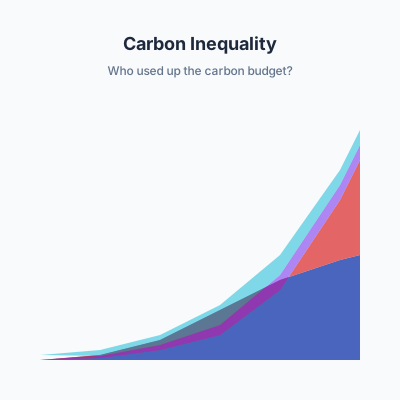
Carbon Inequality
The countries drowning in rising seas didn't cause the flood. We mapped who emitted what, when — and the per-capita gap is staggering.

Climate Vulnerability vs Emissions
Chad emits less CO2 in a year than a US state does in a day. Chad is also one of the most climate-vulnerable countries on Earth. The injustice is measurable.

The Energy-Prosperity Ladder
There is a clear energy consumption threshold countries must cross for human development. Below ~4,000 kWh per capita, every additional kilowatt-hour transforms lives. Above 10,000, you're just heating empty rooms.
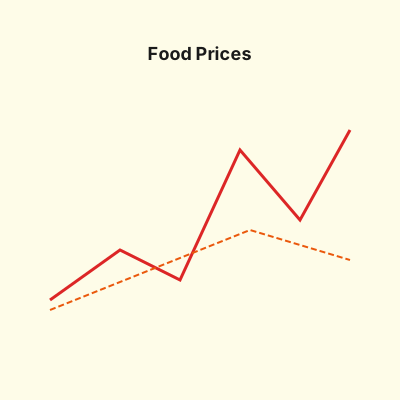
Agricultural Trade & Food Prices
The Arab Spring wasn't about politics. It started with the price of bread. We traced how global commodity spikes ripple into food crises — and who gets hit first.
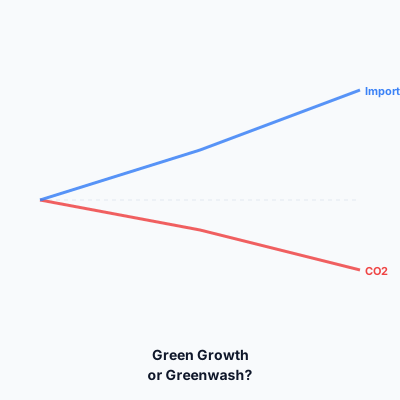
Green Growth or Greenwash
Europe's emissions fell 30%. Its manufactured imports rose 40%. Coincidence? We tested whether 'decoupling' is real or just offshored pollution.
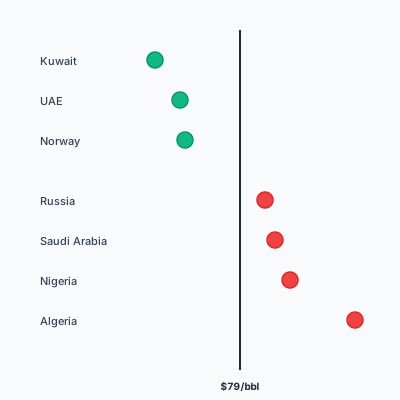
Oil Price & Fiscal Breakeven
Saudi Arabia needs $80 oil to pay its bills. It didn't always. We estimated fiscal breakeven prices for every major oil producer — and tracked how they rose.
Related explainers

Capacity factor
Why a country with 10 GW of solar capacity doesn't actually get 10 GW of electricity.

Carbon leakage
When strict climate policy in one country just pushes emissions across the border.

Consumption vs territorial emissions
The accounting trick that lets rich countries claim they're decarbonizing while importing carbon-heavy goods.

Dutch disease
How a resource windfall can hollow out the rest of your economy — and why the real disease is mismanagement.

Energy intensity
How much energy it takes to produce a dollar of GDP — and why the trend can mislead you.

Fiscal breakeven: the price that keeps the lights on
Every petrostate has a magic number — the oil price needed to balance the budget. It almost always goes up.