Carbon Inequality
The countries drowning in rising seas didn't cause the flood. We mapped who emitted what, when — and the per-capita gap is staggering.
The Countries Drowning in Rising Seas Didn't Cause the Flood
The Marshall Islands will likely cease to exist as a habitable nation within this century. Its highest point is two meters above sea level. Its total historical CO2 emissions are a rounding error -- less than what the United States emits in a single afternoon. This is not an abstraction. It is the single most measurable injustice in the modern world, and the data makes it inescapable.
We pulled every country's CO2 emissions from the Global Carbon Project -- the authoritative dataset maintained by the Global Carbon Project research consortium -- covering annual totals going back to 1750, per-capita figures, and cumulative totals that represent each nation's historical claim on the atmosphere. Then we crossed that with GDP, population, and regional data. The picture that emerges is not subtle.
The Historical Account: Who Burned What, When
The chart below shows annual CO2 emissions from the ten largest historical emitters, stacked from 1900 to the present. Watch how the composition shifts over the century.
For the first half of the twentieth century, this was overwhelmingly a Western story. The United States, the United Kingdom, and Germany dominated global emissions. The US alone has pumped 434,867 million tonnes of CO2 into the atmosphere since industrialization -- 24.3% of all human CO2 emissions ever. One country, with 4.3% of the world's population, is responsible for nearly a quarter of all historical carbon dioxide.
Germany accounts for 5.3%. The United Kingdom for 4.5%. Russia for 6.9%. Add Japan, France, and Canada, and these seven countries -- home to roughly 13% of humanity -- have emitted over 47% of all CO2 in history.
China enters the picture dramatically in the 2000s. Its annual emissions now dwarf everyone else's. But cumulative? China accounts for 15.9% of historical emissions. Its population is four times that of the United States. The US has emitted 1.5 times more CO2 than China over the entire industrial era despite having a quarter of the people. See the two economies side by side -- the per-capita gap is striking.
India -- home to 17.9% of the world's population -- accounts for just 3.7% of cumulative emissions. India's entire historical carbon footprint is smaller than what the US and Europe have emitted since 1990.
Per Capita Today: Qatar to the Congo, a 764x Gap
Aggregate numbers hide the most visceral inequality. The chart below shows per-capita CO2 emissions -- the top 20 highest and bottom 20 lowest emitters on Earth.
The numbers speak for themselves. Qatar emits 41.3 tonnes of CO2 per person per year. Kuwait emits 26.2. Bahrain 24.3. Saudi Arabia 20.4. The United States emits 14.2 tonnes per person -- roughly twice the European average and more than three times the global mean.
At the other end: Chad emits 0.14 tonnes per person. Burundi 0.065. The Democratic Republic of the Congo -- a country of over 100 million people -- emits 0.054 tonnes per capita. That means an average Qatari emits 764 times more CO2 than an average Congolese citizen. An average American emits 102 times more than a Chadian.
These are not marginal differences. The top 10 countries by per-capita emissions average 23.2 tonnes per person. The bottom 50 countries average 0.37 tonnes. That is a 63x ratio. The Gini coefficient of per-capita CO2 emissions across countries is 0.56 -- comparable to the income inequality of the most unequal countries on Earth.
The bottom 50 countries could double, triple, or quadruple their emissions and it would barely register on a global chart. Their contribution to climate change is, in any meaningful sense, zero.
The Income-Emissions Link: Wealth Predicts Carbon
The relationship between income and emissions is not mysterious. Plot GDP per capita against CO2 per capita, with bubble size representing population, and the pattern is stark.
Richer countries emit more. The correlation is strong and unmistakable. But there is important variation within that pattern. European countries tend to cluster below the trend line -- achieving high incomes with relatively lower emissions per capita. The Gulf states sit far above it -- their petrochemical economies and subsidized energy generating extraordinary emissions for their population size. Australia and Canada, with their resource-intensive economies and sprawling geographies, also overshoot.
The large developing nations -- India, Nigeria, Ethiopia, Bangladesh -- sit in the bottom-left corner: low income, low emissions, billions of people. They are not the cause of this crisis. They are, overwhelmingly, the ones who will bear its consequences.
China's Complex Story
No discussion of carbon inequality is honest without addressing China directly. China is now the world's largest annual emitter at over 11,000 million tonnes of CO2 per year -- roughly double the United States. This is the number that gets cited most often, and it is real.
But three other numbers matter just as much.
Per capita, China emits about 8.1 tonnes per person -- less than the US (14.2), less than Canada (13.4), less than Australia (14.5), less than most Gulf states, and roughly comparable to most European nations. China is not, on a per-person basis, an outlier.
Cumulatively, China has emitted 285,087 million tonnes -- 15.9% of all historical CO2, compared to America's 24.3%. The atmosphere does not care about annual flow rates. It cares about the stock of greenhouse gases, and that stock is overwhelmingly Western.
Population share: China has 17.5% of the world's people and 15.9% of cumulative emissions. The US has 4.3% of the world's people and 24.3% of cumulative emissions. India has 17.9% of people and 3.7% of cumulative emissions. If you believe that each human being has an equal right to the atmosphere, these numbers tell you who has overdrawn their account and who has barely touched it.
This does not excuse China's current trajectory. It does mean that framing climate change as "China's problem" is historically illiterate.
The Carbon Budget: Who Used It Up
Climate scientists have estimated that humanity can emit roughly 400-500 billion more tonnes of CO2 to have a reasonable chance of limiting warming to 1.5 degrees Celsius. We have already emitted approximately 1,793 billion tonnes (cumulative from all countries in our dataset). The budget is nearly spent.
The question of who spent it is not abstract. The cumulative per-capita numbers make it vivid:
- United States: 1,259 tonnes per person historically
- United Kingdom: 1,158 tonnes per person
- Germany: 1,125 tonnes per person
- Canada: 897 tonnes per person
- Russia: 848 tonnes per person
Compare that to:
- India: 45.5 tonnes per person
- Nigeria: roughly 15 tonnes per person
- Ethiopia: less than 10 tonnes per person
- Congo (DRC): negligible
An American has used 28 times more of the shared atmospheric commons than an Indian, measured over the entire industrial era. A Brit has used 25 times more. The carbon budget was overwhelmingly consumed by a handful of wealthy nations during the 19th and 20th centuries, while today's fastest-growing populations are asked to decarbonize before they have industrialized.
The Justice Question
Climate change is often discussed as a collective action problem -- as if all nations share equal responsibility and equal obligation. The data demolishes this framing.
The countries most vulnerable to climate impacts -- low-lying island nations, sub-Saharan Africa, South and Southeast Asia -- are overwhelmingly countries that contributed almost nothing to the problem. Bangladesh, which could see a third of its land area flooded with a one-meter sea level rise, has emitted less CO2 in its entire history than the United States emits in two years. Dig into Bangladesh's economic profile and the vulnerability becomes even clearer. Mozambique, repeatedly battered by intensifying cyclones, accounts for less than 0.02% of cumulative global emissions.
This is measurable. It is not a matter of opinion. The Gini coefficient of per-capita emissions is 0.56. The ratio between the top 10 and bottom 50 emitters is 63x. The United States alone has used a quarter of the cumulative carbon budget. The bottom 100 countries by cumulative emissions, home to billions of people, have collectively used less than 5%.
Climate policy that does not reckon with this arithmetic is not serious policy. The question is not whether rich countries should shoulder a disproportionate share of the cost of climate transition -- the data makes that obligation undeniable. The question is whether they will.
Methodology
Data sources: CO2 emissions data from the Global Carbon Project (GCP) via Our World in Data -- including territorial annual emissions, per-capita emissions, and cumulative emissions. GDP per capita (PPP, constant 2021 international dollars) from the World Bank WDI. Population from the GCP dataset (sourced from UN and Gapminder). Country classification (region, income level) from the World Bank.
Raw data inputs:
- GDP per capita, PPP (constant 2021 international $) -- World Bank WDI
- Annual territorial CO2 emissions (million tonnes) -- Global Carbon Project (not yet indexed on MacroVedia; see globalcarbonproject.org)
- CO2 emissions per capita (tonnes per person) -- Global Carbon Project
- Cumulative CO2 emissions (million tonnes) -- Global Carbon Project
- Population (persons) -- Global Carbon Project / UN / Gapminder
Derived metrics (computed in Python):
Cumulative CO2 per capita (tonnes per person), used in the GDP-vs-emissions scatter context and the carbon-budget table:
cumulative_pc = (cumulative_total_Mt * 1e6) / population
Population and emissions shares, used to compare each country's demographic weight to its atmospheric footprint:
pop_share      = population / sum(population_all_countries) * 100
emissions_share = cumulative_total / sum(cumulative_all_countries) * 100
Gini coefficient of per-capita CO2 emissions across countries (standard formula on sorted non-negative values):
G = (2 * sum(i * x_i for i=1..n) / (n * sum(x))) - (n + 1) / n
Top-10 vs bottom-50 ratio (the headline 63x figure):
ratio = mean(top_10_co2_pc) / mean(bottom_50_co2_pc)
Time period: Cumulative emissions are calculated from the earliest available year (as early as 1750 for some countries) through 2024. Per-capita figures use the most recent available year (2023-2024 for most countries).
Sample: 204 countries after excluding aggregates (regions, income groups, world totals).
Inequality metrics: The Gini coefficient is calculated using the standard formula applied to per-capita CO2 emissions across countries. The top-10/bottom-50 comparison uses the 10 highest per-capita emitters versus the 50 lowest. The 63x ratio is the ratio of average per-capita emissions between these two groups.
Limitations: Territorial emissions attribute CO2 to the country where fossil fuels are burned, not where goods are consumed. Consumption-based accounting (which reallocates emissions embedded in trade) would increase the emissions of importing countries (notably the US, EU, Japan) and decrease those of exporting countries (notably China). This means our figures likely understate the true emissions responsibility of wealthy consuming nations. Additionally, within-country inequality in emissions is extreme -- the richest 10% of people globally are responsible for roughly half of all emissions -- but country-level data cannot capture this dimension.
Related research
Carbon Cost of Growth
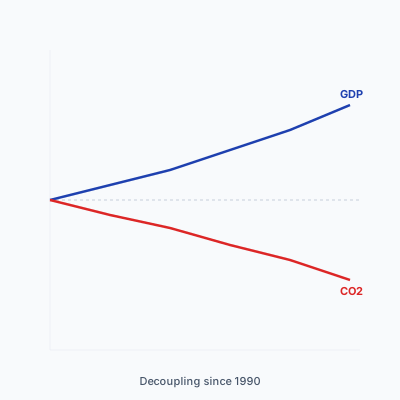
Can a country get richer without cooking the planet? Some have. Most haven't. We tracked GDP growth against CO2 emissions for 30 years — the decoupling story is real, but incomplete.
Climate Vulnerability vs Emissions
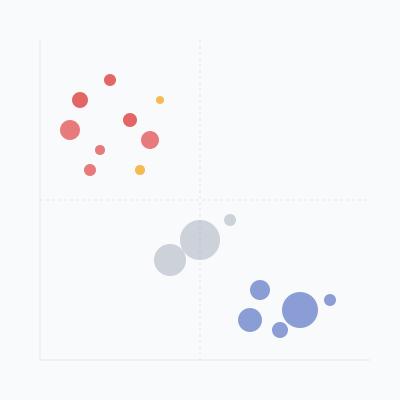
Chad emits less CO2 in a year than a US state does in a day. Chad is also one of the most climate-vulnerable countries on Earth. The injustice is measurable.
The Energy-Prosperity Ladder
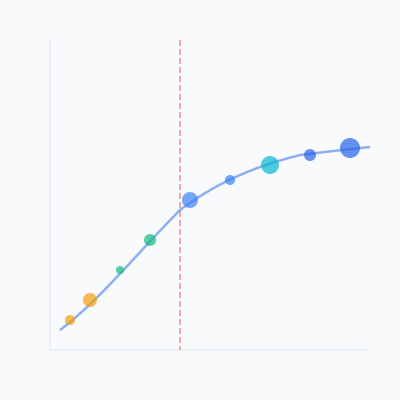
There is a clear energy consumption threshold countries must cross for human development. Below ~4,000 kWh per capita, every additional kilowatt-hour transforms lives. Above 10,000, you're just heating empty rooms.
Agricultural Trade & Food Prices
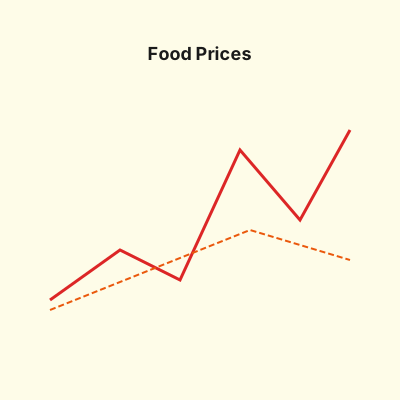
The Arab Spring wasn't about politics. It started with the price of bread. We traced how global commodity spikes ripple into food crises — and who gets hit first.
Green Growth or Greenwash
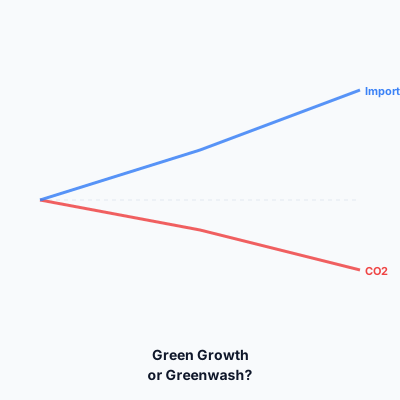
Europe's emissions fell 30%. Its manufactured imports rose 40%. Coincidence? We tested whether 'decoupling' is real or just offshored pollution.
Oil Price & Fiscal Breakeven
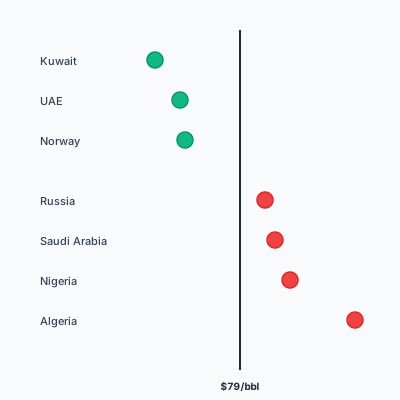
Saudi Arabia needs $80 oil to pay its bills. It didn't always. We estimated fiscal breakeven prices for every major oil producer — and tracked how they rose.
Related explainers
Capacity factor
Why a country with 10 GW of solar capacity doesn't actually get 10 GW of electricity.

Carbon leakage
When strict climate policy in one country just pushes emissions across the border.

Consumption vs territorial emissions
The accounting trick that lets rich countries claim they're decarbonizing while importing carbon-heavy goods.

Dutch disease
How a resource windfall can hollow out the rest of your economy — and why the real disease is mismanagement.

Energy intensity
How much energy it takes to produce a dollar of GDP — and why the trend can mislead you.
Fiscal breakeven: the price that keeps the lights on
Every petrostate has a magic number — the oil price needed to balance the budget. It almost always goes up.