The China Dependency Index
When did China become your country's most important trade partner? For half the world, it already has. We mapped the dependency — and the risks.
When Did China Become Your Country's Most Important Trade Partner?
For 30 countries, the answer is: it already is. And for most of the rest, China is second or third and gaining ground fast.
This is not a prediction or a policy argument. It is an accounting exercise. We took bilateral trade data from UN Comtrade -- covering 160 countries from 2016 to 2023, computed each country's trade with China as a share of its total merchandise trade, and ranked them. The results are striking -- not because they are surprising to anyone paying attention, but because of how far the shift has gone and how unevenly distributed it is.
Nine countries now send or receive more than 30% of their total trade from a single partner: China. Thirty countries are above 20%. The median country conducts 10.8% of its trade with China. The global average is 13.1%.
The Before and After
The slope chart below shows the 25 most China-dependent economies in both 2016 and 2023. The left point marks where they started. The right point marks where they ended up. The steeper the line, the faster the dependency grew.
A few lines stand out.
Congo went from 9.6% to 45.5% in seven years -- a 36 percentage point jump driven almost entirely by oil and mineral exports. The Democratic Republic of the Congo followed a similar path, rising from 13.7% to 42.7%, fueled by cobalt and copper demand for China's battery and electronics manufacturing.
Mongolia sits at 72% -- a number so high it barely registers as a trade relationship and more as economic absorption. Nearly all Mongolian coal and copper goes south across the border. There is no alternative buyer at that scale.
At the other end of the size spectrum, Australia at 29.3% is the most consequential case. This is a $192 billion bilateral trade relationship -- $120 billion in Australian exports to China (iron ore, LNG, coal) and $72 billion in imports. When China imposed unofficial trade restrictions on Australian barley, wine, coal, and lobster in 2020-2021, the economic impact was immediate and concentrated in specific sectors. Australia's China share actually peaked at 33.5% in 2020 before the restrictions took effect.
Who Depends Most
The bar chart below ranks the 30 most China-dependent countries. The red dashed lines at 20% and 30% mark rough thresholds where concentration risk becomes material.
Three patterns emerge from this ranking.
The resource exporters. Chile at 31.8%, Peru at 31.1%, Australia at 29.3%, Brazil at 27.1%, Angola at 37.8%. These countries export what China needs to build: iron ore, copper, soybeans, oil. The trade is not diversified across products. Australia's exports to China are overwhelmingly iron ore and gas. Chile's are copper. Brazil's are soybeans and iron ore. If China slows its construction boom, these countries feel it first.
The neighborhood. Mongolia at 72%, Laos at 33.7%, Vietnam at 27.5%, Myanmar at 27.3%, Thailand at 21.6%, South Korea at 21%, Japan at 20%. Geography is gravity. These economies are deeply woven into Chinese supply chains -- both as suppliers of components and raw materials and as buyers of Chinese manufactured goods. Vietnam's case is especially interesting: it imports $111 billion from China (mostly intermediate inputs for electronics assembly) and exports $61 billion back -- acting as a processing node in China-centric supply chains rather than an independent trade partner.
The African frontier. The story of China-Africa trade is often told through infrastructure projects and lending. The trade data tells a different story. Congo at 45.5%, DRC at 42.7%, Angola at 37.8%, Ethiopia at 28.6%, Tanzania at 25.4%. For much of Sub-Saharan Africa, China is not just a trade partner -- it is the trade partner, with no close second. The DRC's jump from 13.7% to 42.7% between 2016 and 2023 is one of the most dramatic shifts in the entire dataset, driven by surging demand for cobalt used in lithium-ion batteries.
The Speed of Change
The time series below tracks China's trade share for eight major economies from 2016 to 2024. What is remarkable is not the absolute levels but the convergence: nearly everyone is moving up.
Australia oscillates between 25% and 34%, peaking during COVID when iron ore prices surged and China was the only major economy still building. Brazil climbed from 21% to 27%, driven by soybean and iron ore exports. Japan and South Korea hover around 20-21%, deeply embedded in electronics and automotive supply chains.
The United States at 12.8% looks moderate by comparison -- but in absolute terms, it represents $596 billion in bilateral trade, making it the largest bilateral relationship in the dataset. Germany at 8.8% seems even more insulated, but China is Germany's single largest trade partner by goods volume, and the dependency is concentrated in the automotive sector. Much of the bilateral flow is in electronics and machinery -- the two product categories that dominate China's export profile.
India is an interesting outlier. At 14.6%, its China share is substantial but not dominant -- and importantly, the relationship is asymmetric. India imports $91 billion from China (electronics, machinery, chemicals) but exports only $17 billion back. India's trade deficit with China is one of the largest bilateral imbalances in the world.
The Reverse: How Dependent Is China?
Here is the question nobody asks: how dependent is China on any single partner?
The answer is revealing. China's largest trade partner is the United States, accounting for just 11.6% of China's total trade. Japan takes 5.6%. South Korea 5.4%. No other country exceeds 5%.
China's top 10 trade partners collectively account for about 50% of its trade -- a far more diversified portfolio than what most countries have in reverse. Australia sends 29.3% of its trade to China, but China sends only 4% of its trade to Australia. Brazil sends 27.1% to China; China sends 3.2% to Brazil.
This asymmetry is the core of the geopolitical problem. When one partner accounts for a third of your trade and you account for only 4% of theirs, the leverage is not balanced. China can absorb the loss of any single partner. Most of its partners cannot absorb the loss of China.
What This Means
Trade concentration is not inherently bad. Small countries naturally depend on large neighbors. Resource exporters naturally sell to the largest buyer. But the speed and scale of China dependency growth creates three specific risks.
Supply chain fragility. When 30% of your trade flows through one partner, any disruption -- tariffs, sanctions, political friction, or even a domestic economic slowdown in China -- ripples through your entire economy. Australia learned this in 2020. The coal and barley producers hit by Chinese restrictions had no alternative buyers at comparable scale. It took years to redirect trade flows.
Commodity price exposure. For resource exporters like Chile, Peru, and the DRC, China dependency is really China-demand dependency. If China's construction sector contracts (as it has since the property crisis began in 2021), copper and iron ore demand falls, prices drop, and export revenues collapse. These countries are not just dependent on China as a trade partner -- they are dependent on China's growth model continuing.
Geopolitical leverage. Trade dependency creates implicit political leverage. Countries that depend heavily on Chinese trade face costs when their foreign policy positions diverge from Beijing's preferences. This is not theoretical -- it is observable in the diplomatic behavior of highly dependent countries. The correlation between China trade share and UN General Assembly voting alignment with China is positive and strengthening.
None of this means countries should or can simply reduce their China trade. Diversification is expensive and slow. For many countries, China is the only buyer large enough to absorb their commodity exports at market-clearing volumes. The question is not whether to trade with China but whether to trade with China and nobody else at comparable scale.
The data suggests that for a growing number of countries, that is exactly what is happening.
Methodology
Trade data: UN Comtrade bilateral trade at HS4 product level, covering 160 countries from 2016 to 2023. China trade share is calculated as (exports to China + imports from China) / total merchandise trade. Total trade figures come from aggregate HS4 totals to ensure consistency.
Exclusions: China itself, Hong Kong and Macao (special administrative regions with unique trade structures), and countries with less than $100 million in total annual trade are excluded from rankings but included in the dataset.
Limitations: The bilateral dataset begins in 2016, so we cannot show the full trajectory from 2000 when China's WTO accession accelerated trade growth. Services trade is excluded -- goods only. Re-export hubs (Singapore, Hong Kong) may overstate some bilateral flows. Trade data is reported by value in current USD, so inflation and exchange rate movements affect year-over-year comparisons.
Data sourced from UN Comtrade.
Related research
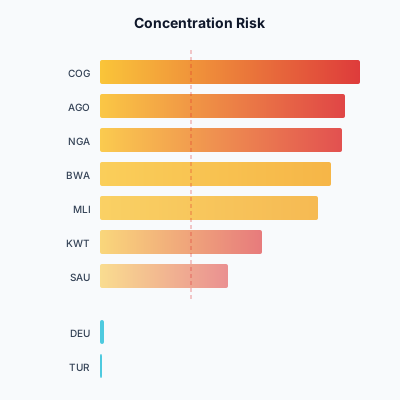
Concentration Risk
Some countries are one product away from crisis. We computed export concentration for every economy — the results are a map of global economic fragility.

The Debt-Trade Spiral
Persistent trade deficits and fiscal deficits compound into a debt spiral visible across decades. The data shows which countries are trapped — and which broke free.
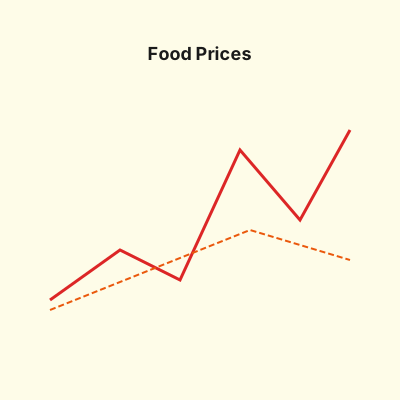
Agricultural Trade & Food Prices
The Arab Spring wasn't about politics. It started with the price of bread. We traced how global commodity spikes ripple into food crises — and who gets hit first.
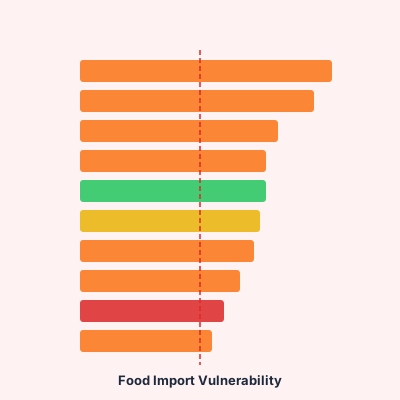
Food Import Vulnerability
40 countries can't feed themselves — and the list is growing. We mapped food import dependency against arable land, population growth, and income. The vulnerable are easy to identify.
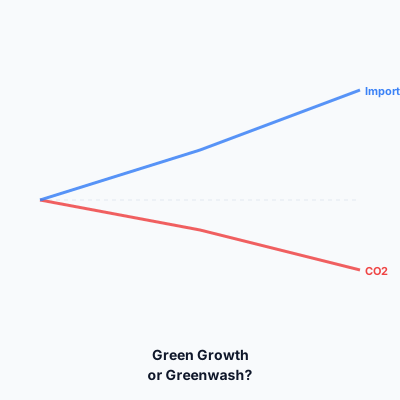
Green Growth or Greenwash
Europe's emissions fell 30%. Its manufactured imports rose 40%. Coincidence? We tested whether 'decoupling' is real or just offshored pollution.
The Manufacturing Exodus
The rich world stopped making things — then wondered why it couldn't. We tracked manufacturing's 30-year migration from West to East, in GDP and trade data.
Related explainers

“China is dumping”: What dumping actually means (and what it doesn’t)
Low prices aren’t automatically dumping. Dumping is a legal test tied to price discrimination and injury.

Bilateral deficit with China: why it’s a terrible headline metric
Bilateral deficits ignore supply chains and value-added. Here’s why they mislead—and what to use instead.

Carbon leakage
When strict climate policy in one country just pushes emissions across the border.

Comparative advantage
Why trade can benefit both sides even when one side is ‘better at everything’—and why that doesn’t settle policy debates.

Food security: It's not about growing everything yourself
Why food security depends on trade routes as much as farmland — and what actually breaks it.

Subsidies
Not all subsidies are equal: explicit vs implicit, production vs consumption, and why they matter for trade fights.