Concentration Risk
Some countries are one product away from crisis. We computed export concentration for every economy — the results are a map of global economic fragility.
Some Countries Are One Product Away from Crisis
The Republic of Congo sends 84% of its export revenue abroad in the form of a single commodity: crude oil. Not 84% to one country -- 84% in one product category. When oil prices crashed from $115 to $28 between 2014 and 2016, the Congolese economy did not slow down. It collapsed. GDP growth went from 6.8% to -2.8% in a single year. Government revenue fell by half. The country defaulted on its debt.
Congo is not an outlier. It is a representative case. Across 162 countries with data in the UN Comtrade database, 30 economies have an export Herfindahl-Hirschman Index above 0.25 -- meaning their exports are heavily concentrated in a handful of products. Nine countries score above 0.50, which is extreme. These are economies where a single bad year for a single commodity can wipe out the national budget.
This is a map of global economic fragility, and it looks exactly like you would expect: oil, diamonds, copper, and coffee.
Measuring Concentration: The HHI
The Herfindahl-Hirschman Index is simple. Take every product a country exports. Compute each product's share of total exports. Square those shares. Sum them. The result falls between 0 and 1. An HHI of 0 means perfectly diversified exports (infinitely many products, each tiny). An HHI of 1 means the country exports exactly one thing.
In practice, an HHI below 0.05 indicates a well-diversified export basket -- think Germany (0.010), the United States (0.028), or Turkey (0.003). An HHI above 0.25 signals dangerous concentration. Above 0.50, you are looking at a country whose economic fate is tied to the price chart of a single commodity.
We computed the HHI for every country using HS4-level export data (approximately 1,200 product categories) from 2023. The median country scores 0.088 -- moderately concentrated. The mean is 0.147, pulled up by a long tail of extremely concentrated economies.
The Most Vulnerable
The bar chart tells a stark story. The top of the list is dominated by two types of economies: oil exporters and mineral exporters.
The petrostates. Congo (HHI 0.71), Angola (0.67), Nigeria (0.66), Kuwait (0.44), Qatar (0.41), Saudi Arabia (0.35). For these countries, "mineral fuels and oils" -- HS Chapter 27 -- is not just the top export. It is the economy. Nigeria's top HS4 product alone accounts for 81% of its $65 billion in annual exports. When Brent crude dropped 65% in 2014-2016, Nigeria's naira lost half its value, inflation hit 18%, and the economy entered its first recession in 25 years.
Angola is even more exposed. Its HHI of 0.67 means that squaring the export shares and summing them still produces a number closer to 1 than to 0. Petroleum crude (HS 2709) accounts for 81% of a $40 billion export basket. The remaining 19% is mostly LNG and diamonds. That is not diversification. That is three bets instead of one.
The diamond and gold economies. Botswana (0.63), Mali (0.60), the Central African Republic (0.43). Botswana built the best-governed economy in Sub-Saharan Africa on the back of diamonds -- 79% of its exports fall under "precious stones and metals." The problem is not governance. The problem is that lab-grown diamonds are getting cheaper every year, and Botswana has no plan B at scale.
The small and forgotten. Comoros sends 78% of its exports as cloves and vanilla (HS Chapter 09: coffee, tea, and spices). Maldives is 58% fish and seafood. Liberia is 63% rubber. Gambia gets 72% from re-exported fuel. These are tiny economies -- Comoros exports $50 million a year -- but the people in them are no less affected when the single product falters.
The surprise: Guyana. Guyana (HHI 0.46) has shot up the concentration rankings in the last five years after ExxonMobil began offshore oil production. Guyana's GDP growth hit 62% in 2022 -- the highest in the world -- but its export basket is now dangerously tilted toward crude. Its GDP growth volatility since 2013 is 21% (standard deviation), the highest of any country in our dataset.
The Diversified: Who Got It Right
At the other end of the spectrum, the most diversified exporters are a who's who of manufacturing economies.
Turkey leads with an HHI of just 0.003. Its top export product -- mineral fuels -- accounts for only 3.3% of its export basket. Turkey exports vehicles, machinery, textiles, steel, food, chemicals, and plastics in roughly equal measure. No single product can sink the Turkish export sector.
Thailand (0.004) is similarly broad: electrical equipment, vehicles, food, rubber, plastics, and jewelry all compete for the top spot. Spain (0.005), France (0.006), and the United Kingdom (0.007) round out the top five.
Germany scores 0.010 -- extraordinarily diversified for the world's third-largest exporter. Vehicles are the top category at just 5.2% of $3.5 trillion in exports. Behind that: machinery, pharmaceuticals, chemicals, electrical equipment, plastics, iron and steel. Germany's export basket is deep, and it is why German GDP growth volatility is a modest 3.3% -- compared to 6.1% for Botswana or 8.5% for Panama.
Japan (0.038) and the United States (0.028) are both well-diversified, though Japan is somewhat more concentrated due to its heavy automotive sector (vehicles account for 15.4% of exports).
Concentration Equals Instability
The relationship between export concentration and economic volatility is not theoretical. It shows up directly in the data.
The scatter chart below plots each country's HHI against the standard deviation of its GDP growth rate from 2013 to 2023. Bubble size represents total export volume.
The pattern is clear: as export concentration rises, GDP growth becomes more volatile. Countries in the bottom-left quadrant -- low HHI, low volatility -- are the diversified manufacturing economies: Germany, Turkey, Thailand, Poland, the Czech Republic. Countries in the upper-right -- high HHI, high volatility -- are the commodity-dependent states: Guyana (HHI 0.46, volatility 21%), the Central African Republic (0.43, 11.8%), Panama (0.54, 8.5%), Maldives (0.40, 16.1%).
This is the mechanism behind the "resource curse." It is not that natural resources are inherently bad for growth -- many resource-rich countries grow faster than average during commodity booms. The problem is the volatility. When your government budget, your exchange rate, and your employment all depend on one commodity price, you get boom-bust cycles that destroy long-term investment, erode institutions, and make planning impossible.
Saudi Arabia is the most interesting large economy on this chart. With an HHI of 0.35 and $316 billion in exports, it is by far the largest highly-concentrated economy. Its GDP growth volatility of 2.8% is remarkably low for its concentration level -- a testament to the sovereign wealth fund and managed production cuts that OPEC provides. Saudi Arabia has, in a sense, turned concentration into a weapon: by controlling supply, it manages the price of its single product. Few other concentrated economies have that option.
Export Anatomy: What Concentration Looks Like
The treemaps below show the export product composition of the six most concentrated economies (with exports above $1 billion). The dominance of a single color -- a single product -- is the visual signature of concentration risk.
Compare these to a diversified economy. Germany's treemap would show a dozen rectangles of roughly equal size -- vehicles, machinery, pharma, chemicals -- each too small to matter on its own. Nigeria's treemap is one giant red block labeled "crude petroleum" with a thin sliver of everything else.
Diversification Success Stories
The most instructive cases are countries that were once concentrated and managed to diversify.
Vietnam went from a rice-and-crude economy in the 1990s to one of Asia's most diversified exporters. Its HHI today is 0.039. The top product category -- electrical equipment, driven by Samsung's massive manufacturing presence -- accounts for 16.5% of $316 billion in exports. But behind that sits footwear, textiles, seafood, furniture, coffee, and a growing auto parts sector. Vietnam's GDP growth volatility is just 1.9% -- the lowest in Southeast Asia. That stability is a direct product of diversification.
Mexico (HHI 0.030) was once a petrostate. In 1980, oil accounted for over 60% of Mexican exports. Today, vehicles are the top category at 9.8% of $594 billion in exports, followed by electrical equipment, machinery, and medical instruments. NAFTA and its successor USMCA did what few trade agreements manage: they reshaped an entire economy's export structure. Mexico's remaining challenge is geographic concentration -- roughly 80% of its trade is with the United States -- but product diversification is strong.
Malaysia (HHI 0.074) diversified from rubber and tin into electronics, palm oil, petroleum products, and chemicals. Electrical equipment leads at 24% -- a touch high -- but the breadth behind it is real. Malaysia exports machinery, palm oil, rubber products, chemicals, LNG, and furniture. No single commodity crash can take down the Malaysian economy the way one crash took down 1980s Malaysia, when tin prices collapsed and triggered a banking crisis.
Indonesia (HHI 0.037) is the largest economy to successfully diversify away from resource dependence. Palm oil, coal, nickel, and rubber remain important, but they are joined by vehicles, electrical equipment, textiles, footwear, and chemicals. The top product -- mineral fuels at 13.4% -- is meaningful but not dominant. Indonesia's GDP growth volatility of 2.2% is remarkably stable for a country of 275 million people spread across 17,000 islands.
The common thread: all four countries invested in manufacturing, integrated into global supply chains, and allowed their export baskets to evolve over decades. Diversification is not a policy you announce. It is an outcome you earn over 20 to 30 years of sustained industrial development.
The Stakes
Concentration risk is not an abstract economic concept. It is the reason governments cannot fund schools after a price crash. It is the reason currencies collapse overnight. It is the reason a country with $40 billion in annual exports can end up in a debt crisis because one commodity moved 30%.
Thirty countries are above the danger line. Nine are in extreme territory. For most of them, the path to diversification is long, uncertain, and requires the kind of sustained institutional commitment that commodity booms tend to undermine. The countries that diversified -- Vietnam, Mexico, Malaysia, Indonesia -- did it during decades of relative stability. Whether today's concentrated economies will get that window is an open question.
The data is clear on one point: the more you depend on a single product, the more you depend on luck.
Methodology
Export concentration was measured using the Herfindahl-Hirschman Index computed from HS4-level (approximately 1,200 product categories) export data from UN Comtrade for reference year 2023. For each country, we compute each HS4 product's share of total exports, square those shares, and sum them:
HHI_c = Σ_i (x_{c,i} / X_c)²
where x_{c,i} is country c's export value of HS4 product i, and X_c is country c's total export value across all products. HHI_c falls in (0, 1]: values near 0 indicate a diversified export basket, values near 1 indicate a single-product economy. The top-3 concentration share is the sum of the three largest product shares:
Top3_c = Σ_{i ∈ top3(c)} (x_{c,i} / X_c)
GDP growth volatility is the standard deviation of annual real GDP growth rates from 2013 to 2023:
σ_c = stddev( g_{c,t} ) for t = 2013..2023
where g_{c,t} is country c's real GDP growth (% change) in year t, sourced from the IMF World Economic Outlook series NGDP_RPCH. Countries with fewer than 8 observations in the window were excluded from the scatter plot. GDP per capita (current US$) is the most recent available observation from the World Bank World Development Indicators series NY.GDP.PCAP.CD. Countries with total 2023 exports below $1 million and aggregate/regional groupings (WLD, EUU, LIC, HIC, etc.) were excluded. Product labels use HS2 chapter-level descriptions for readability — HS4 codes within the same chapter are grouped conceptually in figcaptions but computed independently in the HHI.
Raw data inputs
- UN Comtrade — HS4-level bilateral merchandise trade flows, 2023 (product shares and HHI). Country-level product breakdowns are browsable on TradeVedia.
- GDP, constant prices (% change) — IMF World Economic Outlook series
NGDP_RPCH, annual real GDP growth, used to compute 2013-2023 GDP growth volatility. - GDP per capita (current US$) — World Bank World Development Indicators series
NY.GDP.PCAP.CD, used for country-level context.
Related research
The China Dependency Index
When did China become your country's most important trade partner? For half the world, it already has. We mapped the dependency — and the risks.
The Debt-Trade Spiral
Persistent trade deficits and fiscal deficits compound into a debt spiral visible across decades. The data shows which countries are trapped — and which broke free.
Agricultural Trade & Food Prices
The Arab Spring wasn't about politics. It started with the price of bread. We traced how global commodity spikes ripple into food crises — and who gets hit first.
Food Import Vulnerability
40 countries can't feed themselves — and the list is growing. We mapped food import dependency against arable land, population growth, and income. The vulnerable are easy to identify.
Green Growth or Greenwash
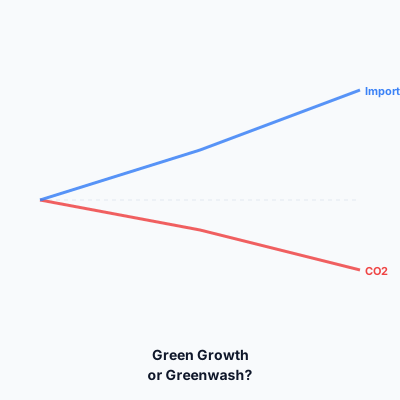
Europe's emissions fell 30%. Its manufactured imports rose 40%. Coincidence? We tested whether 'decoupling' is real or just offshored pollution.
The Manufacturing Exodus
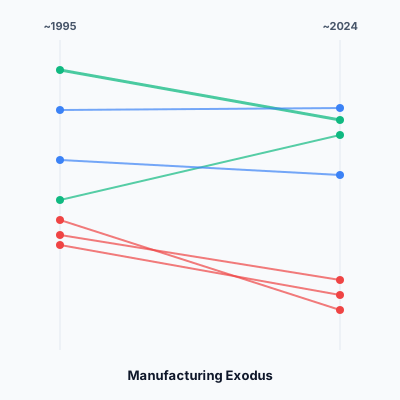
The rich world stopped making things — then wondered why it couldn't. We tracked manufacturing's 30-year migration from West to East, in GDP and trade data.
Related explainers
“China is dumping”: What dumping actually means (and what it doesn’t)
Low prices aren’t automatically dumping. Dumping is a legal test tied to price discrimination and injury.

Bilateral deficit with China: why it’s a terrible headline metric
Bilateral deficits ignore supply chains and value-added. Here’s why they mislead—and what to use instead.

Carbon leakage
When strict climate policy in one country just pushes emissions across the border.
Comparative advantage
Why trade can benefit both sides even when one side is ‘better at everything’—and why that doesn’t settle policy debates.
Food security: It's not about growing everything yourself
Why food security depends on trade routes as much as farmland — and what actually breaks it.
Subsidies
Not all subsidies are equal: explicit vs implicit, production vs consumption, and why they matter for trade fights.