Does Democracy Pay?
Democracies are richer — but did democracy make them rich? The relationship between governance and growth is more complicated than any slogan. We let the data speak.
Democracies Are Richer -- but Did Democracy Make Them Rich?
The median democracy has a GDP per capita of $10,578. The median autocracy: $9,435. The median anocracy -- those messy in-between regimes -- just $2,555. At first glance, the numbers seem to tell a clean story: more democracy, more prosperity. But spend five minutes with the actual data and that story falls apart.
Singapore, with a Polity2 score of -2 (classified as an anocracy), has a GDP per capita of $94,481 -- higher than Norway at $91,884 (a perfect +10 democracy). Qatar, a -10 autocracy, clocks in at $71,441. Meanwhile, India, the world's largest democracy at polity2 +9, sits at $2,818 per capita. Democracy did not make India rich. It has not made most democracies rich. Something else is going on.
The Scatter Plot That Defies Slogans
Plot every country's Polity2 score against its GDP per capita and the result is not the neat upward line that either side of the political debate would like.
The correlation between Polity2 score and GDP per capita is 0.227. That is barely above noise. Even using log-transformed GDP -- which compresses the enormous range from $400 to $94,000 -- the correlation only rises to 0.262. For context, a correlation of 0.26 means that regime type explains about 7% of the variation in national income. Ninety-three percent of the story lies elsewhere.
The scatter plot tells you several things at once. Yes, there is a weak upward trend -- democracies are somewhat richer on average. But the variance is enormous. The left side of the chart (autocracies) spans from some of the poorest countries on Earth to some of the richest. The right side (democracies) shows the same spread, just shifted slightly upward.
The countries that break the pattern are not outliers to be explained away. They are the story.
The Exceptions That Prove the Rule Is Wrong
Singapore is the elephant in every room where this debate happens. Under the People's Action Party, it transformed from a colonial trading post to the world's richest country per capita in two generations -- without multiparty democracy, without a free press, without meaningful political opposition. Its governance scores, as we will see, are among the highest on Earth. Singapore did not need democracy to build institutions. It built institutions without it.
China grew at an average of 8-10% per year for three decades under one-party rule, lifting 800 million people out of poverty -- the largest poverty reduction in human history. Its polity2 score of -7 (autocracy) has barely budged during this entire period. By conventional democratic theory, China should not exist. But it does, and its GDP per capita of $13,806 is rapidly closing the gap with many democracies.
The Gulf states -- Qatar ($71,441), the UAE ($51,348) -- are oil-rich autocracies, and it is fair to argue that their wealth is geological luck rather than governance success. But the UAE's economic diversification strategy has been far more successful than many resource-rich democracies (compare Nigeria's $1,728 per capita despite vast oil reserves). Resource wealth alone does not explain the gap.
Rwanda sits at polity2 -3 (anocracy) under Paul Kagame's increasingly authoritarian rule. Its GDP per capita is just $1,043. A comparison of Botswana and Zimbabwe offers another lens on how governance, not regime labels, shapes economic outcomes. But Rwanda's governance scores are unusually high for Sub-Saharan Africa, its growth rates have averaged over 7% for two decades, and its HDI has improved faster than almost any country in the region. Rwanda is the most uncomfortable data point in the entire debate -- a country where authoritarian governance is, by most institutional metrics, working.
But the Floor Matters
Here is what the simple regime comparison does show:
Autocracies have higher average GDP growth: 5.55% versus 3.46% for democracies. That sounds like a point for autocracies -- until you look at the volatility. The average standard deviation of GDP growth in autocracies is 5.46 percentage points, compared to 4.02 for democracies. Autocracies do not just grow faster on average. They swing harder.
This is the critical distinction. Autocracies can produce economic miracles -- China, Singapore, South Korea under Park Chung-hee, Chile under Pinochet. But they can also produce economic catastrophes: Venezuela (polity2 -3) went from the richest country in Latin America to hyperinflation and mass emigration. Zimbabwe (polity2 +4) destroyed its agricultural sector through land seizure and printed its currency into oblivion. Libya's post-Gaddafi collapse took GDP per capita from $12,000 to under $4,000 in three years.
Democracies rarely collapse this spectacularly. The institutional checks -- independent courts, free press, opposition parties, regular elections -- act as circuit breakers. A democratic government can make bad economic policy, but it is harder for one to sustain catastrophically bad policy for long. Voters punish failure. Courts block overreach. Media exposure forces correction. The floor is higher.
The data confirms this asymmetry. Among autocracies, the gap between the best performer and the worst is vast -- from Singapore's $94,481 to Turkmenistan's $8,602 to Eritrea's $455. Among democracies, the range is narrower at the bottom. Very few democracies are desperately poor, and the ones that are (like Malawi or Sierra Leone) tend to be recent democracies still building institutions.
What Actually Predicts Prosperity: Institutions, Not Regime Type
The most important finding in this data is not about democracy at all. It is about governance quality.
The World Bank's Worldwide Governance Indicators measure six dimensions of institutional quality: Voice and Accountability, Political Stability, Government Effectiveness, Regulatory Quality, Rule of Law, and Control of Corruption. These are measured independently of regime type -- an autocracy can score well on Rule of Law, and a democracy can score poorly on Control of Corruption.
The correlation between the WGI governance composite and log GDP per capita is 0.815. Compare that to the 0.262 correlation between polity2 and log GDP per capita. Institutional quality is a three-times-better predictor of national income than regime type.
The heatmap reveals the pattern. The top-ranked countries by governance quality are overwhelmingly democracies -- Finland, Denmark, Norway, Switzerland. But Singapore (an anocracy) sits comfortably in the top tier, scoring higher than most democracies on Government Effectiveness, Regulatory Quality, Rule of Law, and Control of Corruption. Its only weak dimension is Voice and Accountability -- the political freedom axis. The UAE (an autocracy) also cracks the top 30, with strong scores on Government Effectiveness and Regulatory Quality.
The implication is uncomfortable for democracy advocates: what matters for prosperity is not whether people vote, but whether the state can enforce contracts, regulate markets fairly, control corruption, and maintain stability. Democracies tend to develop these institutions over time, which is why the correlation between democracy and wealth exists. But the causal mechanism runs through institutions, not through elections.
Countries with strong institutions and weak democracy (Singapore) outperform countries with weak institutions and strong democracy (many countries in Sub-Saharan Africa and South Asia). The form of government matters less than the quality of government. You can explore Singapore's economic data to see what effective governance looks like in the numbers.
The Causation Puzzle
Even the modest correlation between democracy and wealth may run in the wrong direction. The "modernization hypothesis," first proposed by Seymour Martin Lipset in 1959, argues that economic development causes democratization -- not the other way around. As countries get richer, their middle classes grow, demand political participation, and eventually force democratic transitions.
South Korea is a textbook case. Its economic miracle happened under military dictatorship (polity2 around -8 in the 1970s). As the country industrialized and its middle class grew, political pressure built until the democratic transition of 1987. Korea did not get rich because it was democratic. It became democratic because it got rich.
The same pattern played out in Taiwan, Chile, and Spain. In each case, economic growth preceded democratic transition. The regime transitions in our data -- 50 cases where a country's polity score shifted by 5 or more points -- show no consistent pattern. Some countries grew faster after democratizing. Others grew slower. The average tells you almost nothing because each transition occurs in unique circumstances.
This does not mean democracy is irrelevant to growth. It means the relationship is not a simple input-output function. Democracy may protect growth by preventing catastrophic policy errors. It may sustain growth by building durable institutions. It may even enable growth by providing legitimate channels for resolving social conflict. But it does not automatically generate growth, and the data proves it.
What the Data Actually Says
Across 160 countries with polity scores, WGI indicators, and economic data, the evidence supports three conclusions:
First, institutional quality predicts prosperity far better than regime type. The correlation between governance composite and income (0.815) dwarfs the correlation between democracy and income (0.262). Countries that want to grow should focus on building effective, transparent, rule-bound institutions -- whether or not they are democracies.
Second, democracies provide a higher floor. They grow slightly slower on average but with less volatility. The risk of economic catastrophe -- the Venezuela scenario, the Zimbabwe scenario -- is significantly lower under democratic governance. For citizens who care about avoiding worst-case outcomes, democracy is an insurance policy.
Third, the causation likely runs both ways, but development precedes democracy more often than the reverse. Rich countries tend to become democratic. Democratic countries tend to stay rich. But poor countries that adopt democracy do not automatically get richer. The mechanism is institutions, and institutions take decades to build regardless of the political system.
The honest answer to "does democracy pay?" is: not directly. What pays is competent, transparent, accountable governance -- the kind that enforces property rights, honors contracts, controls corruption, and invests in public goods. Democracies are better at sustaining this kind of governance over the long run. But they are not the only path to it, and they are not a shortcut.
Methodology
This analysis merges data from four sources: the Polity5 dataset (Center for Systemic Peace) for regime classification, the World Bank's Worldwide Governance Indicators for institutional quality, IMF World Economic Outlook for GDP and growth, and the UNDP Human Development Index. We use the latest available observation per country (polity data through 2020, WGI through 2023, economic data through 2024-25). The sample includes 160 countries with complete data across sources.
Regime classification follows the standard Polity2 thresholds:
regime = "Autocracy"  if polity2 <= -6
       = "Anocracy"   if -5 <= polity2 <= 5
       = "Democracy"  if polity2 >= 6
GDP growth volatility is the standard deviation of annual real GDP growth rates over 2000-2024:
growth_std(country) = stdev( gdp_growth[y] for y in 2000..2024 )
Countries with fewer than 5 observed years are dropped from the volatility calculation.
WGI governance composite is the unweighted mean of the six WGI "Estimate" indicators (each on a -2.5 to +2.5 scale):
wgi_composite = mean(Voice&Accountability, PoliticalStability,
                     GovtEffectiveness, RegulatoryQuality,
                     RuleOfLaw, ControlOfCorruption)
Correlations are Pearson coefficients. GDP-vs-X correlations use log(gdp_pc + 1) to account for the highly skewed income distribution:
corr_polity_log_gdp = pearson( polity2, log(gdp_pc + 1) )
corr_wgi_log_gdp    = pearson( wgi_composite, log(gdp_pc + 1) )
Regime transitions are defined as year-over-year Polity2 shifts of |Δ| ≥ 5, with before/after growth computed as the mean annual real GDP growth in the 5 years preceding and following the transition year.
Raw data inputs
- Polity2 Combined Score — Center for Systemic Peace (polity_scores)
- Voice and Accountability — Estimate — World Bank WGI
- Political Stability and Absence of Violence — Estimate — World Bank WGI
- Government Effectiveness — Estimate — World Bank WGI
- Regulatory Quality — Estimate — World Bank WGI
- Rule of Law — Estimate — World Bank WGI
- Control of Corruption — Estimate — World Bank WGI
- GDP per capita, current prices (US$) — IMF World Economic Outlook
- GDP per capita, PPP (international $) — IMF World Economic Outlook
- GDP, constant prices (% change) — IMF World Economic Outlook
- Human Development Index — UNDP Human Development Report
- Foreign direct investment, net inflows (% of GDP) — World Bank WDI
Related research

Climate Vulnerability vs Emissions
Chad emits less CO2 in a year than a US state does in a day. Chad is also one of the most climate-vulnerable countries on Earth. The injustice is measurable.
Corruption Tax
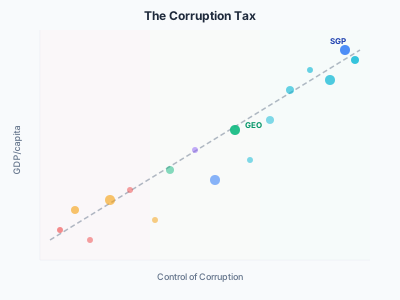
Corruption isn't a moral issue — it's a tax, and we can estimate the rate. Countries with worse governance attract less investment, grow slower, and develop less. The data quantifies the cost.
Who Funds Their Own Defense
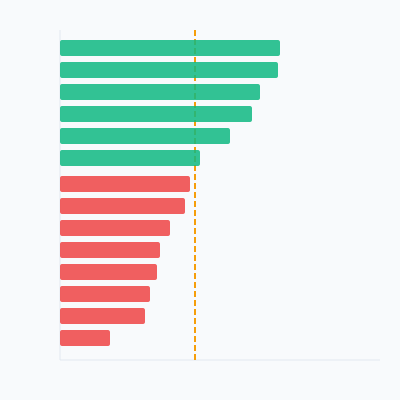
Who's actually paying for Western security? We mapped NATO defense spending against the 2% target. The free-riding is measurable — and the dollar gap is enormous.
Education Spending vs Innovation Output
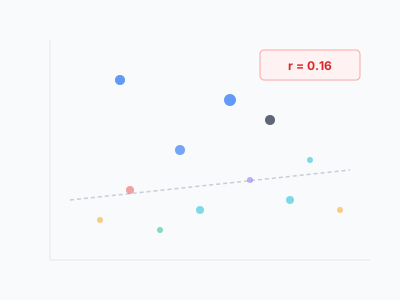
Some countries spend billions on education and produce no patents. Others spend less and lead the world in innovation. The missing ingredient isn't money — it's R&D.

Guns vs Butter in Numbers
Every dollar spent on tanks is a dollar not spent on teachers. We mapped military, education, and health spending for every country — the priorities are stark.
Pandemic Preparedness vs GDP
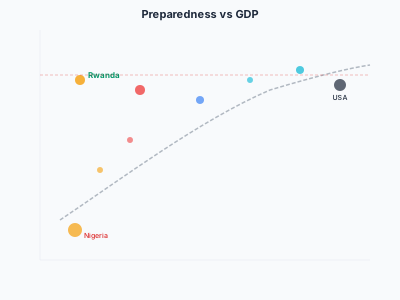
Rich countries assumed they were ready for a pandemic. They weren't. We mapped health infrastructure against income — the overperformers are poor countries with good systems.
Related explainers

Dutch disease
How a resource windfall can hollow out the rest of your economy — and why the real disease is mismanagement.
Economic sanctions: what they are, what they aren’t, and how they leak
Sanctions are financial plumbing and export controls—not magic. They bite through chokepoints and leak via detours.

Governance indicators
What the World Bank's Worldwide Governance Indicators actually measure — and why you should trust the trends more than the rankings.
Industrial policy
The spectrum of policies used to shape what an economy produces—and why the design matters more than the ideology.