The Demographic Dividend vs Demographic Bomb
Half the world is getting old. The other half has millions of young people with no jobs. The demographic dividend is real — but only if you convert it.
Half the World Is Getting Old. The Other Half Has Millions of Young People With No Jobs.
South Korea in 1960 had a median age of 18.3 years, a fertility rate of 6.0 children per woman, and a GDP per capita roughly on par with Ghana's. Today its median age is 45.6, its fertility rate is 0.73 -- the lowest on Earth -- and its GDP per capita is $55,071. In sixty years, a desperately poor country with too many children became a global tech powerhouse with too few.
Nigeria in 1960 had a median age of 18.3 years, a fertility rate of 6.4, and an economy built on subsistence agriculture. Today its median age is 18.1, its fertility rate is 4.4, and its GDP per capita is $7,994. In sixty years, the demographic profile barely changed. Nigeria added 200 million people. It did not add 200 million jobs.
These two trajectories -- one a triumph, the other a warning -- define the central question of 21st-century development: What happens when a country gets a surge of working-age people? Does it get richer, or does it explode?
The Dependency Ratio: One Number That Explains Everything
Every country follows a demographic arc. Birth rates fall after a development surge. Death rates fall first, then birth rates follow. In between, the working-age population (15-64) swells relative to the young and old who depend on it. Demographers measure this with the dependency ratio: the number of dependents (under 15 plus over 65) per 100 working-age adults.
When this ratio drops, a country enters the demographic dividend window. Fewer children to feed means families can save more. A larger workforce means more output per capita. Tax revenues rise while school-age spending plateaus. If -- and this is the critical "if" -- the country invests in education, creates jobs, and builds productive capacity, this window can supercharge growth for two to three decades.
The chart above tells the whole story. Each line traces a country's dependency ratio from 1960 to 2060. The shaded green band marks the "sweet spot" -- dependency ratios between 40 and 50, where the economic tailwind is strongest. Everything after the 2024 line is a projection from the UN Population Division.
Look at the divergence. South Korea rode an extraordinary arc: its dependency ratio plunged from 87.7 in 1966 to a rock-bottom 36.5 in 2015 -- one of the steepest drops ever recorded. During those five decades, Korea built Samsung, Hyundai, POSCO, and the world's fastest internet infrastructure. The demographic dividend did not cause that growth, but it created the conditions that made it possible.
Now look at Japan. Its ratio bottomed at 43.2 in 1990 -- the peak of the bubble economy -- and has climbed relentlessly since. At 70.1 today, Japan has more dependents per worker than Nigeria. But Japan's dependents are elderly retirees drawing pensions, not children needing schools. That distinction changes everything about fiscal sustainability.
And then Nigeria: a dependency ratio of 78.8 in 2024, barely changed from 80.1 in 1960. The dividend window has not opened because fertility has not dropped fast enough. Nigeria's median age is 18.1. Half the population is younger than 18. This is either the greatest economic opportunity in Africa or its greatest liability, and the data so far points toward the latter.
The Converters: South Korea, China, and Thailand
South Korea is the textbook case. In the 1960s, President Park Chung-hee launched aggressive industrialization alongside family planning campaigns that cut the fertility rate from 6.0 to 2.7 in just twenty years. As fewer children entered schools, per-student spending increased. As more workers entered factories, exports surged. Korea's dependency ratio fell below 50 by the mid-1980s, precisely when the chaebol conglomerates were scaling globally.
The numbers are stark. Korea's dependency ratio bottomed at 36.5 in 2015 -- meaning just 36 dependents per 100 workers. No major country has ever had a more favorable ratio. By that point, Korea was already rich. GDP per capita had gone from under $1,000 in 1960 to over $40,000. The dividend was not free money. It was a window of opportunity that Korea filled with export-oriented industrialization, universal education, and massive infrastructure investment.
The price is now coming due. Korea's fertility rate of 0.73 is civilizationally low. Its median age will hit 53.3 by 2040 and 56.7 by 2050. The dependency ratio is climbing again -- but now from the elderly side. Korea is racing to automate before its workforce shrinks. Explore South Korea's economic data to see the fiscal pressures building in real time. Whether it succeeds will determine if the 21st century is as kind to it as the 20th.
China engineered the fastest demographic transition in human history. The one-child policy, implemented in 1980, slashed the dependency ratio from 68.0 to 37.2 by 2010 -- creating the largest single surge of productive workers the world has ever seen. Between 2000 and 2020, China added roughly 100 million working-age adults while the dependency ratio sat near its floor. That workforce built the manufacturing infrastructure that made China the world's factory.
But the one-child policy also planted a time bomb. China's fertility rate has collapsed to 1.01 -- even lower than Korea's peak rate. Its median age, already 39.6, will reach 48.6 by 2040 and 52.1 by 2050. China will grow old before it grows rich enough to afford it. Japan had a GDP per capita of $40,000 when its aging crisis began. China's is $23,846. The arithmetic is unforgiving: fewer workers supporting more retirees with fewer savings per capita.
Thailand followed a similar arc, though less celebrated. Its dependency ratio dropped from 89.8 in 1966 to 43.1 today, while GDP per capita rose from under $1,000 to $21,741. Thailand's fertility rate of 1.15 means it faces the same aging cliff as Korea and China, but with a much lower GDP per capita to cushion the fall. Thailand will test whether a middle-income country can manage an aging population -- a challenge no country has yet solved.
The Missed Opportunities: MENA and Sub-Saharan Africa
The demographic dividend requires more than falling fertility. It requires an economy that can absorb a growing workforce. Without jobs, a youth bulge is not an asset -- it is a powder keg.
Egypt has a dependency ratio of 59.0 and a median age of 24.5. It is squarely in the early dividend window. But youth unemployment stands at 17.3%, and GDP growth, while respectable at 4.5% on average, has been consumed by population growth rather than per-capita gains. Egypt adds roughly 2 million people per year to a labor market that cannot absorb them. The result: a restless, educated-but-unemployed young population that toppled a government in 2011 and has been suppressed since.
Iraq is the sharpest example of a wasted dividend. Its dependency ratio of 66.7 and median age of 20.8 suggest a country on the cusp of the window. But youth unemployment is a catastrophic 31.7%. Nearly one in three young Iraqis has no job. Decades of war, sanctions, and corruption have destroyed the productive capacity that a demographic transition requires. Iraq has young people. It does not have an economy.
The broader Middle East and North Africa pattern is similar. Tunisia (youth unemployment 38.9%), Algeria (29.9%), and Iran (21.3%) all have favorable demographics on paper but labor markets that cannot match them. The Arab Spring was, among other things, a demographic phenomenon -- millions of educated young people confronting closed economies, corrupt patronage networks, and zero social mobility. The youth bulge did not cause the revolutions, but it provided the fuel.
South Africa may be the most tragic case in the data. A dependency ratio of 48.3 and median age of 28.7 put it in the prime dividend window. But youth unemployment is an almost incomprehensible 60.2% -- the highest of any major economy. Six out of ten South Africans aged 15-24 have no work. The demographic dividend is not merely being wasted; it is actively generating social crisis. Post-apartheid South Africa inherited massive structural unemployment, and three decades of policy have failed to dent it.
The scatter plot above makes the divide visible. On the horizontal axis: how much the working-age share of the population changed over twenty years. On the vertical: average GDP growth. Countries in the upper-right quadrant -- India, Vietnam, Bangladesh, Ethiopia -- converted a growing workforce into strong growth. Countries in the lower-right or with red markers had the demographic tailwind but failed to translate it into sustained economic expansion.
The Aging Cliff: Japan, Italy, and Germany
If the demographic dividend is a tailwind, aging is a headwind -- and it is blowing hard.
Japan is the world's oldest large country, with a median age of 49.8 and a dependency ratio of 70.1. Its working-age population has been shrinking since 1995. The effects are everywhere: a national debt exceeding 260% of GDP (financed largely by domestic savers who are now spending down their retirement funds), chronic labor shortages, and GDP growth that has averaged just 0.9% over the past decade. Japan's experience is the clearest preview of what awaits China, Korea, and eventually every country on the aging trajectory.
Italy (median age 48.2, youth unemployment 20.2%) combines aging demographics with Southern European labor market rigidity. Its economy has barely grown in two decades. Germany (median age 45.5) has managed better through immigration and manufacturing exports, but even German growth has slowed to 1.0% as its workforce contracts.
By 2040, Japan's median age will reach 53.1. Korea's will hit 53.3. Italy's will be 52.0 and Germany's 48.1. China, today still thought of as a "young" economy by many investors, will have a median age of 48.6 -- older than Germany today. The global implications are enormous: the countries that drove growth in the late 20th and early 21st century are all aging simultaneously, with no historical precedent for the fiscal pressures this will create.
Who Is Wasting Their Youth?
Youth unemployment is the clearest signal of a wasted demographic dividend. A country with a bulging young population and no jobs is not just failing economically -- it is building social instability.
The bar chart above ranks non-aging countries by youth unemployment. South Africa, Tunisia, Algeria, Iraq, and Iran all have rates above 20%. These are countries where the demographic window is open, the young population is large, and the economy is failing to absorb them.
At the other end, countries like Vietnam (6.3%), Thailand (4.7%), and Mexico (5.8%) have managed to keep youth employment relatively high. The difference is not demographics -- it is policy. Vietnam invested in manufacturing and export zones. Thailand built a tourism and automotive sector. Mexico benefited from nearshoring and proximity to the US market.
The lesson from the data is uncomfortable: demographics are not destiny. The dividend is real, but it is conditional. A growing working-age population creates the possibility of faster growth. Converting that possibility into reality requires functional institutions, job-creating industries, human capital investment, and political stability. Without those, the dividend curdles into frustration, emigration, or unrest.
The Projection: What Happens by 2040
The UN Population Division's projections extend to 2100. Here is what the next fifteen years hold:
India (current median age 28.8, projected 2040: 34.7) is entering the heart of its dividend window with 1.4 billion people. You can explore India's full economic profile to track how the dividend is unfolding in the data. Its dependency ratio of 46.6 is already in the sweet spot. If India can create 10-12 million jobs per year -- a monumental challenge -- it could replicate the East Asian miracle at an even larger scale. If it cannot, it will have a billion working-age people with inadequate employment, and the social consequences will be proportional.
Nigeria (current median age 18.1, projected 2040: 21.7) will not reach the dividend window for at least another decade. Nigeria's economic indicators show the scale of the challenge ahead. Its fertility rate of 4.4, while falling, remains far above replacement. By 2050, Nigeria will have more people than the United States. Whether those people will have jobs, education, and opportunity -- or whether they will have grievances, poverty, and reasons to migrate -- is the single most consequential demographic question in Africa.
China will cross a threshold that no large country has faced: a median age above 48 with a GDP per capita below $25,000. Japan crossed that median-age line at roughly double China's income level. China's social safety net is thinner, its pension system less funded, and its rural-urban divide larger. The next fifteen years will determine whether China's economic model can survive demographic headwinds that sank Japan's growth.
South Korea will become the oldest society on Earth. By 2040, its median age of 53.3 will exceed Japan's 53.1. Korea is investing aggressively in robotics and AI, betting that automation can substitute for missing workers. It is a bet without precedent -- no society has ever tried to automate its way out of a demographic implosion.
Methodology
Dependency ratio
The dependency ratio is plotted directly as reported by the World Bank (SP.POP.DPND). The underlying definition is:
dependency_ratio = (pop_0_14 + pop_65plus) / pop_15_64 * 100
A ratio of 50 means 50 dependents per 100 working-age adults. The "dividend window" is the period during which this ratio is falling and below roughly 55, where the economic tailwind from a favorable age structure is strongest.
Working-age share change (scatter x-axis)
wa_change = working_share(latest_year) - working_share(latest_year - 20)
where working_share is the percent of the population aged 15-64.
Average GDP growth (scatter y-axis)
gdp_growth_avg = mean(real_gdp_growth[last 20 years])
Phase classification
Each country is bucketed into pre-dividend, early-dividend, dividend-window, late-dividend, post-dividend, or aging based on the current level of the dependency ratio, whether it is rising or falling over the most recent 5 years, and median age thresholds. "Converter" vs "waster" labels combine phase with observed GDP growth and youth unemployment plus known historical context.
Raw data inputs
- Age dependency ratio (% of working-age population) — World Bank WDI
- Age dependency ratio, old — World Bank WDI
- Age dependency ratio, young — World Bank WDI
- Population ages 0-14 (% of total) — World Bank WDI
- Population ages 15-64 (% of total) — World Bank WDI
- Population ages 65+ (% of total) — World Bank WDI
- Unemployment, youth total (% of labor force ages 15-24) — World Bank WDI (ILO modeled)
- GDP per capita, PPP (constant 2021 international $) — World Bank WDI
- GDP, constant prices (% change) — IMF WEO
- Median Age — UN DESA World Population Prospects
- Total Fertility Rate — UN DESA World Population Prospects
- Population Growth Rate — UN DESA World Population Prospects
- Life Expectancy at Birth — UN DESA World Population Prospects
Projections beyond 2024 are from the UN DESA medium-variant scenario, which assumes fertility rates converge toward replacement over the long term. Actual outcomes will depend on policy choices, migration patterns, and economic shocks that demographic models cannot predict.
Related research
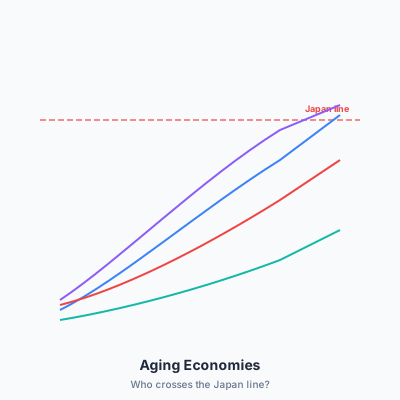
Aging Economies
Japan is the future — and most countries aren't ready. Population aging will break budgets, shrink workforces, and reshape economies. The timeline is visible in the data.
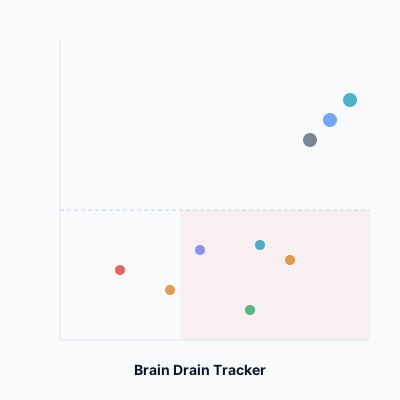
Brain Drain Tracker
Nigeria trains doctors. Britain employs them. We tracked the global brain drain — who loses talent, who gains it, and whether remittances make up the difference.
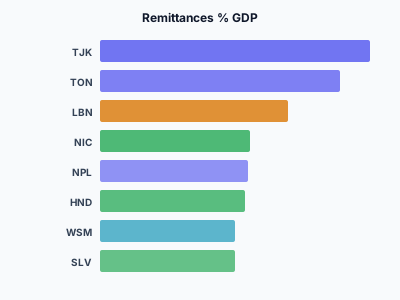
Migration & Remittances
The world's largest poverty reduction program isn't run by any government — it's run by migrants sending money home. Remittances now dwarf foreign aid for most developing countries.
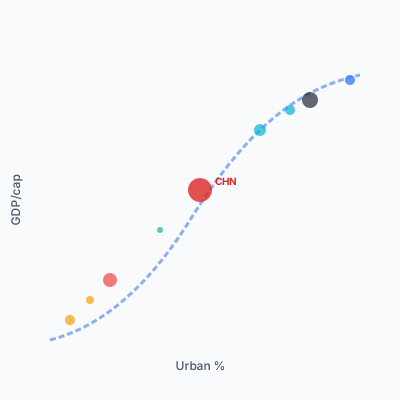
Urbanization vs Productivity
Cities make countries rich — until they don't. We mapped the urbanization-productivity curve for every country. The S-curve is clear, and so are the outliers.
Carbon Cost of Growth
Can a country get richer without cooking the planet? Some have. Most haven't. We tracked GDP growth against CO2 emissions for 30 years — the decoupling story is real, but incomplete.

Carbon Inequality
The countries drowning in rising seas didn't cause the flood. We mapped who emitted what, when — and the per-capita gap is staggering.
Related explainers

Demographic transition
The four-stage model that explains why populations explode, stabilize, and then shrink — and why most of global economics follows from it.

Dependency ratio
The ratio that tells you how many workers are carrying how many non-workers — and why it's the ticking clock behind every pension crisis.