The Energy-Prosperity Ladder
There is a clear energy consumption threshold countries must cross for human development. Below ~4,000 kWh per capita, every additional kilowatt-hour transforms lives. Above 10,000, you're just heating empty rooms.
How Much Electricity Does a Country Need to Thrive?
The answer is surprisingly precise. Plot every country's electricity consumption against its Human Development Index and a pattern emerges that is hard to argue with: there is a ladder, and the rungs are measured in kilowatt-hours. Below a certain threshold, people live shorter lives, receive less education, and earn less money. Cross that threshold, and the curve flattens. More power stops buying more prosperity.
This is the story of that ladder, told through 146 countries and two decades of data.
The Scatter That Tells a Story
The chart below plots every country for which we have both electricity consumption data (World Bank WDI) and Human Development Index scores (UNDP Human Development Reports). Each bubble is a country. Size reflects population. Color reflects region.
The x-axis is logarithmic, which matters. The relationship between electricity and human development is not linear -- it is logarithmic. The correlation between log-transformed electricity consumption and HDI across 146 countries is 0.93. That is not a soft suggestion. That is one of the tightest cross-country relationships in development economics.
The fitted curve tells you everything: steep on the left, flat on the right. Going from 100 to 1,000 kWh per capita buys you a massive jump in HDI. Going from 10,000 to 20,000 buys you almost nothing.
The Threshold
Our data puts the inflection point -- the kWh level where HDI reaches 0.8, the conventional "high human development" boundary -- at roughly 2,600 kWh per capita. Countries below this line are fighting for basics: child survival, secondary education, a life expectancy past 70.
Consider the contrast. Ethiopia consumes 92 kWh per capita -- about enough to run a single refrigerator. Its HDI is 0.494. Bangladesh at 603 kWh sits at 0.68. Viet Nam at 2,624 kWh crosses the threshold with an HDI of 0.764. And Costa Rica at 2,206 kWh reaches 0.833.
That progression is not coincidental. Electricity enables refrigeration (food safety, vaccine storage), lighting (longer productive hours, education), pumping (clean water, irrigation), and communications (information access, markets). Each of these translates directly into the components of HDI: health, education, and income.
But the story changes sharply above the threshold. The United States at 12,551 kWh per capita has an HDI of 0.938. Germany achieves 0.959 with less than half that -- 5,947 kWh. Japan reaches 0.925 on 7,655 kWh. The extra electricity Americans consume over Germans does not make them healthier, better educated, or richer per capita. It does, however, power larger homes, more air conditioning, and more energy-intensive consumption patterns.
The Outliers
Every strong correlation has outliers, and the outliers here tell stories worth listening to.
The overachievers: Sri Lanka stands out. At just 684 kWh per capita -- less electricity than a single American household -- it achieves an HDI of 0.777. That is nearly "high development" territory on a fraction of the energy. The reason is a mix of strong public health and education systems inherited from decades of social investment, even through civil conflict. Cuba tells a similar story: 1,102 kWh and an HDI of 0.764, driven by universal healthcare and education despite severe economic constraints.
The underperformers: South Africa consumes 3,247 kWh per capita -- well above the threshold -- but its HDI is only 0.741, dragged down by extreme inequality, the lingering impact of HIV/AIDS, and an education system that serves a minority well and the majority poorly. The electricity is there. The human development is not evenly distributed.
The overconsumers: Iceland at 50,951 kWh per capita is the extreme case. Its HDI of 0.972 is among the world's highest, but most of that electricity goes to aluminum smelting, not to making Icelanders live longer. Qatar at 19,381 kWh and an HDI of 0.883, Kuwait at 16,571 kWh and 0.845 -- these are countries where cheap fossil energy drives consumption far beyond what development requires. Bahrain uses 22,689 kWh per capita and achieves lower HDI than Denmark at 5,878 kWh.
The efficiency chart above makes this vivid. The countries that extract the most human development per unit of electricity are overwhelmingly in the developing world -- not because they are efficient by design, but because they are on the steep part of the curve where every kilowatt-hour counts. The countries at the bottom -- the Gulf states, Iceland, North America -- have long since left the territory where more energy means more development.
The Regional Story
Zoom out from individual countries and the regional pattern is stark.
Sub-Saharan Africa is at the bottom of the ladder. The median country in the region consumes around 280 kWh per capita. That is not a rounding error -- it is a crisis. You can explore the full economic contrast between Nigeria and Norway -- the gap is staggering. At that level, most people have intermittent access to electricity at best. Hospitals run on generators. Schools close when the sun sets. The entire development conversation in Sub-Saharan Africa begins with energy access.
South Asia is slightly ahead, with a median around 640 kWh, but still well below the threshold. India at 1,182 kWh is the giant here, home to 1.4 billion people climbing the steep part of the curve. Every new solar installation, every rural electrification project, every grid extension in India buys outsized human development returns.
Latin America and the Caribbean sits around the threshold zone, with a median of 1,717 kWh. This is the region with the widest internal spread in efficiency -- Costa Rica and Cuba achieve remarkable development on modest electricity, while others lag despite higher consumption.
Europe and Central Asia and East Asia and the Pacific have both largely crossed the threshold, with medians around 4,700-5,000 kWh. The interesting question for these regions is not "how to get more electricity" but "how to maintain development while reducing consumption" -- the climate question.
North America stands alone at the top, with a median of 13,506 kWh. This is not something to celebrate. It reflects a built environment designed around cheap energy: suburban sprawl, universal air conditioning, limited public transit. The United States and Canada achieve excellent but not exceptional human development at enormous energy cost.
What This Means
The policy implications of the energy-prosperity ladder are blunt.
For the poorest countries, energy access is not a luxury -- it is the single most leveraged development investment available. The steep part of the curve means that relatively modest increases in electricity supply translate into dramatic improvements in human life. A country going from 100 to 500 kWh per capita is buying years of life expectancy, points of literacy, and dollars of income. This is not abstract. It is the difference between a clinic with or without refrigerated vaccines, a school that can or cannot operate after dark, a farmer who can or cannot pump water.
For middle-income countries on the threshold, the challenge is distribution, not volume. South Africa has enough aggregate electricity to achieve high development. It does not, because access and quality are profoundly unequal. The same applies in many countries where national averages mask enormous within-country disparities.
For wealthy countries, more electricity does not buy more development. The flat part of the curve is clear. The marginal HDI return on the next kilowatt-hour in the United States is effectively zero. This does not mean wealthy countries should cut consumption recklessly -- but it means that efficiency improvements and energy transitions in rich countries carry no development cost. You can cut energy consumption substantially and still live just as long, learn just as much, and earn just as well. Denmark proves it. Japan proves it. Most of Europe proves it -- compare the numbers for Germany and the US side by side and the efficiency gap is hard to ignore.
The energy-prosperity ladder is not a theory. It is a pattern visible across 146 countries, robust across two decades of data, and driven by a correlation of 0.93. The ladder is real. The question is whether we take it seriously enough to help the 2 billion people still stuck on the lowest rungs.
Methodology
Data sources: Electricity consumption per capita from the World Bank World Development Indicators (series EG.USE.ELEC.KH.PC), sourced from the World Bank Open Data platform. Human Development Index from the UNDP Human Development Reports, published by the UN Development Programme. Population from UN DESA World Population Prospects. GDP per capita (PPP, constant 2021 international dollars) from WB WDI.
Time period: 2000-2023. For each country, we use the most recent year for which both electricity consumption and HDI data are available.
Sample: 146 countries after excluding aggregates (regions, income groups) and countries missing either electricity or HDI data.
Curve fitting: We fit a logarithmic model HDI = a × ln(kWh_per_capita) + b across all 146 countries, yielding a = 0.090, b = 0.088, with R² = 0.86. This is the curve drawn through the scatter plot.
Efficiency metric: For the "development efficiency" bar chart, we compute efficiency = HDI / (kWh_per_capita / 1000) — that is, HDI points achieved per 1,000 kWh of annual electricity consumption per person. This is a derived metric, not data from any single source. It rewards countries that extract high human development from modest electricity (typically those still on the steep part of the curve).
Limitations: Electricity consumption per capita is a national average that masks within-country inequality -- a country's HDI underperformance may reflect distributional failure rather than energy insufficiency. The World Bank discontinued the electricity consumption series for many countries after 2014-2015, so some countries' "latest" data may be several years old. HDI itself is a composite index with known limitations, particularly in capturing inequality (the Inequality-adjusted HDI would tell a different story for some countries).
Related research
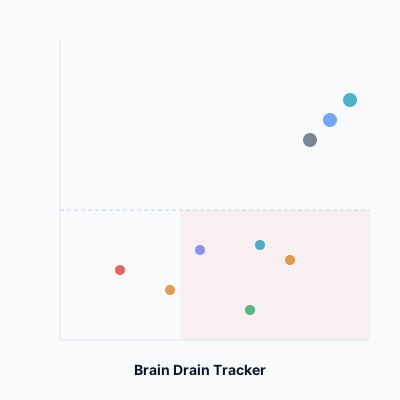
Brain Drain Tracker
Nigeria trains doctors. Britain employs them. We tracked the global brain drain — who loses talent, who gains it, and whether remittances make up the difference.
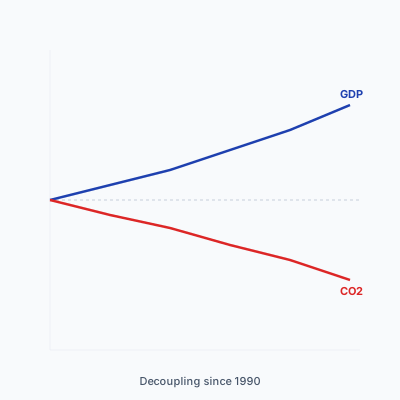
Carbon Cost of Growth
Can a country get richer without cooking the planet? Some have. Most haven't. We tracked GDP growth against CO2 emissions for 30 years — the decoupling story is real, but incomplete.
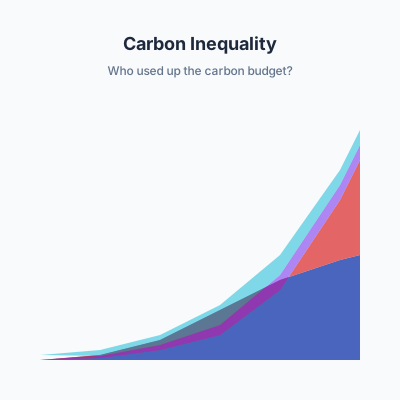
Carbon Inequality
The countries drowning in rising seas didn't cause the flood. We mapped who emitted what, when — and the per-capita gap is staggering.
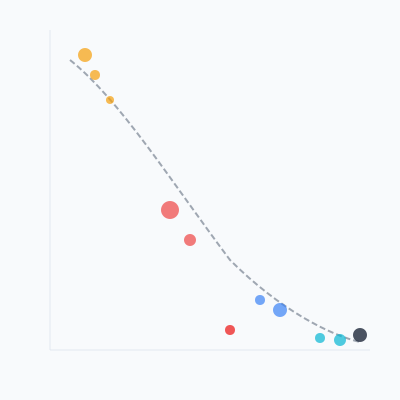
Child Survival & National Income
If you could know only one number about a country, it should be under-5 mortality. It captures income, health, education, water, and women's empowerment in a single statistic.
Climate Vulnerability vs Emissions
Chad emits less CO2 in a year than a US state does in a day. Chad is also one of the most climate-vulnerable countries on Earth. The injustice is measurable.
Education Spending vs Innovation Output
Some countries spend billions on education and produce no patents. Others spend less and lead the world in innovation. The missing ingredient isn't money — it's R&D.
Related explainers
Capacity factor
Why a country with 10 GW of solar capacity doesn't actually get 10 GW of electricity.

Carbon leakage
When strict climate policy in one country just pushes emissions across the border.
Consumption vs territorial emissions
The accounting trick that lets rich countries claim they're decarbonizing while importing carbon-heavy goods.

Demographic transition
The four-stage model that explains why populations explode, stabilize, and then shrink — and why most of global economics follows from it.
Dutch disease
How a resource windfall can hollow out the rest of your economy — and why the real disease is mismanagement.
Energy intensity
How much energy it takes to produce a dollar of GDP — and why the trend can mislead you.