Agricultural Trade & Food Prices
The Arab Spring wasn't about politics. It started with the price of bread. We traced how global commodity spikes ripple into food crises — and who gets hit first.
The Arab Spring Wasn't About Politics. It Started With the Price of Bread.
On December 17, 2010, a Tunisian street vendor named Mohamed Bouazizi set himself on fire. That act is remembered as the spark of the Arab Spring -- the wave of uprisings that toppled governments across North Africa and the Middle East. But Bouazizi did not immolate himself over abstract political grievances. He was a fruit seller in a poor town who could no longer make a living, in a country where the price of bread had become unbearable.
The global food price index had risen 40% in six months. Wheat prices had doubled from their 2009 lows. Cooking oil was up 60%. For countries that import most of their food -- and the Middle East imports more than almost any region on earth -- these were not abstract numbers. They were the difference between eating and not eating.
This is not a one-off story. It has happened three times in fifteen years, with escalating severity. In 2008, food prices spiked and riots erupted across 30 countries. In 2011, the spike helped destabilize the entire MENA region. In 2022, Russia's invasion of Ukraine blocked wheat exports from the Black Sea and sent food prices to their highest levels ever recorded. The transmission mechanism is always the same: global commodity markets spike, import bills surge, fiscal budgets crack, subsidies get cut, and people take to the streets.
We traced the path of food commodity prices from international markets to domestic crises using World Bank Pink Sheet commodity data, UN Comtrade food import flows, and IMF inflation figures. The pattern is not subtle.
The Spike Pattern
The chart below tracks six key food commodities from 2000 to the present. The shaded areas mark the three crisis episodes. The pattern is unmistakable: prices build gradually over months or years, then spike sharply, then crash. Each spike leaves wreckage.
2007-2008: The first global food crisis. Wheat surged from $200/mt in early 2007 to over $440 by March 2008. Rice -- the staple for 3.5 billion people -- nearly tripled, jumping from $330 to over $900. The causes were a perfect storm: drought in Australia, rising biofuel mandates diverting corn from food to ethanol, export bans by India, Vietnam, and Argentina, and speculative flows into commodity futures. The consequences were immediate. The World Bank estimated 130-155 million people were pushed into extreme poverty. Food riots erupted in Haiti, Egypt, Cameroon, Ivory Coast, Mauritania, Mozambique, Senegal, Uzbekistan, Yemen, Bangladesh, and Bolivia. In Haiti, the prime minister was ousted. In Egypt, the army was deployed to bake bread in military bakeries.
2010-2011: The Arab Spring. Prices spiked again, driven by the 2010 Russian drought and heatwave that destroyed a quarter of Russia's wheat crop, followed by a Russian export ban. Wheat climbed back above $330/mt. The timing was devastating. North Africa and the Middle East -- the most wheat-import-dependent region on earth -- absorbed the shock directly. The New England Complex Systems Institute later demonstrated a direct statistical relationship between the FAO food price index and the timing of food riots: when the index crosses a threshold, unrest becomes predictable. In 2011, it crossed that threshold.
2021-2022: The Ukraine shock. Russia and Ukraine together account for roughly 30% of global wheat exports and 20% of maize exports. The February 2022 invasion effectively shut down Black Sea shipping routes. Wheat hit $510/mt by May 2022 -- an all-time high in nominal terms. Simultaneously, fertilizer prices tripled as Russia (the world's largest fertilizer exporter) faced sanctions. The consequences cascaded: Egypt, the world's largest wheat importer, sourced 60-80% of its wheat from Russia and Ukraine. Lebanon, already in financial collapse since 2019, saw bread prices triple. Yemen, in the midst of civil war, lost access to affordable grain. The Horn of Africa -- Somalia, Djibouti, Ethiopia -- faced simultaneous drought and import disruption, pushing millions toward famine.
The Transmission Mechanism
The path from a global commodity spike to a domestic crisis follows a predictable sequence. Understanding it explains why the same countries break every time.
Step 1: Commodity markets move. Global wheat, rice, or maize prices spike on supply disruptions, export bans, or speculation. This happens in Chicago, Kansas City, and Rotterdam commodity exchanges -- far from the countries that will feel the impact.
Step 2: Import bills surge. Countries that import most of their food -- Egypt buying 12 million tonnes of wheat per year, Bangladesh buying 6 million tonnes of rice -- see their import bills jump 30-50% in a matter of months. For countries already running current account deficits, this is fiscal poison.
Step 3: Fiscal pressure mounts. Many food-dependent countries maintain bread and fuel subsidies. Egypt's bread subsidy feeds 70 million people. When wheat prices double, the subsidy budget explodes. Governments face an impossible choice: borrow more, print money, or cut subsidies.
Step 4: Subsidies crack. Eventually, subsidies get reduced or removed. In 2008, Egypt raised bread prices for the first time in decades. In 2022, Sri Lanka ran out of foreign exchange to pay for food and fuel imports. When the subsidy floor drops, the full price shock hits household budgets overnight.
Step 5: Social instability. People who spend 40-60% of their income on food -- the norm in low-income countries -- cannot absorb a 50% price increase. The margin between eating and not eating is thin. When it breaks, protests follow. Sometimes revolutions.
This sequence takes 6-18 months from commodity spike to street protest. It is not a theory. It has played out three times in the data.
Who Gets Hit: Price Pass-Through
The scatter plot below shows how global food price spikes translate into domestic inflation across food-dependent countries. Each dot represents one country in one crisis year. The horizontal axis shows the percentage increase in the global food price index from two years prior. The vertical axis shows that country's domestic consumer price inflation.
The pattern is revealing. During the 2022 Ukraine crisis (purple dots), countries like Lebanon, Turkey, Sri Lanka, Ethiopia, and Argentina experienced inflation rates of 30-70%, far exceeding the global food price increase itself. This amplification happens because food price shocks interact with existing vulnerabilities: currency depreciation, fiscal deficits, supply chain breakdowns, and loss of confidence. A 47% increase in the global food index translated into 72% inflation in Argentina, 33% in Ethiopia, and 171% in Lebanon (where the financial system had already collapsed).
The 2008 crisis (red dots) and 2011 crisis (orange dots) show the same dynamic at lower intensity. Countries with weak institutions, import dependence, and thin reserves consistently experience amplified pass-through. The global shock is the trigger; domestic fragility is the amplifier.
Note the outliers. Sudan, Yemen, and Syria are not just experiencing food price pass-through -- they are experiencing conflict-driven economic collapse where food prices are one of many compounding shocks. For these countries, the global food price spike is gasoline on an already-burning fire.
Regional Dependencies: Different Commodities, Different Vulnerabilities
Not all food-dependent regions are vulnerable to the same commodities. The stacked bars below show the composition of food imports by major category for four regions. The differences explain why different price spikes hurt different places.
MENA: the wheat region. Cereals account for 18% of the Middle East and North Africa's food import bill -- the highest share of any region. This is the wheat dependency. Egypt alone imports 12 million tonnes per year. Algeria, Morocco, Tunisia, Iraq -- all major wheat importers. When wheat prices spike, MENA pays. The 2022 Ukraine disruption was particularly devastating because Black Sea wheat is the cheapest grade, the one that fills subsidy programs and bakeries across the region. Alternative sources (US, Australia, Canada) exist but are more expensive and farther away.
South Asia: the oils region. South Asia's food import bill is dominated by oils and fats -- a striking 48% of the total. This is primarily India and Bangladesh importing vast quantities of palm oil and soybean oil. When palm oil prices spiked in 2022 -- partly due to Indonesia's brief export ban -- it hit South Asian household budgets directly. Cooking oil is not a luxury in South Asia; it is a daily essential. The 2022 palm oil spike pushed Indian cooking oil prices up 30-40% at retail.
Sub-Saharan Africa: the cereal belt. Africa's food imports are the most cereal-heavy at nearly 29% -- reflecting dependence on wheat and rice imports across the continent. Nigeria, Ethiopia, and Kenya are major cereal importers. But Africa's vulnerability goes deeper: the continent also imports significant oils (13%) and sugar (8%). There is no single commodity hedge. Every food price spike hits somewhere.
Latin America: the mixed basket. Latin America's food imports are the most diversified, with no single category dominating beyond the "other" catch-all (fruits, vegetables, fish, beverages). This diversification, combined with the fact that several Latin American countries are major food exporters (Brazil, Argentina), means the region as a whole is less vulnerable to any single commodity shock -- though individual countries like Haiti and Honduras remain highly exposed.
The Exporters: Who Benefits From High Food Prices
Every food price crisis has winners. When wheat prices doubled in 2022, Egyptian households went hungry -- but Brazilian soybean farmers, Canadian wheat growers, and Australian barley exporters posted record profits.
The world's largest net food exporters are Brazil ($263 billion surplus), Canada ($245 billion), France ($179 billion), Australia ($69 billion), and Argentina ($56 billion). These countries benefit directly from every price spike. Their export revenues surge, their agricultural sectors boom, and their current accounts improve. The geopolitics of food is zero-sum: the same price increase that destabilizes Egypt enriches the Prairie provinces.
This asymmetry is structural, not cyclical. The major food exporters -- the US, Brazil, Canada, Australia, Argentina, France, the Netherlands, Thailand -- sit on productive agricultural land in temperate climates with established logistics networks. The major food importers -- Egypt, Nigeria, Bangladesh, the MENA region broadly -- have arid climates, limited arable land, and growing populations. Climate change is widening this gap: the countries most affected by rising temperatures and changing rainfall patterns are disproportionately the ones that are already food-import dependent.
The Pattern Repeats
Three cycles. Same playbook.
2008: Drought + biofuel mandates + export bans + speculation. Wheat doubled, rice tripled. 130-155 million pushed into poverty. Riots in 30+ countries. Haiti's government fell.
2011: Russian drought + export ban. Wheat spiked 80%. The Arab Spring swept across MENA. Governments fell in Tunisia, Egypt, Libya, and Yemen. Syria descended into civil war.
2022: Ukraine war + Black Sea blockade + fertilizer crisis. Wheat hit all-time highs. Sri Lanka's government collapsed. Lebanon's bread crisis deepened. East Africa teetered toward famine.
The interval between crises is narrowing: 3 years from 2008 to 2011, then 11 years to 2022. But the structural vulnerability has only deepened. Global food trade volumes have grown 40% since 2008. More countries are more dependent on imports than ever. Climate variability is increasing. And the concentration of exports -- a handful of countries feeding the world -- creates systemic fragility. A drought in the US Midwest, a war in the Black Sea region, an export ban by India or Indonesia -- any of these can trigger the next spike.
The countries that will break are not hard to identify. They are the ones we have already named: Egypt, Lebanon, Yemen, Bangladesh, Nigeria, Ethiopia, Sudan, Somalia, Haiti. They are countries with high food import dependency, low income, limited arable land, thin fiscal buffers, and growing populations. They were vulnerable before the last crisis, and they are more vulnerable now.
The question is not whether the next food price spike will come. It is when. And whether the countries in the firing line will have built any buffer -- strategic grain reserves, diversified import sources, domestic agricultural investment -- before it arrives. The track record suggests they will not.
Methodology
Commodity prices: Individual commodity prices (wheat US HRW, rice Thai 5%, maize, soybeans, sugar world, palm oil) from the World Bank Pink Sheet monthly data, 2000-2026. Crisis shading spans 2007-09 to 2008-12, 2010-09 to 2011-06, and 2021-09 to 2022-09.
Composite food index: We compute a MacroScribbles composite from three Pink Sheet sub-indices:
composite_t = mean(grains_t, oils_meals_t, other_food_t)
where each input is the World Bank Pink Sheet monthly index (base 2010 = 100).
Price pass-through scatter: For each crisis year c and country i, we compute the food-index change from two years prior and pair it with that country's annual inflation:
food_idx_change_pct(c) = (annual_composite[c] - annual_composite[c-2]) / annual_composite[c-2] * 100
inflation_pct(i, c)    = WEO average consumer price inflation (% change) for country i in year c
Annual composite is the simple mean of monthly composite values within the calendar year. Crisis years used: 2008 vs 2006, 2011 vs 2009, 2022 vs 2020. Sample covers 21 food-vulnerable countries (EGY, LBN, YEM, TUN, DZA, NGA, BGD, PAK, MAR, JOR, SDN, ETH, KEN, LKA, TUR, MOZ, HTI, SOM, IRQ, SYR, ARG).
Regional import composition: For each region R and HS2 chapter category k, we compute:
share_R,k = sum_{i in R} imports_i,k / sum_{i in R} imports_i,all_food * 100
where all_food spans HS chapters 01-24 and categories are: cereals (HS10), oils/fats (HS15), sugar (HS17), meat (HS02), dairy (HS04), and "other food" (the residual within HS 01-24). Aggregation uses the latest Comtrade vintage available (up to 2023).
Net food trade: Food exports minus food imports (HS chapters 01-24) from UN Comtrade, latest year, for countries with combined food trade exceeding $1 billion.
Raw data inputs
- World Bank Pink Sheet monthly commodity prices (not catalogued on MacroVedia): Wheat (US HRW), Rice (Thai 5%), Maize, Soybeans, Sugar (world), Palm oil — worldbank.org/pink-sheet
- World Bank Pink Sheet monthly commodity indices (not catalogued on MacroVedia): Grains, Oils & Meals, Other Food — worldbank.org/pink-sheet
- IMF World Economic Outlook: Inflation, average consumer prices (% change)
- UN Comtrade HS2 bilateral imports and exports, chapters 01-24 — comtrade.un.org
Related research
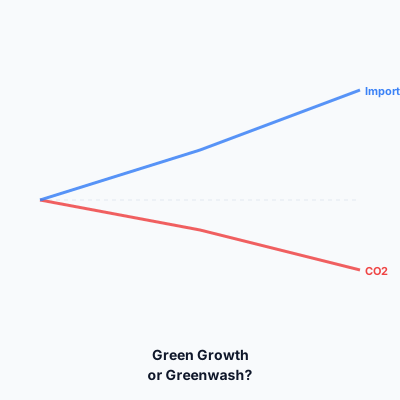
Green Growth or Greenwash
Europe's emissions fell 30%. Its manufactured imports rose 40%. Coincidence? We tested whether 'decoupling' is real or just offshored pollution.
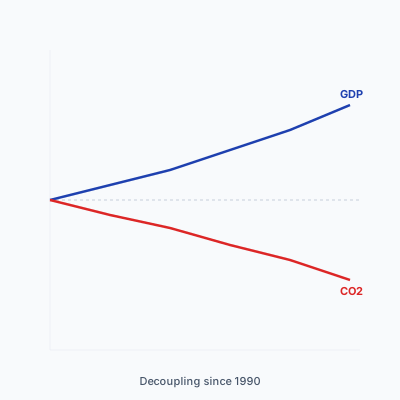
Carbon Cost of Growth
Can a country get richer without cooking the planet? Some have. Most haven't. We tracked GDP growth against CO2 emissions for 30 years — the decoupling story is real, but incomplete.
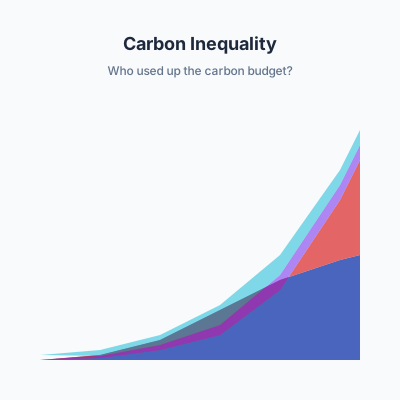
Carbon Inequality
The countries drowning in rising seas didn't cause the flood. We mapped who emitted what, when — and the per-capita gap is staggering.
The China Dependency Index
When did China become your country's most important trade partner? For half the world, it already has. We mapped the dependency — and the risks.
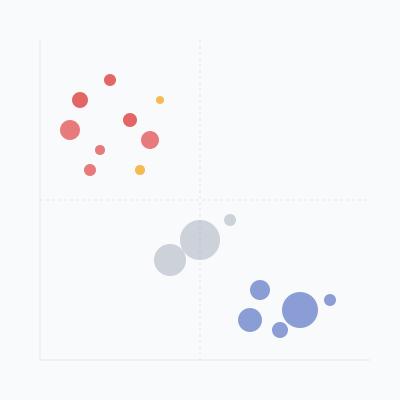
Climate Vulnerability vs Emissions
Chad emits less CO2 in a year than a US state does in a day. Chad is also one of the most climate-vulnerable countries on Earth. The injustice is measurable.
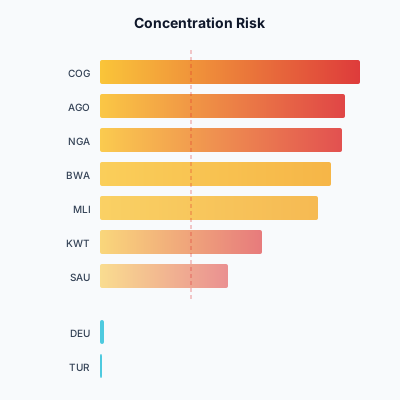
Concentration Risk
Some countries are one product away from crisis. We computed export concentration for every economy — the results are a map of global economic fragility.
Related explainers

Carbon leakage
When strict climate policy in one country just pushes emissions across the border.
“China is dumping”: What dumping actually means (and what it doesn’t)
Low prices aren’t automatically dumping. Dumping is a legal test tied to price discrimination and injury.

Bilateral deficit with China: why it’s a terrible headline metric
Bilateral deficits ignore supply chains and value-added. Here’s why they mislead—and what to use instead.
Capacity factor
Why a country with 10 GW of solar capacity doesn't actually get 10 GW of electricity.

Comparative advantage
Why trade can benefit both sides even when one side is ‘better at everything’—and why that doesn’t settle policy debates.

Consumption vs territorial emissions
The accounting trick that lets rich countries claim they're decarbonizing while importing carbon-heavy goods.