Food Import Vulnerability
40 countries can't feed themselves — and the list is growing. We mapped food import dependency against arable land, population growth, and income. The vulnerable are easy to identify.
40 Countries Can't Feed Themselves. The List Is Growing.
In 2023, the Comoros Islands imported 42% of all their goods as food. Djibouti: 39%. Benin: 33%. The West Bank: 31%. These are not countries choosing to specialize in services or technology. These are countries that cannot grow enough food for their people, buying it on international markets with money they often do not have.
Food import dependency is not inherently dangerous. Singapore imports nearly all its food and nobody worries about it, because Singapore has $65,000 GDP per capita and one of the most efficient port systems on earth. The danger begins when food dependency meets poverty. When a country imports a third of its goods as food and earns $1,500 per person per year, a 40% spike in wheat prices is not an economic nuisance. It is a humanitarian crisis.
We pulled UN Comtrade data on HS chapters 01-24 -- covering everything from live animals and cereals to beverages and tobacco -- for 156 countries. We computed each country's food imports as a share of total merchandise imports, cross-referenced it with arable land per person from the World Bank, and overlaid it with food commodity price indices. The picture is clear: the most food-vulnerable countries in the world are easy to identify. The question is what happens to them when prices spike.
The Dependency Map
The bar chart below shows the 30 most food-import-dependent countries. Each bar represents the share of a country's total merchandise imports that goes to food and agricultural products. The colors tell the real story: red and orange bars (low and lower-middle income countries) are the ones that cannot absorb price shocks. Green bars (high income) can.
Three clusters jump out.
Small island developing states. Comoros, Samoa, Tonga, Antigua and Barbuda, St. Vincent and the Grenadines, Seychelles, Dominica, Grenada, Barbados. For these countries, food import dependency is not a policy failure -- it is geography. You cannot grow wheat on a coral atoll. You cannot raise cattle on a volcanic island of 100,000 people. These countries are structurally food-dependent and always will be. The question is whether they are rich enough to manage it.
Sub-Saharan Africa. Benin at 33%, Mauritania at 25%, Liberia at 24%, Cameroon at 23%, Lesotho at 23%, Congo Republic at 22%. These are countries with growing populations, shrinking arable land per person, and agricultural sectors that have not kept pace with demand. When arable land per person drops below 0.15 hectares -- the level at which a country can barely sustain subsistence agriculture -- food imports become a lifeline, not a luxury. For many of these nations, cereals alone account for the largest share of the food import bill.
The Middle East buffer zone. Djibouti at 39%, Jordan at 20%, Egypt at 22%, Lebanon at 17%. These are arid countries where agriculture was always constrained by water and soil. Egypt feeds 105 million people with just 0.03 hectares of arable land per person -- one of the lowest ratios on earth -- and imports over a fifth of its goods as food. Before the 2022 Ukraine war, Egypt was the world's largest wheat importer. Roughly 80% of that wheat came from Russia and Ukraine.
Rich vs Poor: The Income Filter
The same level of food dependency means entirely different things depending on income. Kuwait imports 17% of its goods as food and spends $1,340 per person per year on food imports. That is 2% of its GDP per capita. Djibouti imports 39% of its goods as food, spending an estimated $350 per person. For a country with GDP per capita under $3,500, that is crushing.
This is the distinction that matters most in food security analysis: dependency versus vulnerability. Singapore, Bahrain, Kuwait, Aruba, Bermuda, the Cayman Islands -- these are food-dependent but not food-vulnerable. They have the foreign exchange reserves, the port infrastructure, and the purchasing power to absorb any price shock the global market can deliver. If wheat prices double, Singapore redirects cargo ships and adjusts contract terms. If wheat prices double in Djibouti, people go hungry.
The genuinely vulnerable countries sit at the intersection of three conditions: high food import dependency, low income, and limited arable land. By that measure, the most vulnerable nations on earth right now are Djibouti, Comoros, Liberia, West Bank and Gaza, Timor-Leste, Tajikistan, Madagascar, and Egypt.
The Land Constraint
Why do some countries import so much food? The scatter plot below reveals the structural answer. The horizontal axis shows arable land per person (logarithmic scale). The vertical axis shows food import dependency. The pattern is unmistakable: less land, more imports.
Countries in the bottom-right quadrant -- like the United States, Brazil, Argentina, and Australia -- have abundant arable land and low food import dependency. They are the world's breadbaskets. Countries in the upper-left quadrant have almost no arable land and import a large share of their goods as food. Singapore has 0.0001 hectares of arable land per person -- essentially zero. Bahrain has 0.001. Kuwait has 0.002.
But the danger zone is the upper-left quadrant filtered by color. The green dots (high income) in that quadrant are fine. The red and orange dots (low and lower-middle income) in that quadrant are the countries that face genuine food insecurity. They have no land, no money, and no buffer.
The middle of the chart tells an important story too. Egypt has 0.03 hectares per person and 22% food import dependency. Jordan has 0.03 hectares and 20% dependency. Lebanon has 0.02 hectares and 17%. These are countries that have pushed their agricultural land to the limit and are now structurally dependent on food imports to close the gap.
When Prices Spike, the Vulnerable Break
The chart below tracks the World Bank's composite food commodity price index from 2005 to 2026. Three episodes stand out, each marked by the red-shaded areas.
2007-2008: The first global food crisis. Food prices nearly doubled in 18 months. The composite food index jumped from roughly 70 in mid-2007 to over 130 by mid-2008. The consequences were immediate and violent. Food riots erupted in Haiti, Egypt, Cameroon, Ivory Coast, Mauritania, Mozambique, Senegal, Uzbekistan, Yemen, Bangladesh, and Bolivia. In Haiti, the prime minister was ousted after "mud cake" became a symbol of hunger. In Egypt, the army was deployed to bake bread in military bakeries. In Cameroon, at least 40 people died in food-related protests. The World Bank estimated that the price spike pushed 130-155 million people into extreme poverty.
2010-2011: The Arab Spring trigger. Food prices spiked again, reaching an index value above 140 by early 2011. The Tunisian vendor Mohamed Bouazizi set himself on fire in December 2010 -- the commonly cited trigger of the Arab Spring -- but the background condition was that bread prices had become unaffordable for millions across North Africa and the Middle East. Egypt, Tunisia, Libya, Yemen, Bahrain, and Syria all experienced uprisings in the following months. Food was not the only cause, but it was the match. Research by the New England Complex Systems Institute found a direct statistical relationship between the FAO food price index and the timing of food riots. When the index crosses a threshold, social unrest becomes predictable.
2021-2022: The Ukraine shock. Russia's invasion of Ukraine in February 2022 disrupted global wheat, sunflower oil, and fertilizer supplies. The food index spiked to nearly 155 -- the highest level in the dataset. For countries dependent on Black Sea grain, the impact was catastrophic. Egypt imports roughly 12 million tonnes of wheat per year, with 60-80% historically from Russia and Ukraine. Lebanon, already in financial collapse, saw bread prices triple. Tunisia rationed subsidized bread. Horn of Africa countries -- Somalia, Djibouti, Ethiopia -- faced simultaneous drought and import disruption.
The pattern is predictable. Food prices spike. Poor food-importing countries cannot absorb the shock. Social instability follows. The bread-price-to-revolution pipeline is not a metaphor -- it is a documented pattern with a 15-year track record.
The Most Vulnerable Countries on Earth
Our vulnerability index combines three factors: food import dependency, income level (as a proxy for shock absorption capacity), and arable land scarcity. The resulting ranking identifies the countries where a food price spike would cause the most damage.
The top 10 most food-vulnerable countries are:
- Djibouti -- 39% food import dependency, lower-middle income, negligible arable land. A gateway port with almost no agricultural hinterland.
- Comoros -- 42% food import dependency, lower-middle income. A volcanic archipelago that grows some vanilla and cloves but imports most staples.
- Liberia -- 24% food dependency, low income. Still recovering from civil war, with agricultural infrastructure far below potential.
- West Bank and Gaza -- 31% food dependency, lower-middle income. Agriculture constrained by conflict, water access, and territorial control.
- Timor-Leste -- 29% food dependency, lower-middle income. One of the youngest countries on earth, with an economy still transitioning from oil dependence.
- Tajikistan -- 27% food dependency, lower-middle income. Mountainous terrain limits agriculture; remittances from Russia fund food imports.
- Madagascar -- 18% food dependency, low income. A large island with significant agricultural potential, but chronic underinvestment.
- Egypt -- 22% food dependency, lower-middle income, 105 million people. The sheer scale makes Egypt the most systemically important entry on this list.
- Mauritania -- 25% food dependency, lower-middle income. Saharan and Sahelian climate leaves little room for rain-fed agriculture.
- Lesotho -- 23% food dependency, lower-middle income. A landlocked enclave entirely surrounded by South Africa, dependent on food transiting through its neighbor.
These are not predictions. These are current conditions. The next food price spike -- whether triggered by climate shock, conflict, export bans, or fertilizer shortages -- will hit these countries first and hardest.
Food Security vs Food Sovereignty
There is a policy debate embedded in this data. One school of thought says food import dependency is fine as long as you can pay for it. Comparative advantage dictates that Singapore should make semiconductors and buy rice, not the reverse. This is the food security framing: access to food matters, not where it comes from.
The opposing view -- food sovereignty -- argues that relying on global markets for survival is inherently dangerous. Export bans (India banned wheat exports in May 2022, rice exports in July 2023), logistics disruptions (the Red Sea shipping crisis of 2024), and commodity speculation can cut off food supplies overnight. Countries that cannot feed themselves from their own soil are one crisis away from catastrophe.
The data supports both arguments, depending on who you are. For Singapore and Kuwait, food security through trade works. For Djibouti and Liberia, it is a trap. The 2022 Ukraine crisis demonstrated that global food markets are not neutral infrastructure -- they are geopolitical systems that can be weaponized, disrupted, or simply overwhelmed.
For the 40 most food-vulnerable countries identified in this analysis, the question is not whether the next food price crisis will come. It is whether they will have built any buffer -- strategic grain reserves, diversified import sources, investment in domestic agriculture -- before it arrives. On current trends, most have not.
Methodology
Food import dependency is computed as the share of a country's total merchandise imports captured by HS2 chapters 01-24 (live animals, meat, dairy, cereals, milling products, oils, prepared foods, beverages, and tobacco), sourced from UN Comtrade bilateral trade flows for 2023:
food_import_share = SUM(imports_usd where HS2 in 01..24) / SUM(imports_usd all HS2)
Food imports per capita normalises the food import bill against UN DESA mid-year population:
food_imports_pc = food_imports_usd / population
Vulnerability score is a MacroScribbles composite designed to rank countries by exposure to a food price shock. It multiplies dependency by an income-level penalty and an arable-land scarcity factor:
income_weight    = {Low: 3.0, Lower middle: 2.0, Upper middle: 1.0, High: 0.3}
arable_factor    = min(3.0, 0.2 / arable_ha_per_person)   # baseline 0.2 ha/person
score            = food_import_share * income_weight * (1 + 0.5 * arable_factor)
Higher scores indicate greater vulnerability. The intuition: a poor country with little arable land and high food import dependency has no buffer when global prices spike.
Food price index is the simple average of three World Bank Pink Sheet commodity sub-indices (Grains; Oils & Meals; Other Food), each normalised to 2010 = 100:
food_index(t) = mean(grains_index(t), oils_meals_index(t), other_food_index(t))
Raw data inputs
- UN Comtrade HS2 bilateral flows — import values by reporter country and HS2 chapter, 2023. Not catalogued in MacroVedia series index; sourced via the TradeVedia ingest pipeline.
- Arable land (hectares per person) — World Bank World Development Indicators. Latest available year per country, 2021-2023.
- GDP per capita, PPP (constant 2021 international $) — World Bank World Development Indicators. Used as the income axis and vulnerability-score context.
- Total Population (July 1) — UN DESA World Population Prospects mid-year estimates, thousands.
- World Bank Pink Sheet: Grains, Oils & Meals, Other Food sub-indices — monthly commodity price indices, 2005 onwards. Not catalogued in MacroVedia series index.
- World Bank income-level classifications — used to colour-code charts and weight the vulnerability score. Joined from the WDI geo dimension.
Data covers 156 countries with total merchandise imports exceeding $100 million in 2023. Aggregate groupings (regions, income groups, "World") and very small territories are excluded. See the EXCLUDE_ISO3 list in the extraction script for the full filter.
Related research
Brain Drain Tracker
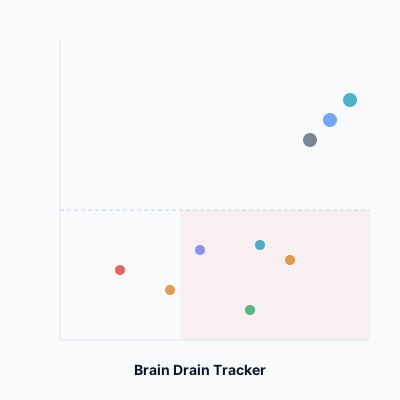
Nigeria trains doctors. Britain employs them. We tracked the global brain drain — who loses talent, who gains it, and whether remittances make up the difference.
Child Survival & National Income
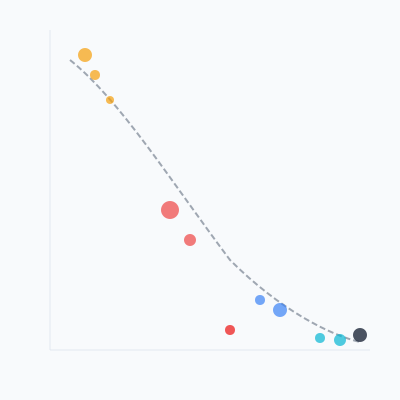
If you could know only one number about a country, it should be under-5 mortality. It captures income, health, education, water, and women's empowerment in a single statistic.
The China Dependency Index
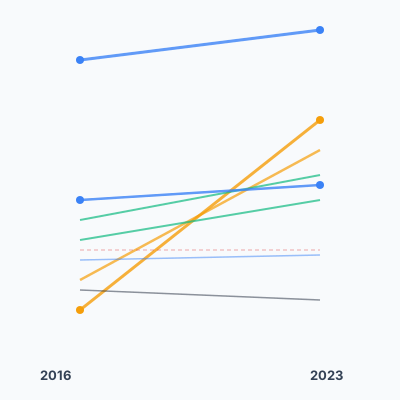
When did China become your country's most important trade partner? For half the world, it already has. We mapped the dependency — and the risks.
Concentration Risk
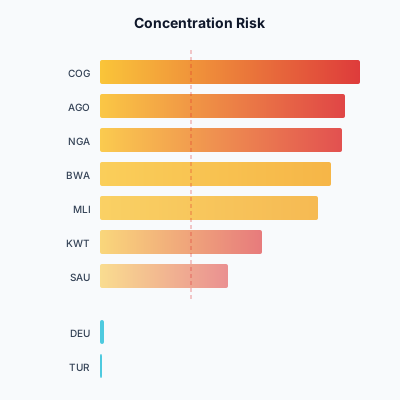
Some countries are one product away from crisis. We computed export concentration for every economy — the results are a map of global economic fragility.
The Debt-Trade Spiral
Persistent trade deficits and fiscal deficits compound into a debt spiral visible across decades. The data shows which countries are trapped — and which broke free.
Education Spending vs Innovation Output
Some countries spend billions on education and produce no patents. Others spend less and lead the world in innovation. The missing ingredient isn't money — it's R&D.
Related explainers
Food security: It's not about growing everything yourself
Why food security depends on trade routes as much as farmland — and what actually breaks it.
“China is dumping”: What dumping actually means (and what it doesn’t)
Low prices aren’t automatically dumping. Dumping is a legal test tied to price discrimination and injury.

Bilateral deficit with China: why it’s a terrible headline metric
Bilateral deficits ignore supply chains and value-added. Here’s why they mislead—and what to use instead.

Carbon leakage
When strict climate policy in one country just pushes emissions across the border.
Comparative advantage
Why trade can benefit both sides even when one side is ‘better at everything’—and why that doesn’t settle policy debates.

Demographic transition
The four-stage model that explains why populations explode, stabilize, and then shrink — and why most of global economics follows from it.