Green Growth or Greenwash
Europe's emissions fell 30%. Its manufactured imports rose 40%. Coincidence? We tested whether 'decoupling' is real or just offshored pollution.
Europe's Emissions Fell 30%. Its Imports Rose 40%. Coincidence?
Between 2000 and 2023, the United Kingdom cut its territorial CO2 emissions by 45%. France cut by 35%. Germany by 36%. These are among the steepest declines of any major economies. Politicians cite these numbers as proof that rich countries can grow while shrinking their carbon footprint -- that decoupling GDP from emissions is not only possible but already happening.
There is a problem with this narrative. Over roughly the same period, the UK's manufactured goods imports surged 179%. France's rose 31%. Italy's climbed 40%. The United States -- which managed only an 18.6% territorial reduction -- saw manufactured imports jump 51%. These countries did not stop consuming carbon-intensive goods. They stopped making them domestically and started buying them from countries where the emissions show up on someone else's ledger.
This is the central question of climate accounting: when a British consumer buys a Chinese-made washing machine, whose emissions are those? Under the territorial accounting system used in international climate agreements, they are China's. Under consumption-based accounting, they are Britain's. The gap between these two numbers tells you how much carbon a country has effectively offshored.
We pulled territorial and consumption-based CO2 data from the Global Carbon Project, along with manufacturing value added from the World Bank and manufactured goods trade from UN Comtrade to test whether decoupling is real, illusory, or somewhere in between.
The Divergence
The chart below tells the core story. For each rich-world country, we indexed territorial CO2 emissions and manufactured goods imports to a common base (2016 = 100). If a country genuinely decoupled -- reduced emissions through efficiency and clean energy while maintaining its industrial base -- the two lines should move together or both fall. If a country merely offshored production, the lines diverge: emissions fall while imports rise.
Start with the United Kingdom. Territorial CO2 dropped sharply -- from roughly 560 million tonnes in 2000 to 308 million tonnes by 2023. But manufactured imports surged, nearly tripling over the longer 2000-2023 period. The UK closed coal power stations, which is genuinely transformative. But it also shut down steelworks, aluminum smelters, and heavy manufacturing plants, replacing domestic production with imports from China, Turkey, and India. The emissions did not disappear. They relocated.
The United States shows a milder version of the same pattern. Territorial CO2 fell 18.6% since 2000 -- largely driven by coal-to-gas switching in electricity generation, which is real decarbonization. But manufactured imports grew 51% over the comtrade period. America's goods trade deficit of $841 billion in manufactured goods tells you something about where the physical economy went.
Germany is an interesting exception. Territorial CO2 fell 36.3% since 2000, but manufactured imports actually declined 69% over the recent period -- because Germany still makes things. Germany is a manufacturing surplus country. Its emissions reduction reflects genuine industrial efficiency improvements, the Energiewende (despite its controversies around nuclear phase-out), and reduced coal dependence. Germany's territorial decline is among the most credible in the G7.
Japan cut territorial emissions by 23.7% since 2000, while manufactured imports rose 24.4%. Japan's story is complicated by the post-Fukushima nuclear shutdown (2011-2015), which temporarily increased fossil fuel use, followed by a gradual nuclear restart. Japan's manufacturing sector remains relatively intact domestically -- the import growth reflects integration with Southeast Asian supply chains rather than wholesale offshoring.
The Suspects
Where does each country sit on the offshoring spectrum? The scatter plot below maps territorial CO2 change (x-axis) against manufactured imports change (y-axis) for all twelve countries in our sample. Countries in the upper-left quadrant -- falling emissions, rising imports -- are the offshoring suspects. Countries in the lower-left -- falling emissions, falling imports -- may be genuinely decoupling.
The UK sits firmly in suspect territory: a 45% territorial CO2 reduction paired with a 179% manufactured imports surge. This is the most extreme divergence in the dataset. The USA is in the same quadrant but less extreme. France and Italy show moderate versions of the pattern.
On the other side, China and India absorbed massive emissions growth. China's territorial CO2 rose 237% since 2000 -- it now emits more than 12 billion tonnes annually, roughly a third of the global total. India's emissions rose 224%. These are the countries that took on the manufacturing the rich world discarded. Vietnam's emissions grew 588% from a small base, reflecting its role as the "China+1" manufacturing hub.
Australia is an outlier among rich countries -- its territorial emissions actually rose 10.5% since 2000, reflecting continued coal and LNG expansion. Australia is one of the few advanced economies that did not even achieve territorial decoupling.
The Smoking Gun: Consumption-Based CO2
The most damning evidence comes from consumption-based CO2 accounting, which reallocates emissions embedded in traded goods to the country that consumes them. If a country's territorial emissions fall but its consumption-based emissions stay flat, the reduction is pure accounting -- carbon moved, not eliminated.
The gap between consumption-based and territorial CO2 is the carbon embedded in a country's net imports. The UK leads the field: its consumption-based CO2 is 58.2% higher than its territorial figure -- 487 million tonnes versus 308 million tonnes. That gap of 179 million tonnes represents carbon that British consumption caused but that shows up on other countries' balance sheets.
France has a 50.7% gap -- 407 million tonnes consumption-based versus 270 million tonnes territorial. France's territorial numbers look impressive partly because of nuclear power (which genuinely produces very low carbon electricity) and partly because France deindustrialized significantly. Both factors are real, but the 50.7% gap tells you that France outsources a substantial share of its carbon footprint.
Germany has a 29.4% gap -- significant but much smaller than the UK or France. Germany's manufacturing base means more of its consumption is produced domestically -- though a look at Germany's import profile still reveals substantial inflows of manufactured goods. Italy at 37.4% and Japan at 15.7% sit in between.
The USA has a 10.4% gap -- surprisingly small given its massive goods deficit. This reflects America's sheer size: even with substantial offshoring, the domestic economy is so large that imports represent a smaller share of total consumption than in smaller European economies.
Flip to the other side. China's consumption-based CO2 is 10.8% lower than its territorial figure -- meaning 1,315 million tonnes of its territorial emissions serve foreign consumption. China is the world's largest net exporter of embedded carbon. India (-17.0%) and Vietnam (-28.7%) are similarly net exporters -- their factories pollute so that consumers in London, Paris, and New York can enjoy clean air statistics. Explore the UK's trade flows to see where those manufactured imports actually come from.
What Is Genuinely Real
It would be dishonest to call all of this greenwash. Some of the emissions reductions in rich countries are unambiguously real.
Coal phase-out. The UK went from generating 39% of its electricity from coal in 2000 to effectively zero by 2024. This eliminated roughly 100 million tonnes of CO2 annually -- a genuine, permanent reduction that cannot be explained by offshoring. Germany reduced coal generation from 51% to around 26% over the same period (though its decision to simultaneously phase out nuclear power remains controversial -- it arguably slowed the overall transition).
Renewable energy. Wind and solar now generate over 40% of UK electricity, up from near zero in 2000. Germany is at roughly 50% renewable electricity. France was already at 75% nuclear, so its electricity was always relatively clean. These investments are structural and cumulative.
Gas switching. The US shift from coal to natural gas in electricity generation -- driven primarily by the shale revolution making gas cheap, not by climate policy -- reduced the carbon intensity of American power by roughly 40% since 2005. Gas emits about half the CO2 per kWh of coal. This is real but incomplete decarbonization.
Efficiency gains. Buildings, vehicles, and industrial processes across the rich world are genuinely more energy-efficient than they were in 2000. LED lighting, better insulation, more efficient engines, and industrial process optimization all contribute. These improvements are real and not attributable to offshoring.
A reasonable estimate: perhaps 60-70% of the UK's territorial emissions reduction is genuine (coal phase-out, renewables, efficiency), and 30-40% is offshored. For the United States, the genuine share is probably higher (closer to 80%) because the territorial reduction itself is modest. For France, the picture is complicated by already-clean electricity from nuclear.
The Global Picture
Here is the number that matters most: global CO2 emissions have not declined. They rose from roughly 25 billion tonnes in 2000 to nearly 38 billion tonnes in 2023. Every tonne that disappeared from the UK's territorial ledger reappeared somewhere else -- mostly in China, India, and Southeast Asia.
If the goal of climate policy is to reduce global emissions, then territorial accounting is measuring the wrong thing. A British factory closure that results in the same product being manufactured in a Chinese coal-powered factory, shipped across an ocean on a bunker-fuel vessel, and trucked to a British warehouse has -- at best -- achieved zero net reduction. At worst, it increased total emissions because Chinese electricity is more carbon-intensive than British electricity was, and the product now requires international shipping that did not exist before.
The Paris Agreement is built on territorial accounting. Countries pledge to reduce their territorial emissions. There is no mechanism to account for embedded carbon in trade. This means that the easiest way for a rich country to hit its Paris targets is to close factories and import the same goods -- shifting emissions to countries with weaker (or no) targets.
This is not a conspiracy. No British politician deliberately said "let us close our steelworks to improve our emissions statistics." The deindustrialization happened for economic reasons -- cheaper production abroad, higher domestic labor costs, a shift toward services. But the climate accounting consequences are real, and they make the emissions reductions of rich countries look more impressive than they are.
The Honest Verdict
Decoupling is partly real and partly an accounting trick. The honest breakdown:
Real decoupling (genuine progress): Coal phase-outs, renewable energy deployment, energy efficiency improvements, and structural shifts toward less energy-intensive economic activity. These are permanent, irreversible gains that would persist even if all offshoring reversed. They account for the majority of territorial reductions in most rich countries.
Accounting decoupling (offshoring): Factory closures replaced by imports from carbon-intensive economies. The emissions still exist -- they just moved to a different row in the spreadsheet. The consumption-based data proves this: the UK's 45% territorial reduction shrinks to 34% on a consumption basis. France's 35% becomes 21%. The gap is the greenwash.
The uncomfortable truth: Global emissions are still rising. Rich-world reductions -- even the genuine ones -- have been more than offset by growth in emerging economies, which are partly (but not entirely) producing goods for rich-world consumption. Until the world's fastest-growing emitters gain access to cheap clean energy at scale, territorial reductions in the West are necessary but nowhere near sufficient.
The next time a politician cites their country's territorial emissions reduction, ask one question: what happened to consumption-based emissions? If the answer is not offered, the number probably flatters the story.
Methodology
All three charts in this piece are MacroScribbles derivations from raw indicators. The formulas below are exactly what the extraction script computes.
Indexing (dual-trend chart). Both territorial CO2 and manufactured-goods import series are rebased to 2016 = 100:
index(year) = value(year) / value(2016) * 100
Percentage change (scatter chart). For each country, we compute percentage change from the 2000 base year (or earliest available year for Comtrade, which starts in 2016):
terr_co2_change_pct = (terr_co2_latest - terr_co2_2000) / terr_co2_2000 * 100
mfg_imports_change_pct = (imp_latest - imp_earliest) / imp_earliest * 100
Countries are classified as "rich-world decouplers" (GBR, DEU, FRA, USA, JPN, AUS, CAN, ITA) or "emerging absorbers" (CHN, IND, VNM, BGD).
Embedded carbon gap (territorial vs consumption chart). For the latest year where both series exist per country:
gap_mt = consumption_co2 - territorial_co2
gap_pct = gap_mt / territorial_co2 * 100
A positive gap indicates a net importer of embedded carbon; a negative gap indicates a net exporter.
Manufactured goods basket. For the Comtrade aggregate we sum import values across HS revision 2 chapters 72 (iron and steel), 73 (articles of iron/steel), 84 (machinery and mechanical appliances), 85 (electrical machinery and electronics), and 87 (vehicles). Import values are current USD, converted to billions for display.
Raw data inputs
- Territorial CO2 emissions, annual, million tonnes — Global Carbon Project national fossil + cement emissions.
- Consumption-based CO2 emissions, annual, million tonnes — Global Carbon Project, derived via multi-regional input-output (MRIO) models.
- CO2 emissions per capita, annual, tonnes per person — Global Carbon Project.
- Manufactured goods imports, annual, current USD — UN Comtrade, HS revision 2 chapters 72, 73, 84, 85, 87. Country-level trade profiles available on TradeVedia.
- Manufacturing value added (% of GDP), annual — World Bank WDI series NV.IND.MANF.ZS.
Limitations. Consumption-based CO2 data lags territorial data by roughly one year. MRIO models underlying consumption-based estimates carry uncertainty typically estimated at 5-10%. Comtrade data starting only in 2016 limits the dual-trend window to recent years; longer-term import trends from other sources confirm the directional story. Some import changes reflect price movements rather than volume changes since values are in current USD rather than deflated or quantity terms.
Related research

Agricultural Trade & Food Prices
The Arab Spring wasn't about politics. It started with the price of bread. We traced how global commodity spikes ripple into food crises — and who gets hit first.
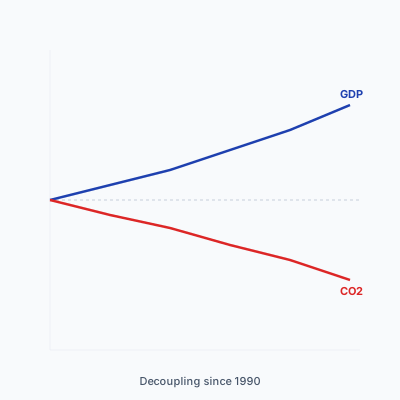
Carbon Cost of Growth
Can a country get richer without cooking the planet? Some have. Most haven't. We tracked GDP growth against CO2 emissions for 30 years — the decoupling story is real, but incomplete.
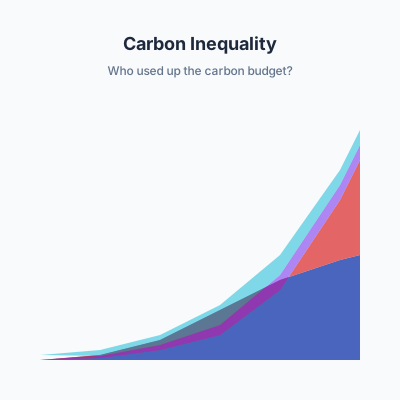
Carbon Inequality
The countries drowning in rising seas didn't cause the flood. We mapped who emitted what, when — and the per-capita gap is staggering.
The China Dependency Index
When did China become your country's most important trade partner? For half the world, it already has. We mapped the dependency — and the risks.

Climate Vulnerability vs Emissions
Chad emits less CO2 in a year than a US state does in a day. Chad is also one of the most climate-vulnerable countries on Earth. The injustice is measurable.
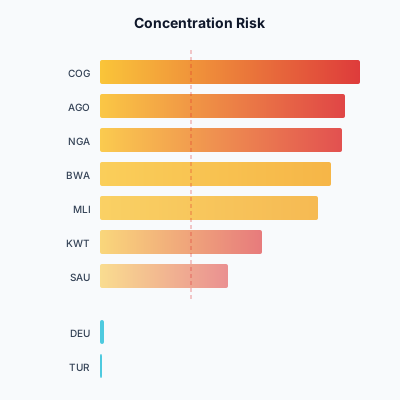
Concentration Risk
Some countries are one product away from crisis. We computed export concentration for every economy — the results are a map of global economic fragility.
Related explainers

Carbon leakage
When strict climate policy in one country just pushes emissions across the border.

“China is dumping”: What dumping actually means (and what it doesn’t)
Low prices aren’t automatically dumping. Dumping is a legal test tied to price discrimination and injury.

Bilateral deficit with China: why it’s a terrible headline metric
Bilateral deficits ignore supply chains and value-added. Here’s why they mislead—and what to use instead.

Capacity factor
Why a country with 10 GW of solar capacity doesn't actually get 10 GW of electricity.

Comparative advantage
Why trade can benefit both sides even when one side is ‘better at everything’—and why that doesn’t settle policy debates.

Consumption vs territorial emissions
The accounting trick that lets rich countries claim they're decarbonizing while importing carbon-heavy goods.