The Manufacturing Exodus
The rich world stopped making things — then wondered why it couldn't. We tracked manufacturing's 30-year migration from West to East, in GDP and trade data.
The Rich World Stopped Making Things
In 1995, the United Kingdom's manufacturing sector accounted for 15.4% of GDP. By 2024, it was 8.0%. The United States went from 16.1% to 10.7%. France dropped from 14.7% to 9.6%. Italy, from 19.2% to 14.8%.
These are not marginal shifts. Over three decades, the advanced economies systematically hollowed out their industrial base -- closing factories, offshoring production, and replacing manufacturing jobs with services. The logic seemed sound at the time: rich countries would design and finance things, poor countries would make them. Everyone would benefit from comparative advantage.
Then COVID hit, and the United States discovered it could not make enough ventilators. Then the chip shortage hit, and every automaker in Europe and America discovered their production lines depended on a handful of foundries in Taiwan and South Korea. Then Russia invaded Ukraine, and Europe discovered its energy infrastructure depended on a country willing to weaponize gas pipelines.
The manufacturing exodus was not an accident. It was a policy choice, made over decades, visible in the data long before it became a crisis. We pulled manufacturing value added from the World Bank World Development Indicators and trade data from UN Comtrade to map where manufacturing went, who gained, and what the trade consequences look like.
The Decline: A Slope Chart
The chart below shows the shift. Each line connects a country's manufacturing share of GDP in the mid-1990s (left) to its share in 2024 (right). Red lines are advanced economies that declined. Green lines are emerging economies. Blue lines are the exceptions -- countries that held their industrial base despite rising incomes.
The steepest declines are in the United Kingdom (-7.4 percentage points) and the United States (-5.4pp). Britain's deindustrialization is the most dramatic in the G7 -- manufacturing now accounts for less GDP than the financial services sector in the City of London alone. The UK went from being the workshop of the world to a country that imports manufactured goods at scale and runs a persistent trade deficit.
France (-5.1pp) and Italy (-4.4pp) followed a similar path, though Italy retained more mid-market manufacturing (machinery, fashion, food processing) than France or Britain. Japan (-2.9pp) declined less dramatically, in part because Japanese industrial policy actively resisted the most aggressive offshoring, maintaining automotive and electronics production domestically even as unit costs rose.
The outliers are revealing. South Korea (+0.3pp) is the only high-income country that actually increased its manufacturing share -- from 26.3% to 26.6%. Korea's industrial policy, centered on chaebols like Samsung, Hyundai, and SK, explicitly prioritized maintaining manufacturing capacity even as the economy developed. Germany (-2.2pp) declined only modestly, holding at 18.0% -- roughly double the UK's figure. More on Germany later.
Where Manufacturing Went
The green lines in the slope chart tell the other half of the story.
Bangladesh went from 15.9% to 21.9% manufacturing GDP -- a 6.0 percentage point gain driven almost entirely by garment exports. Bangladesh is now the world's second-largest garment exporter after China, with over 4 million workers in the textile sector. The country did not diversify into manufacturing broadly. It specialized in one segment and scaled it.
Vietnam gained 5.6 percentage points, rising from 18.8% to 24.4%. Vietnam's manufacturing boom is more diversified than Bangladesh's -- electronics (Samsung's largest phone factory is in Vietnam), footwear, furniture, and increasingly automotive components. Vietnam deliberately positioned itself as the "China+1" alternative, offering lower wages, political stability, and trade agreements (CPTPP, EU-Vietnam FTA) that China lacks.
China is the most complex case. Its manufacturing share actually declined from 31.5% to 24.9% over this period. But that decline is misleading. China's GDP grew from roughly $2 trillion in 2004 to over $18 trillion in 2024. A smaller percentage of a much larger pie means China's absolute manufacturing output increased enormously -- it now accounts for roughly 30% of global manufacturing value added, more than the United States, Japan, and Germany combined.
Some expected gainers disappointed. India actually lost manufacturing share, dropping from 17.9% to 12.6% despite decades of "Make in India" rhetoric. India's manufacturing sector has struggled with infrastructure bottlenecks, labor regulation, and a services-dominated growth model. Indonesia similarly declined from 24.1% to 19.0%. Thailand and Mexico were roughly flat.
The Trade Consequences
Deindustrialization has a direct balance-of-payments consequence. Countries that stop making things still need to buy them. The chart below shows the manufactured goods trade balance (exports minus imports of HS chapters 72-73, 84, 85, and 87 -- iron/steel, machinery, electronics, and vehicles) for the top surplus and deficit countries.
The numbers are stark. China runs a manufactured goods surplus of nearly $2.8 trillion -- exporting $3.8 trillion in machinery, electronics, vehicles, and steel while importing $916 billion. No country in history has dominated manufactured goods trade at this scale. China's manufactured exports alone exceed the entire GDP of most G20 members.
Germany holds a $425 billion surplus, driven by automotive, machinery, and chemical exports. South Korea ($188B) and Japan ($176B) complete the major surplus countries -- all three maintained their industrial base through deliberate policy.
On the deficit side, the United States runs an $841 billion manufactured goods deficit. America imports almost $1.5 trillion in machinery, electronics, and vehicles annually while exporting only $653 billion. This is not a temporary imbalance -- it is a structural feature of an economy that offshored production and retained consumption. The United Kingdom runs a $223 billion deficit, Brazil $132 billion, and Australia $102 billion.
The pattern is simple: countries that deindustrialized now run permanent goods deficits. They finance these deficits by exporting services (finance, consulting, software) and by selling assets (real estate, government bonds, equities) to the surplus countries. This works -- until it doesn't.
The German Exception
Germany is the advanced economy that defied the trend. At 18.0% manufacturing GDP, Germany maintains an industrial base roughly double that of France or the UK, despite having similar wage levels, regulations, and geographic position.
How? Three factors.
First, Germany's Mittelstand -- the roughly 3.5 million small and medium-sized enterprises that form the backbone of the economy -- specialize in capital goods, precision engineering, and niche manufactured products where price competition matters less than quality and technical capability. These are not commodity manufacturers competing on labor cost with China. They make the machines that Chinese factories use.
Second, Germany's apprenticeship system (duale Ausbildung) channels roughly 50% of each cohort into vocational training rather than university, maintaining a skilled manufacturing workforce that most other rich countries have lost. The UK and France pushed dramatically toward university education; Germany maintained the parallel track.
Third, Germany's export orientation is embedded in policy. The euro -- structurally undervalued for Germany relative to where a standalone Deutsche Mark would trade -- acts as a permanent export subsidy. German fiscal conservatism keeps domestic demand suppressed, channeling output toward exports. The result is persistent trade surpluses that have drawn criticism from both the EU and the United States.
But even Germany's model is under pressure. Manufacturing's share has fallen from 20.2% to 18.0% since 1995. Energy costs spiked after the Russia-Ukraine conflict exposed Germany's dependence on cheap Russian gas. The automotive sector faces an existential transition to electric vehicles where China has taken the lead. Germany's manufacturing advantage is real but not permanent.
Supply Chain Reality
The strategic consequences of deindustrialization became visible during three crises in rapid succession.
COVID-19 (2020-2021). The United States discovered it could not manufacture enough N95 masks, ventilators, or testing swabs domestically. Over 90% of antibiotics consumed in America were manufactured in China or India. PPE supply chains ran through a single province in Hubei. Countries that maintained manufacturing capacity -- Germany, South Korea, Japan -- ramped up domestic production within weeks. Countries that had offshored everything scrambled to compete on global spot markets.
The semiconductor shortage (2021-2023). When a fire at a Japanese chip plant, a Texas ice storm, and COVID-related shutdowns in Southeast Asia hit simultaneously, the world discovered that advanced semiconductor manufacturing was concentrated in two companies (TSMC and Samsung) in two geographies (Taiwan and South Korea). Every automaker in Europe and America cut production. Ford, GM, and Stellantis lost millions of vehicles. The US CHIPS Act ($52 billion) and the EU Chips Act ($47 billion) were emergency responses to a vulnerability that had been building for 20 years.
Energy security (2022-present). Europe's dependence on Russian gas was a supply chain vulnerability in energy, not manufacturing. But the response -- building LNG terminals, deploying heat pumps, accelerating renewables -- required manufacturing capacity that Europe largely lacked. Solar panels came from China. Wind turbine components came from China. Battery cells came from China. Europe's energy transition is being manufactured in Asia.
Reshoring -- Or Not
Since 2020, "reshoring," "nearshoring," and "friend-shoring" have become political buzzwords across the G7. The United States passed the Inflation Reduction Act ($369 billion in clean energy manufacturing incentives), the CHIPS Act, and imposed escalating tariffs on Chinese goods. The EU launched its Green Deal Industrial Plan. Japan allocated $10 billion for semiconductor reshoring.
Does the data show a reversal? Not yet. The United States' manufacturing share of GDP was 10.7% in 2021 -- the latest available WDI figure -- showing no uptick from the 10-11% range it has occupied since 2010. The manufactured goods trade deficit of $841 billion in 2024 is larger, not smaller, than pre-pandemic levels.
Some reshoring is happening at the plant level. TSMC is building a $65 billion fab complex in Arizona. Samsung is building a $17 billion fab in Texas. Intel received $8.5 billion in CHIPS Act subsidies. But these are capital-intensive semiconductor fabs employing thousands, not the broad manufacturing base employing millions that the US had in the 1980s.
The structural economics have not changed. A factory worker in Vietnam earns roughly $300/month. In Mexico, $500/month. In the United States, $4,000/month. Tariffs can offset some of this difference, but not all of it -- and tariffs raise costs for domestic consumers and downstream manufacturers. Reshoring specific strategic sectors (semiconductors, pharmaceuticals, defense) is feasible. Reshoring manufacturing broadly would require either sustained subsidies that dwarf current programs or tariff walls that would reshape the global trading system.
The manufacturing exodus took 30 years. Reversing it -- if that is even the goal -- will not happen in a presidential term.
The Stacked Picture
The area chart below shows manufacturing as a share of GDP for major economies stacked over time. It visualizes the composition shift: China's slice dominates, while the advanced economies' slices have thinned visibly since 2000.
The visual tells the story more clearly than any single number. The advanced economies' combined manufacturing share has been steadily compressed, while China and Southeast Asia expanded. South Korea's slice remains remarkably stable -- a blue band that neither grew nor shrank, holding its position through industrial policy and continuous investment.
Methodology
Raw data inputs
- Manufacturing, value added (% of GDP) — WDI series
NV.IND.MANF.ZS, World Bank World Development Indicators. Annual, 1990-2024 where available. The US series ends in 2021; Japan in 2023. China begins in 2004; Vietnam in 2005. - Employment in industry (% of total employment) — WDI series
SL.IND.EMPL.ZS, modeled ILO estimate. Annual from 1991. Includes manufacturing, mining, construction, and utilities. - Bilateral trade flows — UN Comtrade HS revision 2, 2016-2024, reporter-side values in current USD. Core manufactured-goods chapters: HS 72 (iron and steel), HS 73 (articles of iron/steel), HS 84 (machinery and mechanical appliances), HS 85 (electrical machinery and electronics), HS 87 (vehicles). Also available through TradeVedia.
Derived metrics
The slope chart and stream chart use the raw WDI series directly. The trade balance bar is a derived metric:
mfg_trade_balance(country, year) =
    sum over hs2 in {72, 73, 84, 85, 87} of
        ( exports_usd(country, hs2, year) - imports_usd(country, hs2, year) )
Only countries reporting both export and import flows for the latest available year are included, and entries below $1 billion in total manufactured trade are dropped to remove micro-states and reporting artifacts. The top-20 chart concatenates the 10 largest surpluses and the 10 largest deficits.
The slope-chart change figure is computed as:
change_pp(country) = mfg_gdp_share(country, latest_year)
                   - mfg_gdp_share(country, earliest_year >= 1995)
Limitations
Comtrade data starts in 2016, so trade balance trends cannot be traced to the 1990s. The HS chapter selection excludes some manufactured goods (textiles HS 50-63, chemicals HS 28-38, plastics HS 39-40) which would change individual country figures but not the directional story. Manufacturing % GDP is a value-added measure and can shift due to input cost changes (e.g., energy prices) independent of physical output changes. China's WDI manufacturing data starting in 2004 means the slope chart understates its earlier level.
Data sourced from the World Bank and UN Comtrade.
Related research

The Debt-Trade Spiral
Persistent trade deficits and fiscal deficits compound into a debt spiral visible across decades. The data shows which countries are trapped — and which broke free.
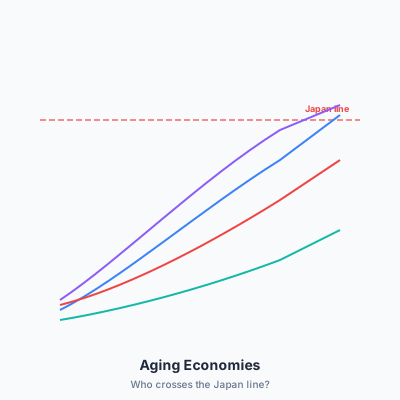
Aging Economies
Japan is the future — and most countries aren't ready. Population aging will break budgets, shrink workforces, and reshape economies. The timeline is visible in the data.
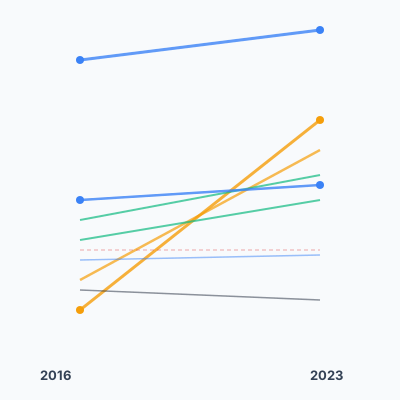
The China Dependency Index
When did China become your country's most important trade partner? For half the world, it already has. We mapped the dependency — and the risks.
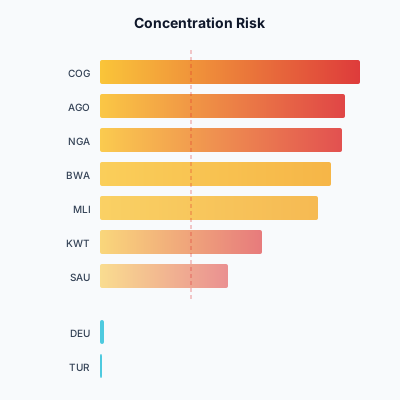
Concentration Risk
Some countries are one product away from crisis. We computed export concentration for every economy — the results are a map of global economic fragility.
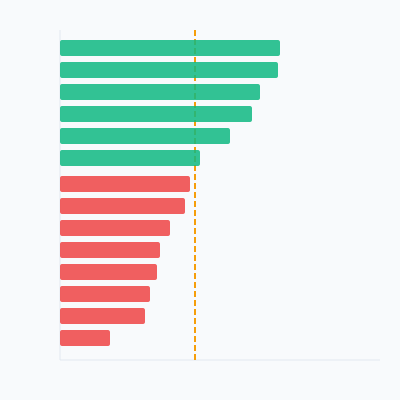
Who Funds Their Own Defense
Who's actually paying for Western security? We mapped NATO defense spending against the 2% target. The free-riding is measurable — and the dollar gap is enormous.

Agricultural Trade & Food Prices
The Arab Spring wasn't about politics. It started with the price of bread. We traced how global commodity spikes ripple into food crises — and who gets hit first.
Related explainers

“China is dumping”: What dumping actually means (and what it doesn’t)
Low prices aren’t automatically dumping. Dumping is a legal test tied to price discrimination and injury.
Base effects
Why year-over-year numbers can look dramatic simply because last year was weird.

Bilateral deficit with China: why it’s a terrible headline metric
Bilateral deficits ignore supply chains and value-added. Here’s why they mislead—and what to use instead.

Capital account / financial account
The mirror image of the current account: how deficits get financed and why ‘money leaving’ is often backwards.

Carbon leakage
When strict climate policy in one country just pushes emissions across the border.

Comparative advantage
Why trade can benefit both sides even when one side is ‘better at everything’—and why that doesn’t settle policy debates.