Petrostates Under Pressure
What happens when the world stops buying your only product? We mapped oil dependency, fiscal breakevens, and diversification progress for every petrostate. Most aren't ready.
What Happens When the World Stops Buying Your Only Product?
For Iraq, 100% of merchandise exports are fuel. For Venezuela, it is 98%. For Algeria, 96%. Kuwait, 91%. Nigeria, 89%.
These are not diversified economies with a commodity sideline. These are single-product states -- countries that have built their governments, their budgets, their social contracts, and their political stability on a product that the world is slowly, unevenly, but unmistakably moving away from.
We pulled trade data from UN Comtrade, fiscal data from the IMF World Economic Outlook, and development indicators from the World Bank to map the structural position of 14 oil-dependent economies. You can explore the global mineral fuels trade to see just how concentrated this market is. The picture is not encouraging for most of them.
The Dependency Map
The bar chart below ranks 14 major petrostates by fuel exports as a share of total merchandise exports. The color intensity reflects the severity: dark red means almost total dependence.
The spread is enormous. At one extreme, Iraq exports essentially nothing but oil. Its non-oil economy barely registers in trade statistics. At the other extreme, Russia at 43% and the UAE at 50% have managed to build meaningful non-oil export sectors -- though oil still dominates.
Three tiers emerge.
Near-total dependence (above 85%). Iraq, Venezuela, Algeria, Kuwait, Nigeria, Angola. These countries have no meaningful fallback. When oil prices crash, government revenues collapse, currencies come under pressure, and fiscal deficits explode. They have had decades to diversify. They have not.
High dependence (60-85%). Qatar, Saudi Arabia, Oman, Norway. These countries are heavily oil-dependent but have either built significant non-oil sectors (Norway) or are actively attempting to (Saudi Arabia, Qatar). Norway at 66% looks similar to Saudi Arabia at 73% in raw dependency terms, but the comparison ends there -- Norway's economy, institutions, and fiscal buffers are in a different league.
Moderate dependence (below 60%). Iran, Kazakhstan, the UAE, Russia. Lower dependency ratios, but context matters. Iran's lower figure partly reflects sanctions restricting oil exports rather than genuine diversification. Russia's 43% reflects a large, diversified economy that still depends heavily on hydrocarbon revenues for government finance.
The Fiscal Trap
Oil dependency creates a specific fiscal pathology. During boom years, governments expand spending -- public sector wages, subsidies, infrastructure, social programs. When oil prices crash, the spending commitments remain but the revenue vanishes. The gap between what a government needs oil to cost to balance its budget (the "fiscal breakeven price") and what oil actually costs determines whether the country runs a surplus or deficit.
The interactive chart below shows this dynamic in action. Select a country to see how its fiscal balance tracks oil price swings. The green and red bars show the government's surplus or deficit as a percentage of GDP. The dark line shows the average crude oil price.
Select Saudi Arabia and the pattern is stark -- dig into Saudi Arabia's full economic profile to see how oil dominates the fiscal picture. During the 2011-2014 oil boom ($104/barrel average), Saudi Arabia ran fiscal surpluses of 5-12% of GDP. When oil crashed to $43/barrel in 2016, the deficit hit -17%. The kingdom burned through $250 billion in reserves in two years. Revenue swung from 44% of GDP to 25% -- a collapse driven almost entirely by oil price, not by any policy change.
Switch to Norway and you see a different picture entirely. Norway runs persistent surpluses -- 10.7% of GDP recently -- because its $1.7 trillion sovereign wealth fund generates returns that supplement oil revenue. Government expenditure is stable and predictable. The oil price swings still show up in revenue, but the fiscal impact is cushioned.
Kuwait stands out with an extraordinary 26.5% fiscal surplus -- the result of low spending and high oil production relative to population. But even Kuwait's surplus depends entirely on oil staying above $50/barrel.
Iraq runs a -7% deficit despite having the fifth-largest proven oil reserves in the world. Government expenditure has expanded relentlessly while revenue remains entirely hostage to oil prices. Algeria is even worse at -12.2%, burning through foreign exchange reserves to sustain subsidies and public sector employment.
The common thread: government expenditure ratchets up during booms and proves politically impossible to cut during busts. The result is that the fiscal breakeven oil price keeps rising. Saudi Arabia needed oil at $25/barrel to balance its budget in 2005. By 2024, that number was closer to $85.
Who Actually Diversified
Every petrostate has a diversification strategy. Saudi Arabia has Vision 2030. Qatar has the National Vision 2030. The UAE has the Centennial Plan. Russia had various modernization programs before sanctions disrupted them. But plans are not outcomes. The chart below shows what actually happened to oil dependency ratios over the past two decades.
The gray bars show each country's fuel export share around 2005. The colored bars show the latest available figure. Green labels mean genuine reduction. Red labels mean oil dependency actually increased.
A few results stand out.
Iran (-26.7pp) shows the largest decline, but for the wrong reasons. International sanctions since 2012 have crippled Iran's ability to export oil, forcing the economy to rely more on non-oil sectors by necessity rather than strategy. This is diversification through coercion, not policy.
Oman (-19.6pp) and Saudi Arabia (-17.9pp) show meaningful progress. Oman has deliberately built tourism, logistics (Duqm port), and manufacturing capacity. Saudi Arabia's drop from 91% to 73% reflects genuine growth in petrochemicals, mining, and services -- though 73% is still dangerously high.
Russia (-18.6pp) diversified significantly from 62% to 43%, driven by arms exports, agricultural modernization, and IT services. Then Western sanctions after 2022 disrupted trade patterns and made the remaining dependency more concentrated on a smaller set of buyers, primarily China and India.
The UAE (-8.3pp) moved from 58% to 50%. Dubai's success as a financial, logistics, and tourism hub is the most cited diversification success story among petrostates. Abu Dhabi remains heavily oil-dependent, but the emirate-level model proves diversification is achievable.
Venezuela (+9.9pp) went in the opposite direction. Oil dependency increased from 88% to 98% as the non-oil economy collapsed under mismanagement, expropriation, and hyperinflation. Venezuela's oil dependency did not increase because oil exports grew -- it increased because everything else shrank.
Iraq (+3.6pp) also got worse, reaching 100% fuel dependency. Two decades of conflict and institutional failure left the non-oil economy hollowed out.
The Model: Norway
Norway is what petrostates dream of being and what almost none of them are.
Norway's oil dependency ratio of 66% is actually higher than Saudi Arabia's headline numbers suggest -- Norway exports enormous quantities of oil and gas relative to its 5.5 million population. But Norway did something that no other petrostate has replicated at scale: it separated oil revenue from government spending.
The Government Pension Fund Global (commonly called the Oil Fund) receives all oil revenue and invests it in global equities, bonds, and real estate. The government withdraws roughly 3% per year to fund the budget -- a rate calibrated to preserve the fund's real value indefinitely. The result is a $1.7 trillion fund ($310,000 per citizen) that generates returns exceeding current oil revenue.
Norway's GDP per capita (PPP) is $91,105. Its government runs a persistent fiscal surplus. Its debt-to-GDP ratio is 43% -- moderate by OECD standards. Its non-oil economy includes shipping, fisheries, technology, and financial services.
The lesson is not that Norway is virtuous and other petrostates are not. The lesson is institutional: Norway's framework was established in the 1990s when oil prices were low and the temptation to spend was manageable. Most petrostates received their oil revenue during boom periods when institutional restraint was hardest.
The Warnings: Venezuela and Nigeria
Venezuela is the cautionary tale. With the world's largest proven oil reserves, Venezuela should be one of the richest countries in Latin America. Instead, GDP per capita data is unavailable because the economy has collapsed so thoroughly that measurement itself has broken down. Government debt reached 164% of GDP. The fiscal deficit runs -3.6% even after the government defaulted on most obligations.
What went wrong is straightforward. The Chavez government (1999-2013) used high oil prices to fund massive social spending without building institutional constraints. When oil crashed in 2014, there was no fund, no reserves, and no non-oil economy to cushion the fall. The result was hyperinflation, economic collapse, and the emigration of roughly 7.7 million people -- about 25% of the population.
Nigeria is a different kind of failure. Africa's largest oil producer has a GDP per capita of just $7,994 (PPP) -- lower than many non-oil African economies. Oil accounts for 89% of exports but has not translated into broad-based development. Resource rents are just 8.6% of GDP -- lower than Angola (30%) or Iraq (43%) -- because production volumes have stagnated due to underinvestment, theft, and institutional dysfunction. The fiscal deficit runs -3.7% despite having one of the lowest expenditure-to-GDP ratios among petrostates. The resource curse in its purest form: enough oil to distort the economy, not enough competent governance to convert it into development.
The Energy Transition Threat
Everything above describes petrostates' vulnerability to oil price cycles -- the pattern of boom, bust, and fiscal crisis that has repeated since the 1970s. The energy transition adds a structural dimension: the possibility that oil demand does not just dip but permanently declines.
The IEA's 2025 World Energy Outlook projects that global oil demand peaks before 2030 under all scenarios. Electric vehicle adoption is accelerating -- EVs accounted for 18% of global car sales in 2024, up from 4% in 2020. Europe has set a 2035 deadline for combustion engine vehicle sales. China, the world's largest car market, is already past 50% EV penetration in new sales.
This does not mean oil goes to zero. Aviation, shipping, petrochemicals, and developing-world transport will sustain demand for decades. But the marginal barrel becomes less valuable as demand flattens and eventually declines. For countries that need oil above $80/barrel to balance their budgets, a world of $50-60 oil driven by demand erosion is an existential scenario.
The timeline matters. Saudi Arabia's Vision 2030 targets fundamental economic transformation by 2030 -- four years from now. The UAE's diversification is more advanced but still incomplete. Iraq has not started. Nigeria's non-oil economy remains underdeveloped. Venezuela's state capacity has collapsed entirely.
The countries that adapted early -- Norway, the UAE, to a lesser extent Kazakhstan and Saudi Arabia -- have a chance of navigating the transition. The countries that did not -- Iraq, Venezuela, Angola, Algeria -- face a closing window.
The data does not predict outcomes. It describes starting positions. And for most petrostates, the starting position is not good.
Methodology
Oil dependency (Comtrade): Fuel exports as a share of total merchandise exports from UN Comtrade (HS chapter 27 = mineral fuels, oils, distillation products), 2016-2024. Cross-checked with the World Bank WDI fuel exports indicator (SITC section 3) for earlier years (2005-2015). Where Comtrade data was unavailable for a country-year, WDI values were used.
oil_dependency_pct = 100 * SUM(export_value_usd WHERE hs2 = '27')
                         / SUM(export_value_usd WHERE flow = 'exports')
Diversification change: Percentage-point change in fuel export share between an early anchor year (~2005, WDI) and the latest available year (Comtrade, with WDI fallback).
diversification_change_pp = oil_dependency_pct(latest)
                          - oil_dependency_pct(~2005)
Fiscal data: Government revenue, expenditure, net lending/borrowing, and gross debt as a share of GDP from the IMF World Economic Outlook (April 2025), covering 2000-2026 (with IMF projections for 2025-2026). Plotted as raw indicators, one country at a time.
Oil price: World Bank Pink Sheet crude oil average (arithmetic mean of Brent, Dubai, and WTI), monthly data aggregated to annual averages, 2000-2026.
GDP per capita: World Bank WDI GDP per capita at PPP in constant 2021 international dollars.
Raw data inputs
Each input below links to its verified MacroVedia series page (where catalogued):
- Fuel exports (% of merchandise exports) — World Bank WDI
- Total natural resources rents (% of GDP) — World Bank WDI
- GDP per capita, PPP (constant 2021 international $) — World Bank WDI
- Government revenue (% of GDP) — IMF World Economic Outlook
- Government expenditure (% of GDP) — IMF World Economic Outlook
- Government net lending/borrowing (% of GDP) — IMF World Economic Outlook
- Government gross debt (% of GDP) — IMF World Economic Outlook
- GDP, current prices (US$) — IMF World Economic Outlook
- UN Comtrade HS 27 bilateral trade flows — see mineral fuels (HS 27) on TradeVedia
- World Bank Pink Sheet crude oil average price (not yet catalogued on MacroVedia)
Limitations: Comtrade data starts in 2016, so diversification trends for the earlier period rely on WDI fuel export shares which use SITC classification rather than HS. The two measures are highly correlated but not identical. Fiscal breakeven oil prices are rough proxies -- actual breakevens depend on production volumes, exchange rates, and off-budget spending not captured in IMF WEO data. Venezuela and Iran data have significant gaps due to reporting discontinuities.
Related research
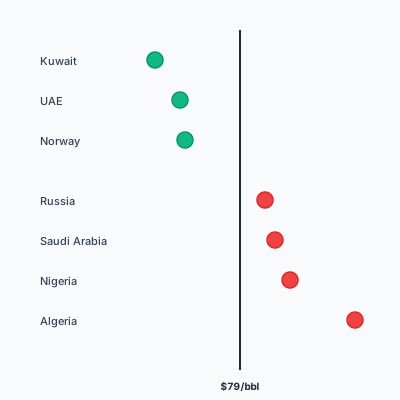
Oil Price & Fiscal Breakeven
Saudi Arabia needs $80 oil to pay its bills. It didn't always. We estimated fiscal breakeven prices for every major oil producer — and tracked how they rose.
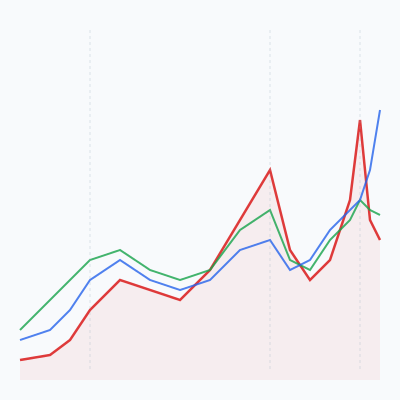
Commodity Supercycles & Inflation
Every inflation crisis in 50 years was foreshadowed by commodity markets. We traced the supercycles — and what they tell us about where we are now.
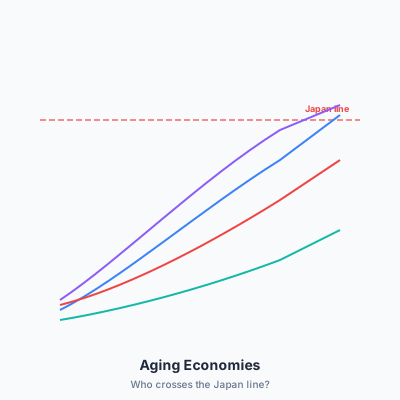
Aging Economies
Japan is the future — and most countries aren't ready. Population aging will break budgets, shrink workforces, and reshape economies. The timeline is visible in the data.
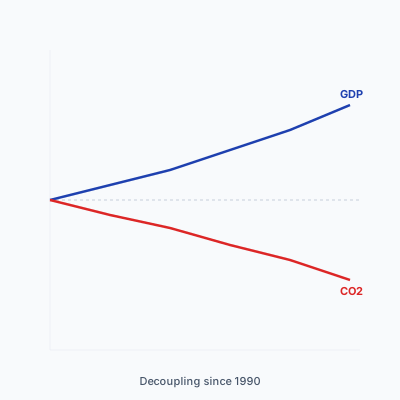
Carbon Cost of Growth
Can a country get richer without cooking the planet? Some have. Most haven't. We tracked GDP growth against CO2 emissions for 30 years — the decoupling story is real, but incomplete.
Carbon Inequality
The countries drowning in rising seas didn't cause the flood. We mapped who emitted what, when — and the per-capita gap is staggering.
Climate Vulnerability vs Emissions
Chad emits less CO2 in a year than a US state does in a day. Chad is also one of the most climate-vulnerable countries on Earth. The injustice is measurable.
Related explainers
Fiscal breakeven: the price that keeps the lights on
Every petrostate has a magic number — the oil price needed to balance the budget. It almost always goes up.
Base effects
Why year-over-year numbers can look dramatic simply because last year was weird.
Capacity factor
Why a country with 10 GW of solar capacity doesn't actually get 10 GW of electricity.

Capital account / financial account
The mirror image of the current account: how deficits get financed and why ‘money leaving’ is often backwards.

Carbon leakage
When strict climate policy in one country just pushes emissions across the border.

Consumption vs territorial emissions
The accounting trick that lets rich countries claim they're decarbonizing while importing carbon-heavy goods.