Pandemic Preparedness vs GDP
Rich countries assumed they were ready for a pandemic. They weren't. We mapped health infrastructure against income — the overperformers are poor countries with good systems.
Rich Countries Assumed They Were Ready for a Pandemic. They Weren't.
Before COVID-19, the conventional wisdom was straightforward: rich countries were prepared for pandemics and poor countries were not. The Global Health Security Index, published in October 2019, ranked the United States first in the world for pandemic preparedness. The United Kingdom came second. Brazil, with its crumbling public health system, ranked 22nd. And countries like Rwanda and Bangladesh were buried near the bottom.
Then the pandemic happened, and the rankings were exposed as fiction. The United States suffered more COVID-19 deaths per capita than Bangladesh. The United Kingdom's death toll dwarfed Rwanda's. Brazil's was catastrophic. Meanwhile, several low-income countries with strong community health systems managed the crisis with a discipline that wealthy nations could not muster.
The lesson was not that money is irrelevant to health infrastructure. It is not. But the relationship between national income and actual health system performance is far looser than most people assume -- and the gap is explained by something money cannot directly buy: governance, system design, and institutional commitment.
What Money Buys
Plot every country's GDP per capita against its DPT3 immunization coverage -- the share of one-year-olds who receive all three doses of the diphtheria-tetanus-pertussis vaccine -- and a familiar shape appears. Richer countries generally achieve higher coverage. The correlation between log-transformed GDP per capita and DPT3 coverage across 234 countries is 0.55.
Each bubble represents a country. Size reflects population. Color indicates region. The dashed line is the fitted curve: DPT3 coverage = 5.85 * ln(GDP per capita) + 30.2.
That correlation is meaningful but far from deterministic. At 0.55, income explains roughly 30 percent of the variation in immunization coverage. The other 70 percent is explained by factors that have nothing to do with how rich a country is.
Look at the left side of the chart. Below $5,000 per capita, you find countries ranging from 39 percent DPT3 coverage (Sudan) to 98 percent (Rwanda). Same income bracket, wildly different outcomes. The scatter is not random noise. It reflects real differences in how countries organize their health systems.
On the right side, the relationship flattens -- and develops its own anomalies. The United States, the richest large country in the dataset, achieves 92 percent DPT3 coverage. That sounds high until you realize that Rwanda, at one-twentieth the income, reaches 98 percent. Japan hits 97 percent. Most of Western Europe exceeds 95 percent. The United States has a coverage gap, and that gap has real consequences: it sits below the 95 percent threshold widely considered necessary for herd immunity against highly transmissible diseases.
The Overperformers
The residual -- the gap between a country's actual immunization coverage and what the income-fitted curve predicts -- reveals who is beating the odds and who is squandering their advantages.
Green bars are overperformers: countries achieving higher immunization coverage than their income would predict. Red bars are underperformers. The magnitudes are instructive.
Rwanda leads the overperformers with a residual of +20.5 percentage points. At $3,265 GDP per capita, the fitted curve predicts DPT3 coverage of about 77 percent. Rwanda delivers 98 percent. This is not an accident. Rwanda built a community health worker network that reaches every village in the country. Each village has three trained health workers responsible for maternal care, childhood immunization, and disease surveillance. The system is funded partly by performance-based financing -- health facilities and workers receive bonuses tied to measurable outcomes. It works because the government treats coverage as a logistics problem, not a funding problem.
Bangladesh tells a parallel story through a different mechanism. At $8,300 GDP per capita, it achieves 98 percent DPT3 coverage against a predicted 83 percent. Bangladesh's secret is not government efficiency but the world's largest NGO: BRAC. Founded in 1972, BRAC built a parallel health delivery system that reaches 100 million people. Its community health workers -- overwhelmingly women -- provide door-to-door immunization, family planning, and basic care in areas where government clinics are distant or dysfunctional. The Bangladeshi model demonstrates that health infrastructure can be built outside the state, provided there is institutional commitment and scale.
Nepal, Tajikistan, Malawi, and Burkina Faso round out the top overperformers, each exceeding their predicted coverage by 14 to 17 percentage points. The common thread is not wealth. It is systems: community health workers, vaccine cold chains that reach rural areas, routine immunization schedules enforced at the local level, and political will to treat coverage as a national priority.
Jamaica stands out among middle-income overperformers. At $11,340 GDP per capita, it achieves 99 percent DPT3 coverage -- the highest in the Western Hemisphere. Jamaica's public health system, inherited from British colonial infrastructure and expanded after independence, treats immunization as a non-negotiable function of government.
The Underperformers
The underperformers are more diverse in their failures, but the patterns are consistent.
Azerbaijan is the most dramatic underperformer: 51 percent DPT3 coverage against a predicted 89 percent, a residual of -37.7 points. Azerbaijan has oil wealth, a GDP per capita of $22,000, and a health system that has deteriorated since the Soviet collapse. Coverage has been declining for years as trust in the health system erodes and supply chains for vaccines remain unreliable.
Papua New Guinea achieves only 42 percent coverage despite having a GDP per capita comparable to Rwanda's. The difference is geography (extreme terrain makes delivery difficult) compounded by weak state capacity in rural areas.
Lebanon, Gabon, and Bolivia are middle-income countries with coverage 25-32 points below their predicted levels. Each has different proximate causes -- political collapse in Lebanon, resource-curse governance in Gabon, institutional fragmentation in Bolivia -- but the underlying pattern is the same: income that never translates into functioning health delivery.
Sudan and the Central African Republic sit at the bottom, but their underperformance relative to income is less surprising given active conflict. War destroys health systems faster than poverty does.
Governance as the Differentiator
If income explains only 30 percent of immunization variation, what explains the rest? The strongest candidate is governance.
The correlation between the World Bank's Government Effectiveness percentile rank and DPT3 coverage is 0.55 -- identical to the income correlation. But the two variables are partially independent. Countries with effective governments achieve high immunization coverage regardless of income level. Countries with ineffective governments fail to convert income into coverage.
The radar chart makes the pattern visible across five dimensions of health infrastructure: immunization coverage, hospital beds per capita, physicians per capita, health spending per capita, and government effectiveness. Compare Rwanda and the United States.
The United States dominates on spending and physician density. It spends more on health per capita than any other country in the world. But its immunization coverage is lower than Rwanda's, and its government effectiveness score, while high in absolute terms, does not translate into the kind of systematic coverage that Rwanda achieves at a fraction of the cost.
Nigeria shows what happens when every dimension is weak simultaneously. Low immunization, minimal hospital beds, few physicians, limited spending, and poor governance combine to produce a health system that fails its population despite being Africa's largest economy. Explore Nigeria's full economic profile to see the broader picture.
The lesson is not that money does not matter -- it clearly does for building hospitals and training doctors. The lesson is that immunization coverage, the most basic measure of whether a health system reaches its population, depends more on organizational capacity than on funding. A community health worker delivering vaccines on foot in rural Rwanda is more effective, per dollar spent, than a $400 billion health bureaucracy that cannot agree on a national immunization schedule.
The Immunization Divide
The 95 percent DPT3 coverage threshold is not arbitrary. For highly transmissible diseases like measles and pertussis, epidemiological models estimate that 92-95 percent population immunity is required to prevent sustained transmission. Below that threshold, outbreaks become inevitable. Above it, the disease cannot find enough susceptible hosts to propagate.
Most of Western Europe, Japan, South Korea, and several low-income overperformers (Rwanda, Bangladesh, Nepal) exceed this threshold. The United States, at 92 percent, sits just below it -- and the national average masks substantial subnational variation. Some U.S. states and counties have DPT3 coverage below 85 percent, driven by a combination of anti-vaccine sentiment, fragmented health insurance, and the absence of a universal primary care system.
This is the paradox of preparedness in rich democracies. The infrastructure exists. The vaccines exist. The funding exists. But the system lacks the coercive or persuasive capacity to achieve universal coverage. In Rwanda, the community health worker shows up at your door. In the United States, you need insurance, a pediatrician appointment, and the initiative to schedule it -- and a growing minority of parents actively refuse.
The anti-vaccine movement is, in epidemiological terms, a luxury of wealth. It exists primarily in countries rich enough that vaccine-preventable diseases have become rare enough to forget. No parent in rural Bangladesh refuses DPT3 because they read a discredited study about vaccine side effects. They refuse only if the health worker does not show up. In wealthy countries, the health worker equivalent (the pediatrician, the public health nurse) shows up -- but the parent says no.
This asymmetry became brutally visible during COVID-19. Countries with community health worker networks -- Rwanda, Bangladesh, Ethiopia, Vietnam -- achieved rapid vaccine deployment once doses became available. Their systems were designed for last-mile delivery. The United States, despite developing the vaccines, struggled with distribution, politicized uptake, and a decentralized health system that could not execute a national campaign.
Lessons from COVID
COVID-19 was a natural experiment in pandemic preparedness. The results contradicted the pre-pandemic consensus:
System design matters more than budget. A side-by-side comparison of Rwanda and the United States puts the contrast in economic terms. Rwanda spent roughly $60 per capita on health annually before the pandemic. The United States spent over $12,000. Rwanda's COVID death rate per capita was a fraction of America's. The difference was not testing capacity or ICU beds. It was contact tracing, community compliance, and a government that could execute a coordinated response because it had spent two decades building the infrastructure to do exactly that.
Governance is the binding constraint. Countries with effective governments -- measured by the World Bank's Government Effectiveness indicator -- achieved higher vaccination rates, faster containment, and lower excess mortality, controlling for income. The correlation between government effectiveness and COVID outcomes was stronger than the correlation between GDP per capita and COVID outcomes.
Trust is infrastructure. In countries where citizens trust the health system, compliance with public health measures was higher. Trust is not something you build during a crisis. It is the accumulated product of decades of reliable service delivery. Rwanda's community health workers are trusted because they have been showing up for twenty years. The CDC was not trusted by a significant portion of the American public because decades of politicization had eroded its authority.
Fragmentation kills. Federal systems with decentralized health authority -- the United States, Brazil, India -- struggled to mount coordinated responses. Unitary systems with centralized health authority -- Rwanda, Vietnam, South Korea -- moved faster. This is not an argument for authoritarianism. South Korea and Japan are democracies. It is an argument for institutional coherence in health system design.
The next pandemic will come. The question is whether wealthy countries will internalize the lesson that preparedness is a system, not a budget line -- or whether they will again assume that money alone makes them ready.
Methodology
Raw data inputs (all originally published by the issuing institutions; MacroVedia links below point to the harmonized series pages):
- GDP per capita, PPP (constant 2021 international $) — World Bank World Development Indicators
- Current health expenditure per capita (current US$) — World Bank World Development Indicators
- Immunization, DPT (% of children ages 12-23 months) — World Bank WDI (compiled from WHO/UNICEF estimates)
- Immunization, measles (% of children ages 12-23 months) — World Bank WDI (compiled from WHO/UNICEF estimates)
- Hospital beds (per 1,000 people) — World Bank WDI
- Physicians (per 1,000 people) — World Bank WDI
- Population, total — World Bank WDI
- Government Effectiveness — Percentile Rank — World Bank Worldwide Governance Indicators
Cross-section: Latest available year per country where both GDP per capita and DPT3 immunization data exist (typically 2022-2023). 234 countries included.
Fitted curve: Log-linear regression of DPT3 coverage on log GDP per capita:
dpt_coverage_hat = a * ln(gdp_pc) + b
residual_i       = dpt_coverage_i - dpt_coverage_hat_i
where a ≈ 5.85 and b ≈ 30.2. Positive residuals flag overperformers (higher coverage than income predicts), negative residuals flag underperformers.
Radar normalization: Each dimension is min-max normalized to 0-100 across all countries with available data, using the latest available year per indicator:
score_i = 100 * (x_i - min(x)) / (max(x) - min(x))
Dimensions: immunization (DPT3), hospital beds per 1k, physicians per 1k, health spending per capita, government effectiveness percentile.
Correlation:
r(ln(gdp_pc), dpt3)              = 0.55   (n = 234)
r(gov_effectiveness_pct, dpt3)   = 0.55   (n = 197)
Pearson correlation between log GDP per capita and DPT3 coverage is 0.55. Pearson correlation between government effectiveness percentile rank and DPT3 coverage is also 0.55, indicating governance quality captures variance largely orthogonal to raw income.
Related research
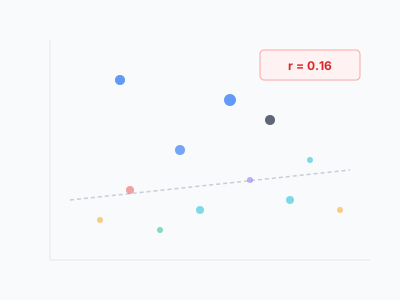
Education Spending vs Innovation Output
Some countries spend billions on education and produce no patents. Others spend less and lead the world in innovation. The missing ingredient isn't money — it's R&D.
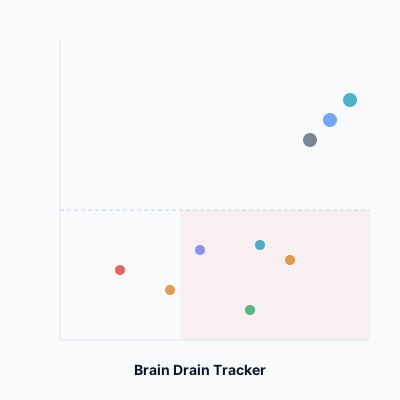
Brain Drain Tracker
Nigeria trains doctors. Britain employs them. We tracked the global brain drain — who loses talent, who gains it, and whether remittances make up the difference.
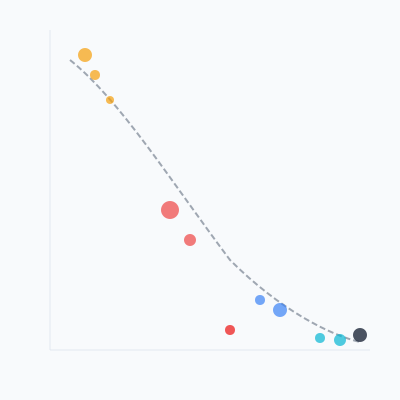
Child Survival & National Income
If you could know only one number about a country, it should be under-5 mortality. It captures income, health, education, water, and women's empowerment in a single statistic.
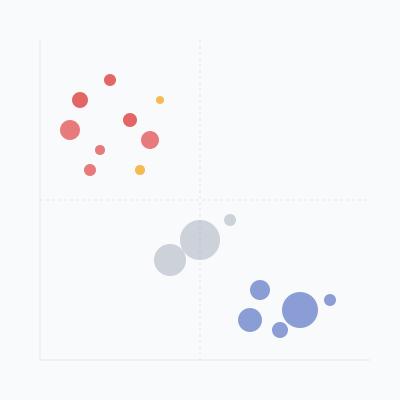
Climate Vulnerability vs Emissions
Chad emits less CO2 in a year than a US state does in a day. Chad is also one of the most climate-vulnerable countries on Earth. The injustice is measurable.
Corruption Tax
Corruption isn't a moral issue — it's a tax, and we can estimate the rate. Countries with worse governance attract less investment, grow slower, and develop less. The data quantifies the cost.
Who Funds Their Own Defense
Who's actually paying for Western security? We mapped NATO defense spending against the 2% target. The free-riding is measurable — and the dollar gap is enormous.
Related explainers

Demographic transition
The four-stage model that explains why populations explode, stabilize, and then shrink — and why most of global economics follows from it.
Dutch disease
How a resource windfall can hollow out the rest of your economy — and why the real disease is mismanagement.
Economic sanctions: what they are, what they aren’t, and how they leak
Sanctions are financial plumbing and export controls—not magic. They bite through chokepoints and leak via detours.
Food security: It's not about growing everything yourself
Why food security depends on trade routes as much as farmland — and what actually breaks it.

Governance indicators
What the World Bank's Worldwide Governance Indicators actually measure — and why you should trust the trends more than the rankings.
Industrial policy
The spectrum of policies used to shape what an economy produces—and why the design matters more than the ideology.