Migration & Remittances
The world's largest poverty reduction program isn't run by any government — it's run by migrants sending money home. Remittances now dwarf foreign aid for most developing countries.
The World's Largest Poverty Reduction Program Isn't Run by Any Government
Somewhere right now, a Nepali construction worker in Qatar is standing in line at an exchange house. He will send $300 home -- about two weeks of wages for work that involves twelve-hour days in temperatures that would shut down a European jobsite. His wife in Kathmandu will use it to pay school fees, buy medicine for his mother, and put food on the table. Multiply this by hundreds of millions of people, and you get the largest poverty reduction program on earth.
It is not run by the World Bank. It is not run by USAID. It is not designed by development economists or debated in the UN General Assembly. It is run by ordinary people who left home to work, and who send money back because their families need it.
In 2024, global remittances reached $892 billion. That is more than six times total foreign aid. For most developing countries, it is the single largest source of external finance -- bigger than foreign direct investment, bigger than development assistance, bigger than portfolio flows. And unlike aid, which comes with conditions and bureaucracy, remittances go directly to the people who need them most.
The Scale: $892 Billion and Growing
The growth has been relentless. In 2000, global remittances totaled $122 billion. By 2024, that number had grown more than sevenfold. Even the 2008 financial crisis barely dented the trend -- remittances dipped slightly in 2009 and resumed growing the following year. COVID-19, which was supposed to devastate remittance flows as migrants lost jobs, had almost no visible impact at all. The line just kept climbing.
This resilience is one of the most important features of remittances. Foreign direct investment flees during crises. Portfolio capital vanishes at the first sign of trouble. Aid budgets get cut when donor countries face their own fiscal pressures. But remittances are sticky. A father does not stop sending money home because there is a recession. He might send less, but he does not stop. The obligation is personal, not institutional. That makes remittances the most stable source of external finance for developing countries -- precisely the kind of money you want when times are hard.
India receives the most in absolute terms -- $138 billion in 2024, driven by its enormous diaspora in the Gulf states, the United States, and the United Kingdom. Mexico is second at $68 billion, almost entirely from workers in the United States. The Philippines ($40 billion), Pakistan ($35 billion), and Egypt ($30 billion) round out the top five.
But absolute numbers miss the real story. India's $138 billion is 3.5% of its massive GDP. For smaller, poorer countries, remittances are not a supplement to the economy. They are the economy.
Who Depends Most: When the Economy IS Remittances
The bar chart below ranks the 25 countries most dependent on remittances as a share of GDP. The colors reflect geography -- and the geography tells its own story.
Tajikistan leads the world at 47.9% of GDP. Nearly half the country's economic output is money sent home by Tajik workers, overwhelmingly from Russia. Think about what that means. If Russia decided to expel Tajik workers tomorrow -- as it has periodically threatened -- Tajikistan would lose half its economy. Not in a gradual decline. Overnight.
Tonga is second at 42.6%. This tiny Pacific island nation of 107,000 people has more Tongans living in New Zealand, Australia, and the United States than in Tonga itself. The economy, in a meaningful sense, has been exported. What remains on the islands runs on diaspora money.
Lebanon at 33.3% is a different case -- a middle-income country that collapsed. Before the 2019 financial crisis, remittances were perhaps 12-15% of GDP. The percentage spiked not because remittances grew but because GDP shrank by more than half. Lebanese abroad are now propping up what remains of the economy. Banks have failed, the currency has lost 90% of its value, but the Western Union transfers keep coming.
The Central American corridor is striking. Nicaragua (26.6%), Honduras (25.7%), El Salvador (24.0%), and Guatemala (19.1%) all depend on remittances for roughly a fifth to a quarter of GDP. Almost all of it comes from one place: the United States. This creates an extraordinary geopolitical vulnerability. Immigration policy in Washington is not just a domestic political issue -- it is the most important economic policy variable for four Central American nations.
Then there are the South Asian labor exporters. Nepal (26.2%) sends workers to the Gulf and Malaysia. Bangladesh and Pakistan are in the same pattern, though at somewhat lower percentages. The Philippines has turned labor export into an explicit national strategy -- the country trains nurses, engineers, and seafarers specifically for overseas deployment. It works. The $40 billion in annual remittances is the single most important source of foreign exchange.
Bigger Than Aid: Remittances vs FDI vs ODA
Development economists have spent decades debating how to get more aid money to poor countries. The data suggests they have been asking the wrong question. For most developing countries, remittances already dwarf both foreign aid and foreign direct investment.
The chart above compares three financial flows as a share of GDP for the top developing-country receivers. The pattern is consistent: the purple bar (remittances) dominates.
For Guatemala, remittances are 19% of GDP. FDI is 1.6%. ODA is 0.4%. Remittances are twelve times larger than FDI and nearly fifty times larger than aid. For Pakistan, the ratio is 9.4% remittances versus 0.7% FDI and 1.1% ODA. For Bangladesh, 6.1% remittances versus 0.3% FDI.
India is instructive. At $138 billion, Indian remittances are larger than the entire foreign aid budget of every donor country in the world combined. India's remittances are five times its FDI inflows and sixty times its ODA receipts. The largest single development program for India is not any government initiative -- it is the 18 million Indians working abroad.
The implications are profound. When policymakers in Nigeria or Morocco or the Philippines think about economic strategy, the most important variable is not what the World Bank will lend or what bilateral donors will give. It is whether their workers abroad can keep sending money home. Policy should follow the money, and the money is coming from migrants.
The Human Story Behind the Numbers
Behind every dollar in these charts is a specific person making a specific sacrifice. A Filipino nurse working double shifts in a Saudi hospital. A Honduran roofer in Houston wiring money through a strip-mall remittance shop. A Bangladeshi garment worker in Dubai who shares a room with seven other men to minimize expenses so he can send more home.
These are not comfortable arrangements. The Gulf labor model, which drives remittances for much of South Asia, involves the kafala sponsorship system -- workers tied to specific employers, often unable to leave or change jobs, housed in labor camps, working in extreme heat. The ILO estimates that 50 million people are in conditions of modern forced labor globally. Many of them are remittance senders.
The Philippines has made this explicit. The government operates the Philippine Overseas Labor Office, which actively recruits and deploys workers abroad. Filipino seafarers crew roughly a quarter of the world's commercial ships. Filipino nurses staff hospitals across the Gulf, the UK, and North America. The government calls them "modern-day heroes." Critics call it a policy of exporting people because the domestic economy cannot employ them.
Is it a model or exploitation? Both, probably. The remittance money lifts families out of poverty, builds houses, educates children. But it also means families separated for years, parents who watch their children grow up through phone screens, communities where every working-age adult has left.
The Vulnerability: What Happens When Hosts Catch a Cold
The stability of remittances -- their resilience through crises -- has limits. The flows are stable because the obligation is personal. But the ability to send depends on having a job. And the jobs are in someone else's economy.
COVID-19 tested this. The global financial crisis of 2009 caused only a brief dip in remittances. But COVID lockdowns in 2020 physically prevented migrants from working, particularly in the Gulf states where construction stopped and service sectors shut down. The expected catastrophe -- projections of 20%+ declines -- did not materialize. Remittances dipped only briefly and then surged. Why? Migrants drew down savings. Host countries provided some support. And, critically, digital transfer channels made it easier to send money even when physical movement was restricted.
But the structural vulnerability remains. Tajikistan's dependence on Russia means that Russian economic sanctions, ruble devaluation, or anti-immigrant sentiment directly translates into economic crisis in Tajikistan. Central America's dependence on the United States means that American immigration enforcement is Central American economic policy. The Gulf states' dependence on cheap imported labor could shift if automation advances or domestic employment policies change.
And there is a subtler vulnerability: brain drain. When the most motivated, most capable people in a country leave to work abroad, they send money back -- but they also take their skills, their energy, their capacity to build things at home. Remittances can sustain an economy. It is less clear that they can develop one.
The Transfer Tax: 6% on the World's Poorest People
Sending money home costs money. The global average cost of remitting $200 is about 6.3% -- meaning that out of every $200 a migrant earns and sends, $12.60 is taken by transfer companies, banks, and exchange rate margins. For some corridors, the cost is much higher. Sending money to Sub-Saharan Africa averages over 8%. Sending money from South Africa to neighboring countries can exceed 15%.
At 6.3% of $892 billion, the global remittance industry extracts roughly $56 billion per year in fees. That is more than most countries receive in foreign aid. It is a tax on the world's poorest people, paid for the privilege of sending their own money to their own families.
The Sustainable Development Goals include a target to reduce remittance costs to 3% by 2030. Progress has been slow. Banks and money transfer operators have little incentive to lower prices, particularly in corridors where competition is limited and regulation favors incumbents. Mobile money and cryptocurrency have introduced some competition -- M-Pesa in East Africa, for instance, has reduced costs on some corridors -- but the global average has barely moved in a decade.
There is a straightforward policy win here. If remittance costs dropped from 6% to 3%, an additional $27 billion per year would reach families in developing countries. No aid budget. No loan conditions. No institutional overhead. Just letting people keep more of the money they earned.
What This Means
Remittances challenge the way we think about development. The conventional model involves rich countries giving money to poor countries through official channels -- aid agencies, multilateral banks, NGO programs. But the actual flow of money from rich to poor is dominated by something far simpler: people working and sending cash home.
The policy implications are underappreciated. Immigration policy in rich countries is development policy for poor countries. Transfer costs are a regressive tax on the global poor. Labor rights for migrant workers are not just a humanitarian concern -- they directly affect economic stability in origin countries.
For the countries at the top of the dependency chart -- Tajikistan, Tonga, Lebanon, the Central American corridor -- the question is whether remittance dependency is a bridge or a trap. A bridge, if the money funds education, health, and eventually domestic economic development. A trap, if it creates a permanent pattern where the most productive people leave and the economy runs on transfers rather than production.
The data cannot answer that question. But it can show the scale. Nearly $900 billion a year. More than six times total foreign aid. Growing every year. The world's largest poverty reduction program, run not by any institution but by hundreds of millions of people who left home and did not forget where they came from.
Methodology
Raw data inputs
All indicators come from the World Bank World Development Indicators (WDI) dataset on MacroVedia.
- Personal remittances, received (% of GDP) -- country-level remittance dependency ranking.
- Personal remittances, received (current US$) -- global trend (WLD aggregate) and absolute receipts by country.
- Foreign direct investment, net inflows (% of GDP) -- FDI leg of the remittances-vs-FDI-vs-ODA comparison.
- Net official development assistance received (current US$) -- ODA leg of the comparison (converted to % of GDP, see below).
Derived metrics
The remittances-vs-FDI-vs-ODA comparison requires putting three flows on a common basis. Remittances and FDI are published directly as % of GDP. ODA is published only in current US$, so we derive implied nominal GDP from the remittances pair and divide:
implied_gdp_usd = remittances_usd / (remittances_pct_gdp / 100)
oda_pct_gdp     = (oda_usd / implied_gdp_usd) * 100
Where the reference year has no observation for a given leg, we fall back up to two years earlier. Negative FDI observations (net outflows) are clipped to zero in the grouped-bar visual for visual clarity only; the underlying data is unchanged.
Country scope
Countries are those carrying a World Bank income-level classification (High income, Upper middle income, Lower middle income, or Low income). Regional and income-group aggregates (WLD, LMY, EAP, etc.) are excluded from country-level analysis; the global trend chart uses only the WLD aggregate row.
Latest year
The dependency ranking and triple comparison take each country's most recent non-null observation. For most countries this is 2024; a handful resolve to 2023.
Limitations
Remittance data captures only formal channels -- the actual volume is likely 30-50% higher due to informal transfers (hawala, hand-carried cash, cryptocurrency). Some countries have data only through 2023. ODA figures are net and can be negative for countries that are themselves donors. The implied-GDP derivation inherits any revisions or lag in the remittances %-of-GDP series, so the derived oda_pct_gdp should be read as directional rather than precise.
Data sourced from the World Bank World Development Indicators via MacroVedia.
Related research
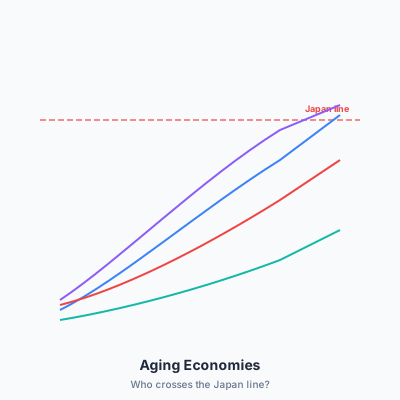
Aging Economies
Japan is the future — and most countries aren't ready. Population aging will break budgets, shrink workforces, and reshape economies. The timeline is visible in the data.
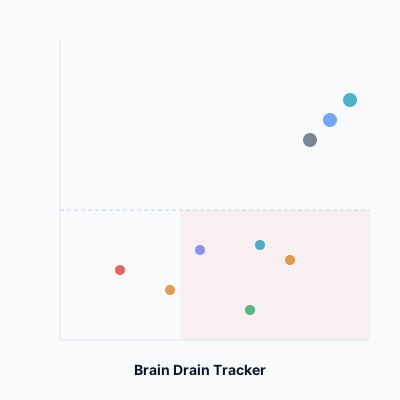
Brain Drain Tracker
Nigeria trains doctors. Britain employs them. We tracked the global brain drain — who loses talent, who gains it, and whether remittances make up the difference.
The China Dependency Index
When did China become your country's most important trade partner? For half the world, it already has. We mapped the dependency — and the risks.
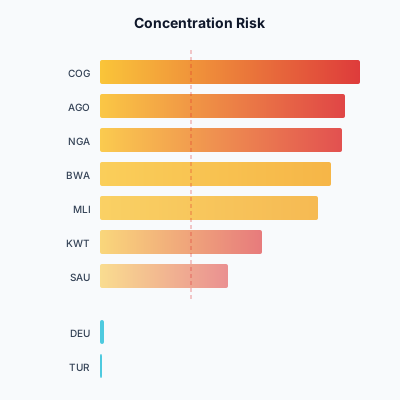
Concentration Risk
Some countries are one product away from crisis. We computed export concentration for every economy — the results are a map of global economic fragility.

The Debt-Trade Spiral
Persistent trade deficits and fiscal deficits compound into a debt spiral visible across decades. The data shows which countries are trapped — and which broke free.
The Demographic Dividend vs Demographic Bomb
Half the world is getting old. The other half has millions of young people with no jobs. The demographic dividend is real — but only if you convert it.
Related explainers
“China is dumping”: What dumping actually means (and what it doesn’t)
Low prices aren’t automatically dumping. Dumping is a legal test tied to price discrimination and injury.

Bilateral deficit with China: why it’s a terrible headline metric
Bilateral deficits ignore supply chains and value-added. Here’s why they mislead—and what to use instead.

Carbon leakage
When strict climate policy in one country just pushes emissions across the border.

Comparative advantage
Why trade can benefit both sides even when one side is ‘better at everything’—and why that doesn’t settle policy debates.

Demographic transition
The four-stage model that explains why populations explode, stabilize, and then shrink — and why most of global economics follows from it.

Dependency ratio
The ratio that tells you how many workers are carrying how many non-workers — and why it's the ticking clock behind every pension crisis.