Renewable Transition Scoreboard
Which countries are actually transitioning to renewables — and which are just talking about it? We ranked every country by solar and wind adoption. The leaders aren't who you'd expect.
The Renewable Transition Scoreboard: Who Is Actually Doing It?
Every country claims to be transitioning to renewable energy. The pledges are solemn, the targets ambitious, the press releases exhausting. But which countries have actually shifted their electricity grids away from fossil fuels -- and which are coasting on geography, legacy infrastructure, or outright bluster?
The distinction matters more than most climate discussions acknowledge. Norway generates 98% of its electricity from renewables. Denmark generates 87%. Both numbers appear in the same column of the same ranking table. But the stories behind them are entirely different. Norway's number comes from hydroelectric dams built decades ago, exploiting abundant rivers and fjords that most countries simply do not have. Denmark's number comes from a deliberate, expensive, politically contested 25-year campaign to build wind turbines and solar panels on flat farmland with no natural energy advantages. One is geography. The other is policy. Conflating the two produces misleading scorecards.
We pulled generation data from IRENA for 161 countries, decomposed renewable electricity into its component technologies (solar, wind, hydro, bioenergy, geothermal), and cross-referenced with GDP per capita from the World Bank to test the relationship between wealth and energy transition. The question is not "who has the most renewable electricity" but "who is building the most new renewable capacity, and how fast."
The Scoreboard: Solar and Wind as the Real Test
Total renewable share is a misleading metric. It rewards countries that happen to sit on rivers. Solar and wind share -- the technologies that require active investment, policy support, and grid integration -- is the honest measure of transition effort.
Denmark leads the world at 67.5% of electricity from solar and wind alone. This is not an accident. Denmark started building offshore wind in the early 1990s, maintained feed-in tariffs through political cycles, and accepted the grid management costs of high intermittency. The result is a power system that would have been called impossible 20 years ago.
Lithuania at 53.9% is a genuine surprise. A small Baltic state with no obvious renewable advantages has built one of Europe's most solar-and-wind-dependent grids, driven largely by EU renewable targets and access to the Nordic electricity market as a balancing resource.
Uruguay at 40.1% solar+wind (91.5% total renewable) is the developing world's standout. Between 2008 and 2017, Uruguay went from near-zero wind power to generating 40% of its electricity from wind alone. It did this through transparent auction mechanisms and credible long-term contracts that attracted private capital without sovereign guarantees. The transformation took less than a decade.
Germany at 39.9% solar+wind demonstrates what the world's fourth-largest economy can achieve -- and the costs involved. The Energiewende has cost consumers over EUR 200 billion in renewable surcharges since 2000. It simultaneously phased out nuclear power, which many analysts regard as a strategic error that slowed overall decarbonization. Germany's grid is deeply renewable but also deeply complicated.
Greece, Spain, and Ireland cluster around 39-40% solar+wind share. Southern Europe's solar advantage and Ireland's Atlantic wind resource are paying dividends. Portugal at 37.3% solar+wind atop 70% total renewable (with substantial hydro) rounds out the Iberian success story.
The United Kingdom at 32.8% solar+wind is lower than many assume, partly because British solar output is limited by its latitude. But the UK's offshore wind sector is world-class -- the country operates more offshore wind capacity than any nation except China.
The Hydro Illusion
Look at the full renewable share column and you see a different ranking: Norway (97.7%), Brazil (89%), Uruguay (91.5%), Denmark (86.6%). Norway and Brazil are at the top because of hydroelectric dams, most of them built 30-60 years ago. These are genuine zero-carbon electricity sources, and they provide baseload stability that wind and solar cannot. But they are not replicable. You cannot build the next Norway in Saudi Arabia or Nigeria. The geography simply does not exist.
Brazil's 89% renewable share masks a more complex reality. Brazilian electricity is roughly 65% hydro, with solar and wind contributing 20.7%. The hydro dominance makes Brazil's grid clean by accident of the Amazon basin. But Brazil's most recent capacity additions have been heavily tilted toward wind and solar, partly because the best hydro sites are already developed and partly because of growing political resistance to further Amazon dam construction.
Canada, New Zealand, and several Latin American countries present similar profiles: high total renewable share driven by legacy hydro, with solar and wind as minor components. These countries get credit in renewable rankings that they did not earn through recent policy effort.
Does Wealth Predict Transition?
The conventional wisdom is that rich countries transition faster because they can afford the upfront investment. The data tells a messier story.
The scatter plot reveals no clean relationship between GDP per capita and renewable share. Some of the world's richest countries -- Japan (21.6% renewable), South Korea (9.4%), Singapore -- have low renewable shares. Some of the poorest -- Ethiopia, Mozambique -- have high shares from hydro. The middle-income countries show the widest variance: China at 30.1% sits alongside Saudi Arabia at 1.2%.
What wealth does buy is the ability to overbuild. Rich countries can afford to install more solar and wind capacity than their grid strictly needs, using excess generation for exports, storage, or curtailment. Denmark overbuilds deliberately, exporting surplus wind power to Norway (which stores it in reservoirs) and importing Norwegian hydro when the wind dies. This is expensive grid management that poor countries cannot afford.
The real predictor is not GDP but political will combined with grid flexibility. Uruguay (GDP per capita $22,000) achieved higher solar+wind penetration than the United States (GDP per capita $73,000) because Uruguay's government made a coherent long-term commitment that the US political system -- with its two-year election cycles and state-by-state regulatory fragmentation -- could not match. Compare the two economies side by side and the wealth gap makes Uruguay's achievement all the more remarkable.
The Leapfroggers: Where Growth Is Fastest
The most interesting signal in the data is not the current scoreboard but the growth rate. Which countries are adding solar and wind capacity fastest?
Vietnam leads with a 90.5% compound annual growth rate in solar+wind capacity from 2015 to 2023. Vietnam went from essentially zero solar capacity to over 16 GW in five years, one of the fastest solar buildouts in history. This was driven by generous feed-in tariffs that attracted massive private investment -- perhaps too generous, as the grid struggled to absorb the new capacity, leading to widespread curtailment. Vietnam's story is one of ambition outpacing infrastructure.
The UAE at 89.2% CAGR and Saudi Arabia at 82.1% CAGR represent the petrostates' hedging strategy. Both countries have realized that burning oil for domestic electricity while exporting it would be irrational when solar is cheaper. Saudi Arabia's solar resource is among the world's best -- the kingdom receives roughly twice as much solar radiation per square meter as Germany. The economics of solar in the Gulf are compelling regardless of climate policy.
Argentina at 49.7% CAGR, Colombia at 57.8%, and Kazakhstan at 46.6% are middle-income countries where renewable growth is accelerating from low bases. These are not climate-policy-driven transitions in the European sense. They are economic decisions: solar and wind are now the cheapest source of new electricity in most of the world, and these countries are responding to price signals.
The developing country presence on this list -- highlighted in amber -- challenges the narrative that the energy transition is a rich-world luxury. Vietnam, El Salvador, Lebanon, Colombia, and Argentina are all building solar and wind capacity faster than most advanced economies. They are doing so not because of Paris Agreement pledges but because the economics have flipped. Solar panels that cost $76 per watt in 1977 cost $0.20 per watt today. Wind turbines have followed a similar cost curve. At these prices, renewable energy is not charity -- it is the rational economic choice.
The Giants: China and India
No discussion of the energy transition is complete without the two countries that will determine its success or failure.
China installed more solar capacity in 2023 alone (217 GW) than the United States has installed in total (175 GW). China's total renewable capacity is 1.45 million MW -- more than the next five countries combined. In absolute terms, China is doing more to build renewable energy than any other country by a wide margin.
But China's electricity system is enormous -- roughly 9,500 TWh per year -- and its renewable share is only 30.1%, with solar+wind at 15.6%. Coal still generates over 60% of Chinese electricity. China is simultaneously the world's largest renewable energy investor and the world's largest coal consumer. Both statements are true, and neither cancels the other. China's renewable buildout is staggering in scale but insufficient in proportion, at least so far.
India presents a starker challenge. With 19.9% renewable share and 9.8% solar+wind, India's grid remains heavily coal-dependent. India has ambitious targets -- 500 GW of non-fossil capacity by 2030 -- but grid infrastructure, land acquisition, and financing constraints have slowed deployment. India's solar potential is enormous. Its execution has been uneven. Explore India's full economic picture to understand the scale of the infrastructure gap.
The per-capita framing matters here. China's renewable capacity per capita is roughly 1,030 watts per person. Denmark's is 2,180 watts per person. India's is 125 watts per person. The gap between what developing countries have built and what they need is immense.
What Nuclear Tells Us
France generates 70% of its electricity from nuclear power. Its renewable share is only 26.6%, with solar+wind at 13.8%. In most renewable scorecards, France ranks poorly. But France's electricity is among the lowest-carbon in the world -- roughly 55g CO2/kWh versus 350g for Germany and 380g for the United States. Nuclear provides the same climate benefit as renewables (zero direct emissions) without the intermittency challenges.
France's case exposes a philosophical tension in the energy transition debate. If the goal is to reduce carbon emissions, nuclear works. France proved this decades ago. But the renewable energy movement has largely excluded nuclear, and most renewable targets explicitly count only wind, solar, hydro, and biomass. France is penalized in renewable rankings for having solved the carbon problem a different way.
Whether this exclusion is justified is beyond the scope of a data article. But it is worth noting that the five lowest-carbon electricity grids in the world -- Norway, France, Sweden, Switzerland, and Finland -- all rely heavily on either hydro or nuclear or both. No country has yet achieved very low-carbon electricity using solar and wind alone, though Denmark (87% renewable, 67.5% solar+wind) is getting close.
Sub-Saharan Africa: Highest Potential, Lowest Adoption
Sub-Saharan Africa receives more solar radiation per square meter than any other inhabited region. It also has the lowest renewable energy capacity per capita. Nigeria, Africa's largest economy, generates roughly 19% of its electricity from renewables (almost entirely hydro) and has negligible solar capacity for a country of 220 million people sitting under equatorial sun.
The barriers are not technological. Solar panels cost the same in Lagos as in Lisbon. The barriers are financial and institutional: weak grids that cannot absorb variable generation, limited access to long-term project finance, currency risk that deters foreign investment, and regulatory uncertainty that prevents developers from committing capital.
This is the transition's most important frontier. If Sub-Saharan Africa follows the coal-to-gas-to-renewables pathway that rich countries took, global emissions targets are unachievable. If Africa leapfrogs directly to renewables -- as it leapfrogged landlines for mobile phones -- the arithmetic changes dramatically. The data suggests this leapfrog has barely begun.
The Honest Verdict
The renewable transition is real but profoundly uneven. A handful of countries -- Denmark, Uruguay, Portugal, Germany, Spain, Greece, Lithuania -- have built genuinely new renewable energy systems through deliberate policy effort. A larger group -- Norway, Brazil, Canada, New Zealand -- enjoy high renewable shares from legacy hydroelectric infrastructure they did not recently build. The world's two most important energy consumers -- China and India -- are building renewable capacity at unprecedented scale while remaining deeply dependent on coal.
Three facts should anchor any honest assessment:
Solar and wind are now the cheapest source of new electricity in most of the world. This was not true a decade ago. It is now true almost everywhere, and it changes the transition from a subsidy-dependent policy exercise to an economic inevitability. The question is no longer "will renewables win?" but "how fast?"
Grid integration is the binding constraint, not generation cost. Denmark can run on 87% renewables because it has interconnectors to Norway and Sweden that provide balancing. Most developing countries lack this infrastructure. Storage (batteries, hydrogen, pumped hydro) is improving but not yet cheap enough to solve intermittency at continental scale.
The transition is 25 years behind schedule. The world installed 510 GW of renewable capacity in 2023. To limit warming to 1.5C, the IEA estimates the world needs to install 1,200 GW per year by 2030. We are roughly halfway there. The gap is closing, but it is still enormous, and it is concentrated in the developing world where financing, grid infrastructure, and institutional capacity are weakest.
The scoreboard shows progress. It does not show enough.
Methodology
Renewable electricity generation: IRENA Renewable Energy Statistics, 2000-2023. Generation data in GWh decomposed by technology: solar photovoltaic, concentrated solar thermal, onshore wind, offshore wind, hydropower (excluding pumped storage), bioenergy, and geothermal. Total renewable share computed using IRENA's RE share of electricity generation series.
Solar+wind share of total electricity — derived metric:
total_electricity_gwh = total_renewable_gwh / (re_share_pct / 100)
solar_wind_share_pct  = (solar_pv_gwh + solar_thermal_gwh
                         + onshore_wind_gwh + offshore_wind_gwh)
                        / total_electricity_gwh * 100
Solar+wind capacity CAGR (2015-2023) — derived metric:
sw_cap_mw(year) = solar_pv_cap_mw(year)
                  + onshore_wind_cap_mw(year)
                  + offshore_wind_cap_mw(year)
cagr = (sw_cap_mw(2023) / sw_cap_mw(2015)) ^ (1 / 8) - 1
Only countries with 2015 starting capacity >10 MW included (to avoid spurious growth rates from tiny bases). Only countries with 2023 ending capacity >500 MW shown in the growth chart.
Renewable capacity per capita — derived metric:
renew_cap_per_capita_w = total_renew_cap_mw * 1,000,000 / population
Country coverage: 161 countries with matching data across IRENA and World Bank sources. Countries with population below 500,000 excluded to remove city-states and micro-territories. Regions, territories, and aggregates excluded.
Raw data inputs
World Bank World Development Indicators (catalogued on MacroVedia):
- GDP per capita, PPP (constant 2021 international $) — from World Bank WDI
- Population, total — from World Bank WDI
- Renewable electricity output (% of total electricity output) — from World Bank WDI
- Electricity production from renewable sources, excluding hydroelectric (% of total) — from World Bank WDI
IRENA Renewable Energy Statistics (sourced directly from IRENA, not yet catalogued on MacroVedia):
- Total renewable electricity generation (GWh)
- Solar photovoltaic generation (GWh)
- Concentrated solar thermal generation (GWh)
- Onshore wind generation (GWh)
- Offshore wind generation (GWh)
- Hydropower excluding pumped storage generation (GWh)
- Bioenergy generation (GWh)
- Geothermal generation (GWh)
- Total renewable installed capacity (MW)
- Solar photovoltaic installed capacity (MW)
- Onshore wind installed capacity (MW)
- Offshore wind installed capacity (MW)
- Renewable share of electricity generation (%)
Data sourced from the International Renewable Energy Agency (IRENA) and the World Bank.
Related research
Carbon Cost of Growth
Can a country get richer without cooking the planet? Some have. Most haven't. We tracked GDP growth against CO2 emissions for 30 years — the decoupling story is real, but incomplete.
Carbon Inequality
The countries drowning in rising seas didn't cause the flood. We mapped who emitted what, when — and the per-capita gap is staggering.
Climate Vulnerability vs Emissions
Chad emits less CO2 in a year than a US state does in a day. Chad is also one of the most climate-vulnerable countries on Earth. The injustice is measurable.
The Energy-Prosperity Ladder
There is a clear energy consumption threshold countries must cross for human development. Below ~4,000 kWh per capita, every additional kilowatt-hour transforms lives. Above 10,000, you're just heating empty rooms.
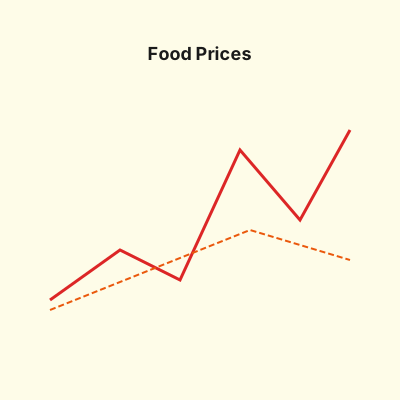
Agricultural Trade & Food Prices
The Arab Spring wasn't about politics. It started with the price of bread. We traced how global commodity spikes ripple into food crises — and who gets hit first.
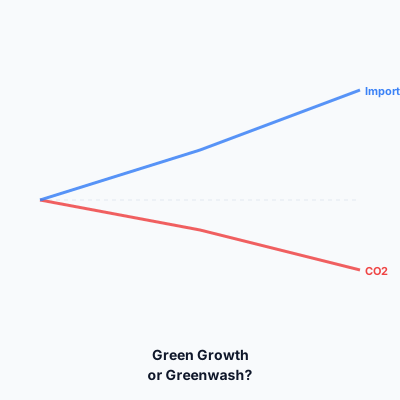
Green Growth or Greenwash
Europe's emissions fell 30%. Its manufactured imports rose 40%. Coincidence? We tested whether 'decoupling' is real or just offshored pollution.
Related explainers
Capacity factor
Why a country with 10 GW of solar capacity doesn't actually get 10 GW of electricity.

Carbon leakage
When strict climate policy in one country just pushes emissions across the border.

Consumption vs territorial emissions
The accounting trick that lets rich countries claim they're decarbonizing while importing carbon-heavy goods.

Dutch disease
How a resource windfall can hollow out the rest of your economy — and why the real disease is mismanagement.
Energy intensity
How much energy it takes to produce a dollar of GDP — and why the trend can mislead you.
Fiscal breakeven: the price that keeps the lights on
Every petrostate has a magic number — the oil price needed to balance the budget. It almost always goes up.