South-South Trade Rise
The world's fastest-growing trade routes don't pass through the West. South-South trade has outpaced every other category for 20 years. We mapped the new corridors.
The World's Fastest-Growing Trade Routes Don't Pass Through the West
In 2016, trade between developing countries -- what economists call South-South trade -- totaled $2.1 trillion. By 2023, it had reached $3 trillion. That is a 44% increase in seven years, and it understates the structural shift underway because the real story is not just the volume but the new corridors being built: China to Vietnam, India to Bangladesh, Thailand to Indonesia, Brazil to Argentina.
We classified every bilateral trade flow in the UN Comtrade database using the World Bank's income classification. "North" means High income. "South" means everything else -- Upper middle income, Lower middle income, and Low income countries. Then we tracked how trade between these groups has evolved from 2016 to 2024. The picture that emerges is one of a trading system that is slowly but unmistakably becoming less Western-centric.
The Composition of Global Trade
The stacked area chart below shows total merchandise exports broken into three categories: North-North trade (between high-income countries), North-South trade (between high-income and developing countries), and South-South trade (between developing countries).
North-North trade still dominates -- roughly $13.3 trillion in 2024, accounting for just over half of all classified trade flows. This is the transatlantic and trans-Pacific commerce that built the postwar trading system: the United States and Europe buying from each other and from Japan, Canada, and Australia.
North-South trade is the second-largest category at roughly $9.6 trillion. This captures the classic development-trade pattern: developing countries exporting raw materials and manufactured goods to rich countries, and importing machinery, technology, and consumer goods in return.
South-South trade, at $3 trillion, is the smallest category in absolute terms -- about 11-12% of classified global trade. But that share has been remarkably persistent and gently rising, from 11.1% in 2016 to 11.6% in 2024, even as total trade volumes surged. More importantly, South-South trade weathered the 2020 pandemic shock better than North-North trade and recovered faster.
Who Grew Fastest?
The compound annual growth rate (CAGR) tells a more nuanced story than simple share gains. Over the 2016-2023 period:
North-North trade grew at 6.4% annually, boosted by the post-pandemic recovery and high commodity prices. North-South trade grew more slowly at 2.9%, partly reflecting the US-China trade war redirecting some flows. South-South trade grew at 5.3% -- not the fastest in absolute terms, but the most structurally significant.
Why? Because South-South trade growth is self-reinforcing. When Thailand builds a factory to supply Vietnam, that factory does not shut down when American demand dips. When India builds a port to serve Bangladesh, it creates permanent trade infrastructure. The North-North growth rate, by contrast, is more cyclical -- driven by price swings in energy and commodities rather than by new structural trade relationships.
Where the New Trade Flows
The chart below shows the 15 largest South-South export corridors in 2023. Red bars indicate China-involved trade; green bars are non-China corridors.
The dominance of China is immediately obvious. The top 15 corridors are entirely China-involved: China to Vietnam ($137.6 billion), China to India ($117.7 billion), Brazil to China ($104.3 billion), China to Malaysia ($87.4 billion), China to Mexico ($81.5 billion). These are not small numbers. China's exports to Vietnam alone exceed the total GDP of most African nations.
But the non-China corridors, while smaller, are structurally fascinating. Turkey to Iraq at $24 billion reflects a deepening regional trade network. Thailand to Malaysia ($23.9 billion) and Thailand to Vietnam ($22.4 billion) show intra-ASEAN supply chains maturing. India to Bangladesh ($22.5 billion) demonstrates how South Asian economic integration is proceeding through trade even when politics makes it slow. Brazil to Argentina ($16.7 billion) keeps Mercosur alive in practice if not always in policy ambition.
These non-China corridors are the real proof that South-South trade is a structural phenomenon, not just a synonym for "China trades with everyone."
The China Question
Every discussion of South-South trade eventually arrives at the same question: how much of this is really just China?
The answer: a lot, but less than you might think, and the share is slowly declining.
In 2016, China accounted for 65% of all South-South trade flows in our dataset. By 2023, that had fallen to 56.5%. In absolute terms, China's South-South trade grew from $1.4 trillion to $1.7 trillion -- but the rest of the developing world's intra-trade grew faster, from $734 billion to $1.3 trillion, nearly doubling.
This is the critical finding. Non-China South-South trade almost doubled in seven years, growing from $734 billion in 2016 to $1.3 trillion in 2023. That $580 billion increase is larger than the entire GDP of Thailand or Argentina. It represents genuine diversification of the developing world's trade relationships away from the old hub-and-spoke model where everything flowed through Western capitals.
China remains the engine, but the rest of the machine is growing its own momentum.
The Corridors Beyond China
The non-China South-South trade network reveals three distinct clusters.
Intra-ASEAN. The deepest non-China South-South integration is in Southeast Asia. Thailand, Vietnam, Malaysia, Indonesia, and the Philippines have built a web of supply chains for electronics, automobiles, food processing, and petrochemicals. Thailand alone exports over $80 billion to its ASEAN neighbors. The ASEAN Free Trade Area, now three decades old, has created genuinely integrated manufacturing networks that function independently of both China and the West. When Samsung assembles phones in Vietnam, many of the components come from Thailand and Malaysia.
The India Network. India's South-South trade is growing on multiple fronts: $22.5 billion to Bangladesh (garments, fuel, machinery), $20.3 billion from Indonesia (palm oil, coal), $20.2 billion from Thailand (electronics, rubber), $16 billion to South Africa (petroleum products, vehicles). India is not yet a manufacturing export powerhouse on China's scale, but it is becoming a hub for refined petroleum exports to the developing world and a major market for Southeast Asian commodities.
Latin American Integration. Brazil-Argentina trade ($16.7 billion in exports, $11.9 billion flowing back) remains the anchor of South American commerce. These are mature trade flows in automobiles, soybeans, and industrial goods. They survived multiple currency crises, political upheavals, and trade disputes. The fact that they persist and grow tells you something about the gravity of geographic proximity in trade.
Beyond Raw Materials
The old model of South-South trade was simple: developing countries traded raw materials with each other because they had nothing else. That model is dead.
China exports $137.6 billion to Vietnam -- overwhelmingly manufactured inputs for electronics assembly. Thailand exports machinery and auto parts to Indonesia and Malaysia. India ships refined petroleum and pharmaceuticals across the developing world. Brazil exports aircraft, processed food, and industrial machinery alongside its soybeans.
The composition shift matters because it creates stickier trade relationships. A country that exports iron ore to another can switch buyers relatively easily -- the ore is fungible. A country that supplies specific electronic components to a specific assembly line in a specific factory is locked into a supply chain. South-South manufactured goods trade is creating exactly these kinds of structural dependencies, building a parallel trading system that exists alongside rather than within the Western-centric one.
The Institutional Infrastructure
The trade numbers do not exist in a vacuum. Developing countries are building the institutional infrastructure to sustain and deepen South-South commerce.
RCEP (Regional Comprehensive Economic Partnership), which took effect in 2022, created the world's largest free trade area by GDP -- and it does not include the United States or the European Union. It covers China, Japan, South Korea, Australia, New Zealand, and all ten ASEAN members. The tariff reductions and rules-of-origin harmonization it provides will accelerate intra-Asian trade for decades.
Belt and Road Initiative (BRI) has spent over $1 trillion on infrastructure connecting developing countries to each other and to China. Ports in Pakistan, railways in Kenya, highways in Southeast Asia -- these are trade infrastructure investments that change the economics of South-South commerce permanently.
BRICS expansion brought in Saudi Arabia, the UAE, Egypt, Ethiopia, and Iran in 2024, creating a bloc that covers 46% of the world's population and 36% of global GDP (PPP). Whether BRICS becomes a meaningful economic institution or remains a talking shop is debatable, but the ambition itself signals that developing countries see their future trade relationships as increasingly South-South.
African Continental Free Trade Area (AfCFTA), launched in 2021, aims to create a single market for 1.3 billion people. Intra-African trade is currently low -- around 15% of the continent's total trade -- but the institutional framework is now in place for that to change.
What It Means: A Multipolar Trading System
The data tells a clear but measured story. South-South trade is real, growing, and structurally diversifying beyond China. But it has not displaced the traditional trading system -- it is growing alongside it. North-North trade still accounts for more than half of global commerce. The United States and the European Union remain the world's largest economic relationship.
What has changed is the margin. In a world where South-South trade is 11% of global commerce and growing, and where non-China South-South trade has doubled in seven years, the Western-centric trading system is no longer the only game in town. Developing countries have alternatives. When the United States imposes tariffs on China, Chinese exports reroute through Vietnam and Mexico. When Europe tightens standards on agricultural imports, Brazilian soybeans find buyers in the Middle East and South Asia.
This optionality -- the ability to reroute, to substitute, to diversify -- is the real power shift. It is not that South-South trade will replace North-South or North-North trade. It is that the existence of viable South-South alternatives changes the bargaining power of every developing country in every trade negotiation. The rich world's implicit assumption that it is the only customer is no longer true. And that changes everything, slowly, at the margin, one trade corridor at a time.
Methodology
Data. Bilateral merchandise trade from UN Comtrade via the HS4-level bilateral dataset, covering 2016-2024. We use export flows only (reporter's exports to partner) to avoid double-counting bilateral trade.
Raw data inputs.
- HS4 bilateral export flows (reporter, partner, year, value USD) from UN Comtrade -- explore country-level corridors on TradeVedia.
- Country income classification (High / Upper middle / Lower middle / Low) from the World Bank World Development Indicators geo dimension.
Classification. Countries are classified as "North" (High income) or "South" (non-High income) using the World Bank income classification from the World Development Indicators. This is a static classification -- some countries (e.g., Romania, Panama) changed income groups during the period. We use the current classification for all years, which may slightly overstate or understate shifts for reclassified countries.
Categories. North-North = both countries High income. South-South = both countries non-High income. North-South = one High income, one non-High income (regardless of direction). Trade flows where either country lacks an income classification are excluded.
Formulas.
ns(c)            = "N" if income_level(c) == "High income" else "S"
category(r, p)   = "north_north" if ns(r)=="N" and ns(p)=="N"
                 = "south_south" if ns(r)=="S" and ns(p)=="S"
                 = "north_south" otherwise

trade[y, cat]    = sum( value_usd[y, r, p] where flow=="exports"
                        and category(r, p) == cat )

share[y, cat]    = trade[y, cat] / sum_cat( trade[y, cat] )  * 100

CAGR[cat]        = ( trade[2023, cat] / trade[2016, cat] ) ^ (1/7) - 1

china_share[y]   = sum( trade[y, r, p] where category=="south_south"
                        and (r=="CHN" or p=="CHN") )
                 / sum( trade[y, r, p] where category=="south_south" )
Coverage. The dataset covers 184 reporting countries with income classifications. Not all country pairs report in all years. 2024 data may be incomplete for some reporters. 2025 data is excluded from analysis due to partial coverage.
Limitations. Services trade is excluded (Comtrade covers merchandise only). Re-exports and transit trade may inflate some bilateral corridors (e.g., Singapore, Hong Kong). China classification as "South" (Upper middle income) is the biggest methodological driver of results -- if China were classified as "North," the South-South category would shrink dramatically. This is a feature of the World Bank classification system, not a flaw in the analysis, but readers should be aware that "South-South trade" in this context includes the world's second-largest economy.
Related research
The China Dependency Index
When did China become your country's most important trade partner? For half the world, it already has. We mapped the dependency — and the risks.
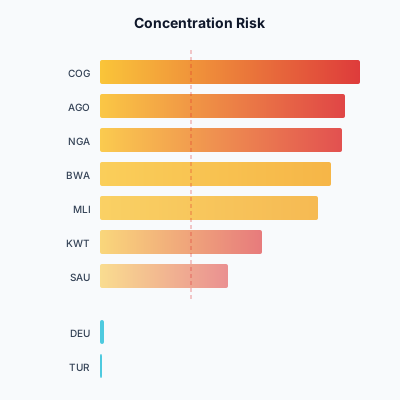
Concentration Risk
Some countries are one product away from crisis. We computed export concentration for every economy — the results are a map of global economic fragility.

The Debt-Trade Spiral
Persistent trade deficits and fiscal deficits compound into a debt spiral visible across decades. The data shows which countries are trapped — and which broke free.
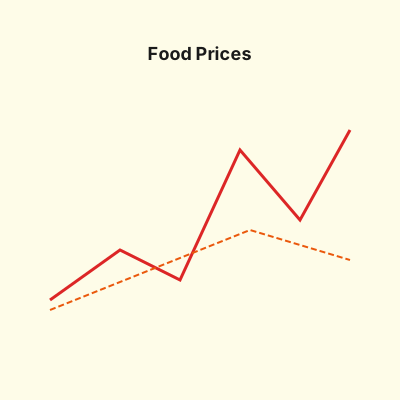
Agricultural Trade & Food Prices
The Arab Spring wasn't about politics. It started with the price of bread. We traced how global commodity spikes ripple into food crises — and who gets hit first.
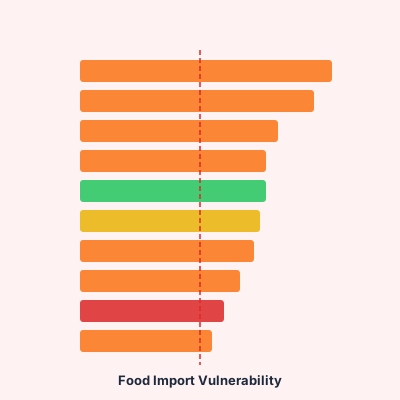
Food Import Vulnerability
40 countries can't feed themselves — and the list is growing. We mapped food import dependency against arable land, population growth, and income. The vulnerable are easy to identify.
Green Growth or Greenwash
Europe's emissions fell 30%. Its manufactured imports rose 40%. Coincidence? We tested whether 'decoupling' is real or just offshored pollution.
Related explainers
“China is dumping”: What dumping actually means (and what it doesn’t)
Low prices aren’t automatically dumping. Dumping is a legal test tied to price discrimination and injury.

Bilateral deficit with China: why it’s a terrible headline metric
Bilateral deficits ignore supply chains and value-added. Here’s why they mislead—and what to use instead.

Carbon leakage
When strict climate policy in one country just pushes emissions across the border.

Comparative advantage
Why trade can benefit both sides even when one side is ‘better at everything’—and why that doesn’t settle policy debates.
Food security: It's not about growing everything yourself
Why food security depends on trade routes as much as farmland — and what actually breaks it.

Subsidies
Not all subsidies are equal: explicit vs implicit, production vs consumption, and why they matter for trade fights.