Commodity Supercycles & Inflation
Every inflation crisis in 50 years was foreshadowed by commodity markets. We traced the supercycles — and what they tell us about where we are now.
Every Inflation Crisis Was Foreshadowed by Commodity Markets
In 1973, crude oil cost $2.80 a barrel. By 1974, it was $11. By 1980, it was $37. In those same years, US consumer price inflation went from 6% to over 13%. The sequence was not a coincidence. It was a transmission mechanism that has repeated, with variations, every time commodity prices surge -- in the 2000s, and again in the 2020s.
Commodity supercycles are multi-decade swings in raw material prices, driven by structural shifts in supply and demand. They are not ordinary business cycle fluctuations. They are tectonic movements that reshape the global economy for years at a time, and they have been the single most reliable predictor of inflation waves over the past half-century.
We pulled commodity price data from the World Bank Pink Sheet going back to 1960, constructed composite indices for energy, food, and metals, and compared them against consumer price inflation from the IMF World Economic Outlook for seven major economies. The pattern is remarkably consistent.
The Supercycles
The chart below shows three composite commodity indices -- energy, food, and metals -- from 1970 to the present, all rebased to 2010 = 100. The vertical dashed lines mark the events that triggered or accelerated each cycle.
Three distinct supercycles emerge from the data.
The First Cycle: 1970s Oil Shocks. Energy prices were negligible by modern standards at the start of the 1970s -- the index reads just 4.4 in 1970. Then the 1973 OPEC oil embargo tripled prices overnight. The index jumped from 6.6 to 12.5 in a single year. The 1979 Iranian Revolution pushed it to 32.4, and by 1980 it hit 41.1 -- a tenfold increase in a decade. Food followed energy upward, rising from 26 in 1970 to nearly 72 by 1980. The entire developed world was engulfed in stagflation.
The Second Cycle: 2000s China Boom. After two decades of relative calm, China's accession to the WTO in 2001 unleashed a commodity demand shock unlike anything seen since industrialization. China was building the equivalent of a new Chicago every year. Energy surged from 53.5 in 2000 to 151 in 2008. Metals went from 39 to 94. Food from 47 to 112. Every raw material on earth was being sucked into the construction of Chinese infrastructure. The 2008 financial crisis ended the cycle abruptly -- energy crashed from 151 to 80 in a single year.
The Third Cycle: 2020s Supply Shock. The pandemic shutdown of 2020 compressed commodity demand to historic lows -- energy hit 53.2, its lowest point since the late 1990s. Then everything reversed. Supply chains broke. Shipping costs exploded. Russia's invasion of Ukraine in February 2022 weaponized energy markets. The energy index spiked to 205.5 in 2022 -- the highest reading in the entire dataset, surpassing even the 2008 peak. Food hit 137.8. For the first time in a generation, inflation became a front-page political crisis in advanced economies.
By 2024, the energy index had retreated to 95.7, roughly back to its 2010 baseline. But metals have taken a different path entirely, surging to 142.5 in 2024 and continuing to climb -- driven by the energy transition's insatiable demand for copper, aluminum, and lithium.
The Transmission: How Commodities Become Inflation
The chart below overlays the commodity composite index (a simple average of energy, food, and metals) against US consumer price inflation. The dual axes make the lead-lag relationship visible.
The pattern is consistent across five decades. Commodity prices spike first. Inflation follows with a delay of roughly six to twelve months.
In 1980, US inflation hit 13.5% -- the peak of the stagflation era -- while the commodity composite reached 55.5, its highest level in two decades. In 2008, the commodity composite hit 119.1 as oil approached $97 a barrel, and US inflation rose to 3.8%. In 2022, the composite surged to 157.6, and inflation followed to 8.0% -- the highest in four decades.
The transmission mechanism is straightforward. Energy costs flow into transportation, manufacturing, and heating. Food commodity prices flow into grocery bills. Metals prices flow into construction and durable goods. These are not obscure financial instruments. They are the physical inputs of everything an economy produces.
What makes the relationship asymmetric is that the upward transmission is fast and the downward transmission is slow. When oil prices double, gasoline stations adjust within days. Airlines add fuel surcharges within weeks. But when oil prices fall, the surcharges linger, rents that rose during the inflation have sticky leases, and wages that were raised to compensate workers do not get cut back. This is why inflation crises tend to be sharp and painful, while disinflation is gradual.
The 2009 data point is telling. Commodities collapsed during the financial crisis -- the composite fell from 119 to 83 in a year -- and US inflation went briefly negative at -0.3%. Deflation. That is how powerful the commodity-inflation link is: when raw material prices crash hard enough, even consumer prices decline.
Which Commodities Predict Inflation Best?
Not all commodities have the same predictive power for inflation. The heatmap below shows the correlation between year-over-year changes in each commodity category and US inflation, at three different time lags: same year, one year later, and two years later.
Energy dominates. The same-year correlation between energy price changes and inflation is 0.41 -- the strongest of any category at any lag. This makes intuitive sense. Energy is the most pervasive input cost. Every good that is manufactured, transported, heated, or cooled has an energy component. When oil prices spike, the effect ripples through the entire economy within months. See the global trade in mineral fuels and oil to appreciate the sheer scale of energy flows.
Food shows a different pattern. Its correlation with inflation peaks at a one-year lag (0.31), suggesting a slower transmission. Agricultural commodity price changes take time to flow through the food processing and retail chain. Wheat prices in January may not show up in bread prices until the next harvest cycle and distribution period.
Metals are the weakest contemporaneous predictor (0.02 same-year) but show moderate correlation at one-year (0.28) and two-year (0.22) lags. This makes sense: metals feed into construction and manufacturing cycles that take years to complete. A copper price increase today shows up in housing costs and appliance prices well into the future.
The practical implication is that energy prices are the canary in the coal mine. If you want to know where inflation is headed in the next twelve months, watch oil.
Three Cycles, One Pattern
Each supercycle has a different trigger, but the sequence follows the same template: a structural shift in supply or demand creates a commodity price surge, the surge transmits into consumer prices, central banks respond with interest rate hikes, higher rates eventually crush demand, and commodity prices collapse. Then the cycle begins again.
The 1970s: Supply Disruption. The trigger was political -- the OPEC oil embargo of 1973 and the Iranian Revolution of 1979. The developed world discovered that its entire economic model depended on cheap Middle Eastern oil, and that this oil could be weaponized. Crude oil went from $2.80 to $37 a barrel. The Federal Reserve under Paul Volcker raised interest rates to 20% in 1981, inducing a deliberate recession to break the inflationary spiral. It worked, but at enormous cost.
The 2000s: Demand Shock. The trigger was China's industrialization -- the largest urbanization in human history, happening in compressed time. Between 2000 and 2010, China consumed more cement than the United States used in the entire twentieth century. Oil went from $28 to $97 a barrel. Copper tripled. The Fed kept rates low for too long, fueling a housing bubble that burst in 2008 and triggered a global financial crisis. Commodity prices crashed along with everything else.
The 2020s: Supply Chain Collapse. The trigger was the pandemic, followed by the Ukraine war. COVID-19 shut down production and scrambled logistics worldwide. The post-lockdown demand surge collided with depleted inventories and broken supply chains. Russia's invasion of Ukraine removed a major energy and grain exporter from Western markets. Energy spiked to its highest level in the dataset. Central banks -- having dismissed inflation as "transitory" through most of 2021 -- pivoted to aggressive rate hikes in 2022. The Fed took rates from near zero to over 5% in eighteen months.
The common thread is that interest rate hikes can suppress demand, but they cannot create oil, grow wheat, or mine copper. Monetary policy addresses the second-round effects of commodity shocks -- wage-price spirals, inflation expectations -- but it does nothing about the underlying supply constraint. This is why commodity-driven inflation is so difficult to manage. The tools available to policymakers are blunt instruments applied to a sharp problem.
Where We Are Now
By early 2026, the picture is mixed. Energy has cooled substantially from its 2022 peak -- the index sits around 121.5, not far above its 2010 baseline. The immediate crisis triggered by the Ukraine war has been partially absorbed through a combination of demand destruction in Europe, increased US production, and the gradual reorientation of Russian energy exports to Asian markets.
But the metals story is different and potentially more consequential for the next decade. The metals index has surged to 235.1 -- by far its highest reading in the dataset. This is not a spike driven by speculation or supply disruption. It is a structural demand shift driven by the energy transition. Electric vehicles require six times more mineral inputs than conventional cars. A single offshore wind turbine requires 8 tonnes of copper. Explore the global iron and steel trade to see one piece of this metals picture. The International Energy Agency has estimated that meeting net-zero targets would require a quadrupling of mineral supply by 2040.
This creates a paradox. The policy response to the 2020s energy-driven inflation crisis -- accelerating the transition away from fossil fuels -- is itself generating a new commodity demand cycle in metals. The energy supercycle may be fading, but the metals supercycle may just be beginning.
US inflation has moderated to 2.95% in 2024, down from the 8.0% peak in 2022. But if historical patterns hold, the next inflationary impulse may come not from oil but from the metals and minerals needed to build a post-fossil-fuel economy. The canary may have changed species, but it is still in the coal mine.
Methodology
Commodity indices were constructed from World Bank Commodity Price Data (Pink Sheet and Pink Indices). Inflation data uses the IMF World Economic Outlook's average consumer price inflation series (annual percentage change).
Energy composite — simple average of three commodities, each rebased to 2010 = 100:
for commodity c in {crude_oil_avg, natgas_US, coal_AU}:
    index_c(y) = price_c(y) / price_c(2010) * 100
energy(y) = mean(index_crude_oil(y), index_natgas(y), index_coal(y))
Food composite — simple average of three World Bank Pink Indices that are already 2010 = 100:
food(y) = mean(oils_meals_idx(y), grains_idx(y), other_food_idx(y))
Metals composite — simple average of three metals, each rebased to 2010 = 100:
for commodity c in {copper, aluminum, gold}:
    index_c(y) = price_c(y) / price_c(2010) * 100
metals(y) = mean(index_copper(y), index_aluminum(y), index_gold(y))
Commodity composite (dual-axis overlay chart):
composite(y) = mean(energy(y), food(y), metals(y))
Correlations (heatmap chart) — Pearson coefficient on year-over-year percentage changes, 1980-2025, at three lags:
chg_c(y)    = (index_c(y) - index_c(y-1)) / index_c(y-1) * 100
corr(c, L)  = pearson( chg_c(y), us_inflation(y + L) )  for L in {0, 1, 2}
A positive lag L means commodity changes in year y are matched against inflation in year y + L; i.e. commodities lead inflation by L years. A minimum of 10 overlapping pairs is required for a correlation to be reported.
Raw data inputs
- World Bank Pink Sheet: crude oil (average), US natural gas, Australian coal, copper, aluminum, gold, US HRW wheat, maize — see the World Bank commodity markets portal
- World Bank Pink Indices: Oils & Meals, Grains, Other Food (already rebased 2010 = 100)
- IMF World Economic Outlook: Inflation, average consumer prices (% change) for USA, DEU, GBR, JPN, CHN, IND, BRA
All data and code are available in the MacroScribbles repository.
Related research
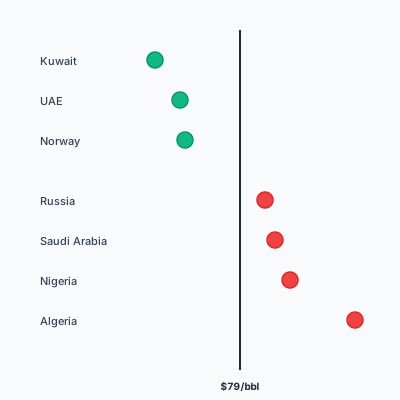
Oil Price & Fiscal Breakeven
Saudi Arabia needs $80 oil to pay its bills. It didn't always. We estimated fiscal breakeven prices for every major oil producer — and tracked how they rose.
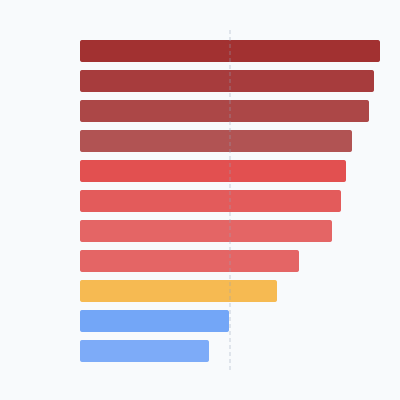
Petrostates Under Pressure
What happens when the world stops buying your only product? We mapped oil dependency, fiscal breakevens, and diversification progress for every petrostate. Most aren't ready.
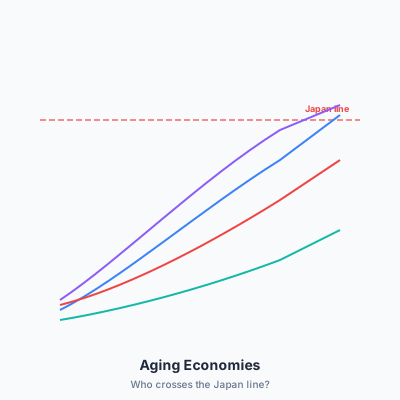
Aging Economies
Japan is the future — and most countries aren't ready. Population aging will break budgets, shrink workforces, and reshape economies. The timeline is visible in the data.
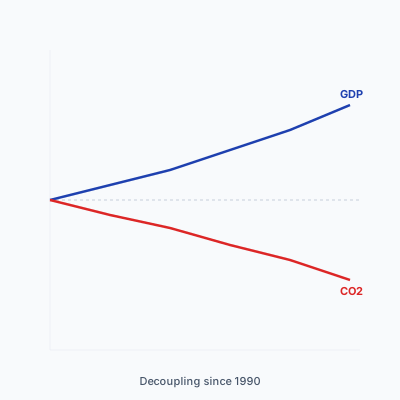
Carbon Cost of Growth
Can a country get richer without cooking the planet? Some have. Most haven't. We tracked GDP growth against CO2 emissions for 30 years — the decoupling story is real, but incomplete.
Carbon Inequality
The countries drowning in rising seas didn't cause the flood. We mapped who emitted what, when — and the per-capita gap is staggering.

Climate Vulnerability vs Emissions
Chad emits less CO2 in a year than a US state does in a day. Chad is also one of the most climate-vulnerable countries on Earth. The injustice is measurable.
Related explainers
Fiscal breakeven: the price that keeps the lights on
Every petrostate has a magic number — the oil price needed to balance the budget. It almost always goes up.
Base effects
Why year-over-year numbers can look dramatic simply because last year was weird.

Capacity factor
Why a country with 10 GW of solar capacity doesn't actually get 10 GW of electricity.

Capital account / financial account
The mirror image of the current account: how deficits get financed and why ‘money leaving’ is often backwards.

Carbon leakage
When strict climate policy in one country just pushes emissions across the border.

Consumption vs territorial emissions
The accounting trick that lets rich countries claim they're decarbonizing while importing carbon-heavy goods.