Urbanization vs Productivity
Cities make countries rich — until they don't. We mapped the urbanization-productivity curve for every country. The S-curve is clear, and so are the outliers.
Cities Make Countries Rich -- Until They Don't
There is perhaps no more reliable pattern in development economics than this: as countries urbanize, they get richer. The correlation between the share of a population living in cities and GDP per capita is one of the strongest empirical relationships in the social sciences. It holds across continents, across decades, across political systems.
But the relationship is not linear. It follows an S-curve -- slow at first, then explosive, then flattening. And in the flattening lies the story that most development textbooks leave out: the overurbanization trap, where cities grow faster than the economies and infrastructure that are supposed to sustain them.
The S-Curve
Plot every country's urban population share against its GDP per capita on a logarithmic scale and the pattern is unmistakable.
Each bubble is a country. Size reflects population. Color reflects region. The dashed line is a logistic fit across 247 countries. The correlation between urbanization and log GDP per capita is 0.68 -- strong, persistent, and not remotely accidental.
The shape tells a story about how economies transform. At the bottom left, you find countries like Ethiopia and Burundi -- under 25% urban, GDP per capita under $3,000. Agriculture dominates. Most people live where the food grows. At the top right, Singapore sits at 100% urban with GDP per capita over $130,000. Between these extremes, the S-curve traces the path that virtually every economy follows: rural exodus, industrial takeoff, service transition.
The mechanism is straightforward. Cities concentrate talent, reduce transaction costs, and enable specialization. A farmer in rural Ethiopia produces food for his family. That same person in Addis Ababa might work in a textile factory, a call center, or a construction crew -- each generating more economic value per hour. Cities create labor markets, knowledge spillovers, and infrastructure efficiencies that rural areas structurally cannot. This is not opinion. It is the agglomeration effect, and it has been measured in every economy that has ever urbanized.
But look at the scatter more carefully. The relationship is tight in the middle -- the 40% to 70% urbanization range where industrial economies are being built. Below 30% and above 85%, it loosens considerably. That loosening is where the interesting stories live.
The Speed
Not all urbanization is created equal. Some countries have compressed a century of demographic transformation into two decades. Others have barely moved.
The chart above shows the 20 fastest urbanizing countries since 2000, measured by the absolute change in urban population share. Nepal leads -- adding nearly 36 percentage points of urban population in just 24 years, a staggering pace driven by remittance-funded construction in the Kathmandu Valley and secondary cities. China added nearly 30 percentage points, moving almost 400 million people from countryside to city. Turkey urbanized at a comparable rate, fueled by a construction boom that physically reshaped Anatolian cities.
The speed matters because it determines whether infrastructure can keep pace. South Korea urbanized rapidly in the 1960s through 1980s, but it did so alongside massive state-directed investment in housing, transit, water, and power. The Korean government built the cities that Koreans moved into. Many of today's fastest urbanizers are not doing this. They are building cities by accretion -- slums growing outward from colonial-era cores, without the sewerage, transit, or housing stock to support the people arriving.
China's Transformation
China's urbanization is the most dramatic demographic event in human history, and it is not close.
In 1980, China was 19% urban. By 2024, it was 66%. That means roughly 650 million people -- more than the entire population of Europe -- moved from rural areas to cities in a single generation. No country has ever urbanized this many people this fast.
The economic consequences were proportional. China's GDP per capita in 1980 was approximately $1,000 in PPP terms. By 2024, it exceeded $24,000. The S-curve chart above shows China sitting almost exactly on the fitted line -- its urbanization rate and GDP per capita are in lockstep, textbook agglomeration economics playing out at continental scale.
But China's urbanization was not organic. It was engineered. The hukou household registration system controlled who could move where, creating a managed flow of labor into export-oriented coastal cities. The government built the infrastructure ahead of (or at least concurrent with) the people: 40,000 kilometers of high-speed rail, 160,000 kilometers of expressways, dozens of entirely new cities. This was not Lagos or Dhaka, where people arrive and the city improvises around them. This was state-planned urbanization with state-planned infrastructure.
The catch is that China's model may have overbuilt. Ghost cities -- newly constructed urban districts with almost no residents -- are a well-documented feature of Chinese urbanization. Real estate comprised at peak roughly 30% of GDP, a ratio that no economy has sustained without crisis. China is now navigating the dangerous phase of the S-curve: the plateau, where the easy productivity gains from moving farmers to factories have been captured, and the next phase of growth requires moving factory workers into services, innovation, and consumption. You can explore China's full economic profile to see how this transition is playing out in the data. This transition has tripped up every middle-income country that has attempted it.
The Overurbanization Trap
Latin America is the puzzle that breaks the simple urbanization-prosperity narrative. The region is highly urbanized -- Brazil at 88%, Argentina at 92%, Mexico at 82% -- yet its GDP per capita remains solidly middle-income. If urbanization drives wealth, Latin America should be rich. It is not.
The explanation is structural. Latin America urbanized early and fast, primarily through rural-to-urban migration driven by agricultural mechanization and rural poverty rather than by industrial demand for labor. People moved to cities because the countryside collapsed, not because factories were hiring. The result was "urbanization without industrialization" -- large cities with vast informal economies, where millions work in low-productivity services rather than in the high-productivity manufacturing that drove Asian urbanization.
Sao Paulo, Mexico City, and Buenos Aires are enormous. They are also profoundly unequal. Latin American cities contain some of the world's most productive economic zones -- finance, technology, aerospace -- alongside sprawling favelas and colonias where economic activity is largely informal. The aggregate GDP per capita obscures this duality. The city as a whole generates less productivity per urban resident than the S-curve would predict, because a large share of urban residents are not participating in the formal economy.
Africa is heading down a similar path, but faster. Sub-Saharan Africa is urbanizing rapidly -- Lagos has grown from 7 million to over 16 million people since 2000 -- but much of this growth is urbanization into poverty. Kinshasa, Dar es Salaam, and Nairobi are gaining millions of residents without a corresponding expansion of formal employment, infrastructure, or housing. Nigeria's economic data illustrates the gap between urban growth and productivity gains. The result is megacity slums: dense, underserved, economically marginal settlements that have the population density of Tokyo but the infrastructure of a village.
The data shows this clearly. Sub-Saharan African countries sit below the S-curve in the scatter plot -- they are more urbanized than their GDP per capita would predict, or equivalently, less productive than their urbanization level should deliver. This is overurbanization: cities that have grown past the infrastructure and industrial base required to make density productive.
The Infrastructure Gap
Urbanization is not inherently productive. Density is not inherently productive. What makes cities productive is infrastructure: transport that moves workers to jobs, water and sanitation that keep populations healthy, electricity that powers factories and offices, telecommunications that enable services, and housing that is decent enough to function as a stable base for economic life.
When infrastructure scales with population, urbanization delivers the textbook agglomeration benefits. When it does not, urbanization delivers congestion, disease, housing crises, and informal economies. The difference between Seoul and Lagos is not that one has more people in a smaller space. It is that one built the systems -- transit, sewerage, power, housing -- that make density work, and the other did not.
Dhaka, Bangladesh, with over 22 million people, has one of the highest population densities of any major city on Earth. It also has one of the lowest rates of formal sewage treatment. The economic potential of those 22 million people -- their labor, their proximity, their potential for specialization -- is suppressed by the absence of the infrastructure that would let density function as an economic asset rather than a liability.
This is the infrastructure bottleneck, and it is visible in the data. Countries that invested in infrastructure alongside urbanization -- South Korea, China, the Gulf states -- sit on or above the S-curve. Countries that urbanized without infrastructure investment -- most of Sub-Saharan Africa, much of South Asia -- sit below it. The gap between the two is not about culture, geography, or governance ideology. It is about concrete, pipe, wire, and rail.
Convergence
Despite these challenges, the global trajectory is unmistakable: everyone is urbanizing. The convergence is visible when you plot urbanization over time for countries at different stages.
Singapore has been 100% urban since the 1960s. Belgium and Japan were already over 60% urban by 1960 and have plateaued above 95% and 90% respectively. South Korea compressed its urbanization into three decades, going from 28% to over 80% between 1960 and 1990. China's steep ascent from 1980 onward is the most dramatic line on the chart. India and Nigeria are still early in their S-curves, below 40%, but accelerating.
The convergence implies something important: according to the UN Population Division, by 2050 the world will be roughly 68% urban, up from 57% today. Virtually all of the growth will happen in Africa and South Asia -- the two regions that are currently urbanizing fastest and, not coincidentally, investing the least in urban infrastructure relative to the need.
This means the urbanization-productivity question is not academic. It is the central economic question of the next three decades. If Africa and South Asia can urbanize with infrastructure -- following the Korean or Chinese model rather than the Latin American one -- the productivity gains will be enormous. If they cannot, the world will add 2 billion urban residents who are living in slums, working in informal economies, and generating far less output than their density should enable.
The S-curve says urbanization drives productivity. The data says it does -- but only when cities are built, not just inhabited. The distinction between building cities and merely filling them is the difference between development and displacement. And that distinction is, in the end, an infrastructure question.
Methodology
Raw data inputs (all from the World Bank World Development Indicators):
- Urban population (% of total population) — SP.URB.TOTL.IN.ZS
- GDP per capita, PPP (constant 2021 international $) — NY.GDP.PCAP.PP.KD
- Employment in industry (% of total employment) — SL.IND.EMPL.ZS
- Population, total — SP.POP.TOTL
Time period: 1960-2024. For the scatter plot, we use the most recent year for which both urbanization and GDP data are available. For trajectories, we use the full time series.
Sample: 247 countries after excluding aggregates (regions, income groups) and countries missing both urbanization and GDP data.
S-curve fitting. A logistic function is fitted to (urban %, log GDP per capita) pairs via grid search over L, k, x0:
urban_pct = L / (1 + exp(-k * (ln(gdp_pc) - x0)))
Best fit: L = 100, k = 0.6, x0 = 8.8. Correlation between urbanization and log GDP per capita across the sample is 0.68.
Urbanization speed. For each country, the start year is the earliest observation in [2000, 2005] and the end year is the latest observation in [2020, ∞), requiring at least 15 years of span:
speed_pp = urban_pct(end_year) - urban_pct(start_year)
The bar chart shows the top 20 by speed_pp.
Limitations: Urbanization definitions vary by country -- what counts as "urban" in China (towns with over 1,500 people) is different from what counts in France or the United States. GDP per capita PPP smooths purchasing power differences but cannot capture the within-country inequality that makes aggregate figures misleading. The relationship between urbanization and productivity is correlational, not causal in a strict econometric sense -- both are driven by underlying structural transformation. Infrastructure investment data, which would strengthen the analysis, is not available at comparable quality across countries.
Related research

Brain Drain Tracker
Nigeria trains doctors. Britain employs them. We tracked the global brain drain — who loses talent, who gains it, and whether remittances make up the difference.
Aging Economies
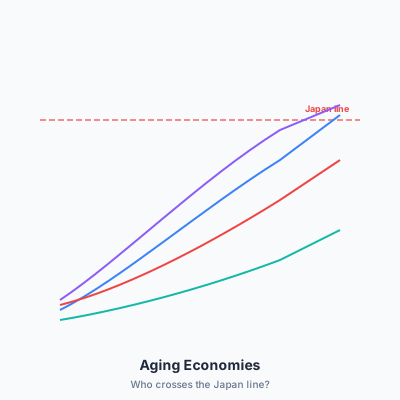
Japan is the future — and most countries aren't ready. Population aging will break budgets, shrink workforces, and reshape economies. The timeline is visible in the data.

Child Survival & National Income
If you could know only one number about a country, it should be under-5 mortality. It captures income, health, education, water, and women's empowerment in a single statistic.
The Demographic Dividend vs Demographic Bomb
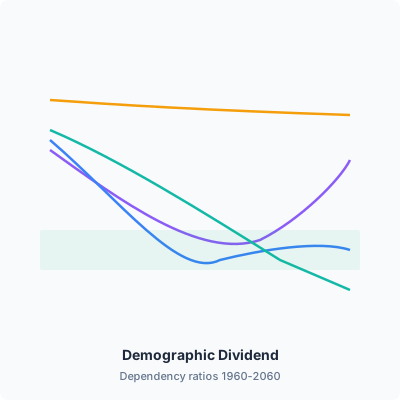
Half the world is getting old. The other half has millions of young people with no jobs. The demographic dividend is real — but only if you convert it.

Education Spending vs Innovation Output
Some countries spend billions on education and produce no patents. Others spend less and lead the world in innovation. The missing ingredient isn't money — it's R&D.

The Energy-Prosperity Ladder
There is a clear energy consumption threshold countries must cross for human development. Below ~4,000 kWh per capita, every additional kilowatt-hour transforms lives. Above 10,000, you're just heating empty rooms.
Related explainers

Demographic transition
The four-stage model that explains why populations explode, stabilize, and then shrink — and why most of global economics follows from it.

Dependency ratio
The ratio that tells you how many workers are carrying how many non-workers — and why it's the ticking clock behind every pension crisis.

Food security: It's not about growing everything yourself
Why food security depends on trade routes as much as farmland — and what actually breaks it.

Purchasing power parity: why $1 isn't $1 everywhere
Nominal exchange rates lie about living standards. PPP is the correction — and it changes the global picture dramatically.

The Human Development Index: one number for 'is life getting better?'
HDI packs life expectancy, education, and income into a single score. It's useful — until it isn't.