Brain Drain Tracker
Nigeria trains doctors. Britain employs them. We tracked the global brain drain — who loses talent, who gains it, and whether remittances make up the difference.
Nigeria Trains Doctors. Britain Employs Them.
In 2023, Nigeria had roughly 75,000 registered physicians for a population of 220 million people. That is one doctor for every 2,900 Nigerians. The United Kingdom, meanwhile, employed approximately 10,000 Nigerian-trained doctors in its National Health Service. Britain knows this. The NHS publishes the data. There is no secret about it.
This is the brain drain in its most brutal form: a poor country invests scarce public resources in training skilled professionals, and a rich country harvests the result. Nigeria pays for medical school. Britain gets the doctor. The transaction is voluntary -- individual doctors choose to leave -- but the aggregate effect is a systematic transfer of human capital from countries that cannot afford to lose it to countries that could train their own but find it cheaper to recruit abroad.
The brain drain is not a metaphor. It is measurable. We can track who educates, who emigrates, and who benefits. And the data tells a story that is both more nuanced and more damning than the usual policy debates suggest.
The Drain Map: Education Meets Emigration
The scatter plot below maps two variables: how much a country invests in tertiary education (x-axis: gross enrollment rate) and how many people leave (y-axis: net migration rate per 1,000). Countries in the lower-right quadrant -- high education, negative migration -- are the brain drain's primary victims. They educate people and then lose them.
The pattern is stark. Every origin country in our sample sits below the zero line -- they are all net emigration countries. Pakistan and Jamaica stand out with the most negative migration rates. Lebanon and Romania combine high tertiary enrollment with significant outflows -- they are producing graduates for other countries' labor markets.
Above the zero line sit the destination countries. Canada, Australia, the United Kingdom, and the United States all have high tertiary enrollment AND positive net migration. They educate their own populations well, and then top up with the best from everyone else. The rich get richer.
India presents an interesting case: it has moderately negative migration but massive absolute numbers. A migration rate of -0.3 per 1,000 does not look dramatic -- until you remember that India has 1.4 billion people. That small rate represents hundreds of thousands of highly skilled emigrants annually.
The Health Drain: Where It Hurts Most
Brain drain is painful in every skilled profession, but the health sector is where it becomes lethal. A country can survive losing software engineers to Silicon Valley. It cannot easily survive losing doctors to the NHS.
The gap is staggering. Germany has 4.5 physicians per 1,000 people. Australia has 4.1. Cuba, which prioritized medical training as national strategy, has 9.5 -- the highest in our sample, and a deliberate policy choice.
Now look at the other end. Ghana has 0.27 physicians per 1,000. Haiti has 0.29. Nigeria has 0.38. These are countries where a single doctor might serve a catchment area of 3,000 to 4,000 people. And every doctor who emigrates makes the ratio worse for everyone who stays.
Sub-Saharan Africa carries roughly 25% of the global disease burden but has approximately 3% of the world's health workforce. This is not an accident of geography. It is the direct result of decades of health worker emigration to wealthy countries that prefer to recruit trained professionals rather than invest in training their own.
The Philippines has 0.76 physicians per 1,000 -- better than sub-Saharan Africa but still critically low. And the Philippines is the most interesting case study in the brain drain, because the outflow is deliberate.
The Philippines Model: Strategy or Exploitation?
The Philippines has an explicit policy of training workers for export. The country runs nursing schools, maritime academies, and engineering programs that are specifically designed to produce graduates for overseas employment. The government manages the outflow through the Philippine Overseas Employment Administration. Remittances from the 10+ million Filipinos working abroad are the single largest source of foreign exchange.
Is this brilliant or tragic? The answer is both.
The strategy works in the narrow sense that the Philippines has found a way to monetize its greatest asset -- its people. The $40 billion in annual remittances sustains millions of families. The country has built institutional infrastructure to protect overseas workers, collect fees, and channel money home.
But the strategy also means the Philippines has chronically low physician density, nurse shortages in provincial hospitals, and a perpetual shortage of skilled workers in domestic industries. The best graduates leave. The training pipeline exists not to serve the Filipino population but to supply foreign labor markets. One study found that Filipino nursing graduates were more likely to emigrate within five years of graduation than to work in a Filipino hospital for that same period.
The Philippines model is the brain drain turned into national policy. Whether that represents pragmatic adaptation or a damning failure of development strategy depends on whether you think a country should build its economy around exporting its most educated citizens.
Does the Money Come Back?
The standard response to brain drain concerns is: remittances. Yes, skilled workers leave, but they send money home. And the money, the argument goes, is worth more than the worker would have produced domestically.
The chart compares two flows for each origin country: what the government spends on education (as a percentage of GDP) and what it receives back in remittances (also as a percentage of GDP).
For some countries, the math looks favorable on paper. Lebanon spends just 1.2% of GDP on education but receives 33.4% of GDP in remittances. Haiti spends 1.0% on education and gets back 16.3% in remittances. Jamaica invests 5.5% and receives 16.2%.
But this comparison is misleading in a fundamental way. Remittances go to families. They buy food, pay rent, cover school fees. They are private consumption. Education spending produces public goods -- doctors, engineers, teachers, researchers -- that generate spillover benefits for the entire economy. A country that loses a doctor and gains $50,000 in remittances has made a bad trade, even if the family receiving the money is better off. The hospital that lost the doctor is not.
Nigeria makes the case most starkly. The country spends just 0.3% of GDP on education -- one of the lowest rates in the world -- and receives 8.4% back in remittances. But with only 0.38 physicians per 1,000 people, the remittance money cannot buy what Nigeria actually needs: more doctors. You cannot wire a surgeon home through Western Union.
India and Mexico show a different pattern: relatively healthy education spending (4.1% of GDP each) and modest remittance returns (3.5% and 3.6% respectively). These are large, diversified economies where the brain drain is painful but not existential. For smaller, poorer countries, the drain is a different magnitude of problem entirely.
The Reversals: It Can Be Done
The brain drain narrative is not entirely hopeless. Several countries have demonstrated that talent can be brought home -- or that diaspora networks can generate benefits without requiring physical return.
India is the most celebrated reversal. In the 1960s through 1980s, the Indian "brain drain" to the United States was a source of national hand-wringing. Indian engineers and scientists left for American universities and companies and did not come back. Then two things happened: India liberalized its economy in 1991, and the IT sector exploded. The Indian diaspora in Silicon Valley became a bridge, not just a drain. Capital, knowledge, and eventually people flowed back. Bangalore, Hyderabad, and Pune were built in significant part by returnees and diaspora investment. India's net migration rate, while still slightly negative, reflects a vastly different dynamic than it did thirty years ago.
South Korea followed a similar arc. In the 1960s, South Korea was one of the poorest countries in Asia, and its brightest students left for American and European universities. The Park Chung-hee government created explicit incentive programs to bring scientists home, offering research funding, housing, and guaranteed positions. By the 1980s, the return flow was substantial. Samsung, Hyundai, and LG were built with returned talent.
China invested heavily in "sea turtle" programs -- incentives for overseas Chinese academics and entrepreneurs to return. The results have been transformative, particularly in technology and biomedical research. China's net migration has shifted dramatically as domestic opportunities expanded.
The common thread is that reversals require domestic economic growth that creates opportunities competitive with what destination countries offer. You cannot guilt people into coming home. You have to offer them something worth coming home to.
The EU Drain: Europe's Internal Migration
The 2004 and 2007 enlargements of the European Union created one of the largest brain drain episodes in modern history -- and it happened within a single political union.
Poland lost an estimated 2 million people to the UK, Germany, Ireland, and the Netherlands in the decade after accession. Romania lost a similar number to Italy, Spain, Germany, and the UK. The Baltic states lost proportionally even more -- Latvia's population declined by roughly 20% between 2000 and 2020.
The EU brain drain is distinctive because the political framework that caused it -- free movement of labor -- was supposed to be a benefit, not a cost. And for the EU as a whole, it was efficient: workers moved from where wages were low to where they were high, improving overall productivity. But for individual origin countries, the effect was devastating. Romania lost doctors, engineers, and IT specialists. Villages emptied. Schools closed. The demographic pyramid inverted.
Poland's recent data is fascinating. In 2022, after the Ukraine war began, Poland's net migration rate jumped to +25 per 1,000 -- not because Poles came home, but because Ukrainian refugees arrived. Poland went from brain drain origin to brain drain destination in a single year, though not by choice. By 2025, the rate had swung back to -8.7 per 1,000, suggesting many of those arrivals were temporary.
Romania's drain continues. Compare Romania and Germany side by side to see the economic gap that drives the outflow. With a net migration rate of -1.5 per 1,000 and a shrinking population, Romania faces the dual challenge of emigration and low fertility. The country educates well -- 55% gross tertiary enrollment -- but cannot retain its graduates against German and Austrian salaries that are three to four times higher.
The Honest Assessment
Brain drain is real, it is measurable, and for the most affected countries, it is economically devastating. The data does not support the optimistic "brain gain" narrative except in a handful of cases where domestic economic growth created pull factors strong enough to reverse the flow.
Remittances help. They are the world's largest poverty reduction program, as we documented in our remittances analysis. But they do not replace human capital. A billion dollars in remittances cannot substitute for ten thousand doctors. Money is fungible; skills are not.
The countries most damaged by brain drain share a common profile: they invest modestly in education, produce skilled graduates, and then lose those graduates to countries with higher wages and better working conditions. The solution, in theory, is straightforward -- create domestic conditions that retain talent. In practice, that requires precisely the kind of economic development that the brain drain itself undermines. It is a trap.
The destination countries -- the United States, the United Kingdom, Canada, Australia, Germany -- benefit enormously from brain drain and have little incentive to stop it. The NHS saves billions by recruiting Nigerian and Indian doctors instead of training British ones. Silicon Valley's competitive advantage rests partly on its ability to attract the world's best engineers. These are not accidental outcomes. They are policy choices, even when they are not acknowledged as such.
The Philippines model -- deliberate labor export -- represents one pragmatic response. India's reversal represents another. But for most brain drain countries, the path from drain to gain remains elusive. Jamaica still loses 80% of its university graduates. Haiti still has fewer doctors per capita than almost anywhere on earth. Nigeria still trains physicians for the NHS. You can dig into the economic data for Nigeria and the Philippines to see how the drain shows up in development indicators.
The data does not offer easy answers. But it does offer clarity about who pays and who benefits. And on that question, there is no ambiguity at all.
Methodology
Brain drain severity is not directly measured by any single indicator. We combine raw indicators from World Bank WDI and UN DESA Population Division to build two derived views (the drain quadrant and the remittance offset) alongside one raw cross-country view (the physicians gap).
Derived metric: brain drain quadrant
A country sits in the "brain drain quadrant" when it invests in tertiary education yet still loses population on net.
brain_drain_signal(country) = (tertiary_enrollment_gross_pct, net_migration_rate_per_1000)
quadrant = BRAIN_DRAIN   if tertiary_enrollment_gross_pct >= 30 AND net_migration_rate < 0
         = BRAIN_GAIN    if net_migration_rate > 0
         = OTHER         otherwise
Countries in the brain drain quadrant produce skilled workers and then lose them -- the operational definition used in this article.
Derived metric: remittance vs education outlay
For each origin country we compare the public cost of producing graduates against the private inflow of remittances they send home:
remit_offset(country) = remittances_received_pct_gdp - government_education_spending_pct_gdp
A large positive value means cash inflows dwarf the state's education bill on paper, but the two flows are not fungible: remittances fund household consumption, while education spending produces public goods (doctors, teachers, engineers) with economy-wide spillovers. The metric illustrates the gap but does not close it.
Raw data inputs
- Net Migration Rate (per 1,000 population) -- UN DESA Population Division 2024 revision. Includes all migration; no global dataset comprehensively tracks skill-level migration.
- School enrollment, tertiary (% gross) -- World Bank WDI. Cross-referenced with UNESCO UIS. Gross enrollment can exceed 100% due to age-flexible enrollment and international students.
- Physicians (per 1,000 people) -- World Bank WDI, original source WHO Global Health Observatory. Most recent available year varies by country (2015-2024). A proxy for skilled worker retention, not a direct measure of emigration.
- Government expenditure on education, total (% of GDP) -- World Bank WDI. Government expenditure only; excludes private education spending.
- Personal remittances, received (% of GDP) -- World Bank WDI. Includes compensation of employees and personal transfers. Informal channels may add 30-50% to official figures.
- GDP per capita, PPP (constant 2021 international $) -- World Bank WDI. Used as context for ranking origin countries in the remittance offset view.
The physicians gap chart is a raw cross-country comparison: origin countries from our focus list alongside six major destination countries. The contrast illustrates the health dimension of brain drain but does not prove causation -- low physician density in developing countries reflects multiple factors beyond emigration, including training capacity and domestic health spending.
Related research
Urbanization vs Productivity
Cities make countries rich — until they don't. We mapped the urbanization-productivity curve for every country. The S-curve is clear, and so are the outliers.
Aging Economies
Japan is the future — and most countries aren't ready. Population aging will break budgets, shrink workforces, and reshape economies. The timeline is visible in the data.
Child Survival & National Income
If you could know only one number about a country, it should be under-5 mortality. It captures income, health, education, water, and women's empowerment in a single statistic.
The Demographic Dividend vs Demographic Bomb
Half the world is getting old. The other half has millions of young people with no jobs. The demographic dividend is real — but only if you convert it.
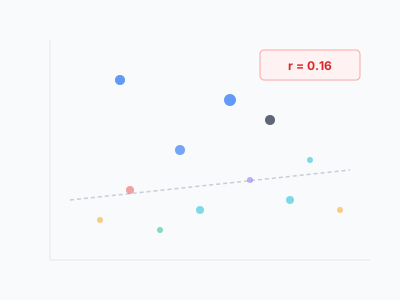
Education Spending vs Innovation Output
Some countries spend billions on education and produce no patents. Others spend less and lead the world in innovation. The missing ingredient isn't money — it's R&D.
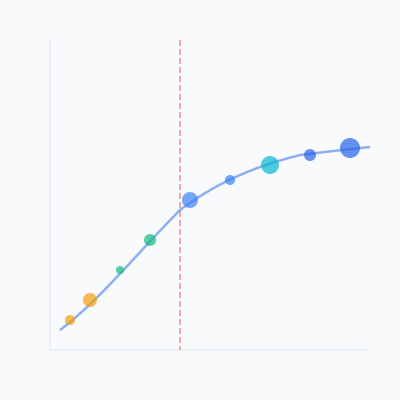
The Energy-Prosperity Ladder
There is a clear energy consumption threshold countries must cross for human development. Below ~4,000 kWh per capita, every additional kilowatt-hour transforms lives. Above 10,000, you're just heating empty rooms.
Related explainers

Demographic transition
The four-stage model that explains why populations explode, stabilize, and then shrink — and why most of global economics follows from it.

Dependency ratio
The ratio that tells you how many workers are carrying how many non-workers — and why it's the ticking clock behind every pension crisis.

Food security: It's not about growing everything yourself
Why food security depends on trade routes as much as farmland — and what actually breaks it.

Purchasing power parity: why $1 isn't $1 everywhere
Nominal exchange rates lie about living standards. PPP is the correction — and it changes the global picture dramatically.

The Human Development Index: one number for 'is life getting better?'
HDI packs life expectancy, education, and income into a single score. It's useful — until it isn't.