Climate Vulnerability vs Emissions
Chad emits less CO2 in a year than a US state does in a day. Chad is also one of the most climate-vulnerable countries on Earth. The injustice is measurable.
Chad Emits Less CO2 in a Year Than a US State Does in a Day. Chad Is Also Drowning.
An average American has put 1,259 tonnes of CO2 into the atmosphere over their country's industrial history. An average Chadian has contributed 2.5 tonnes. That is a 504-to-one ratio. Today, Chad emits 0.14 tonnes of CO2 per person per year -- roughly what an American household produces by running a clothes dryer for a month.
Chad is also one of the ten most climate-vulnerable countries on Earth. Its economy is 38% agriculture. Its people are overwhelmingly poor. When drought intensifies, when Lake Chad continues shrinking, when the Sahel pushes further south, there is no adaptation budget, no seawall fund, no crop insurance backstop. There is just exposure.
This is the defining injustice of climate change: the countries that did the least to cause it will suffer the most from it. And the data makes the pattern undeniable.
We pulled cumulative per-capita CO2 emissions from the Global Carbon Project, crossed it with agricultural dependence and GDP data from the World Bank, and built a composite vulnerability score for 201 countries. The result is a map of global injustice that should make anyone with a policy lever uncomfortable.
The Injustice Map
The chart below plots every country by its cumulative per-capita CO2 emissions (horizontal axis, log scale) against its climate vulnerability score (vertical axis). Bubble size reflects population. The upper-left quadrant -- high vulnerability, low historical emissions -- is where the injustice concentrates.
The pattern is stark. Burundi, Mozambique, Niger, Chad, Madagascar, and South Sudan cluster in the upper-left: vulnerability scores above 50, cumulative emissions under 10 tonnes per person. The United States, Germany, the United Kingdom, and Japan sit in the lower-right: vulnerability scores below 7, cumulative emissions above 500 tonnes per person.
Eighty-three countries fall into the "most unjust" quadrant -- high vulnerability, low cumulative emissions. Their average cumulative CO2 per capita is 26 tonnes. The 84 "protected polluters" in the opposite quadrant average 529 tonnes per capita -- twenty times more. The countries that built the problem are the ones best equipped to survive it.
Who Is Most Vulnerable
Vulnerability here is not a single number handed down by nature. It is a composite of measurable economic and structural factors: how much of a country's economy depends on agriculture, how low its income is, how exposed its coastline, and whether it is a small island developing state. These factors compound.
Burundi ranks most vulnerable with a score of 60. Its economy is 35% agriculture. Its GDP per capita is $1,051 -- among the lowest on Earth. Its annual CO2 emissions per person are 0.065 tonnes. That is not a typo. A Burundian emits less carbon dioxide in a year than an American does in roughly five hours of driving.
Mozambique scores 54. South Sudan 54. Madagascar 53. The Central African Republic 53. Niger 52. Malawi 50. Chad 50.
Every single one of these countries is classified as low income by the World Bank. Every one has agriculture as a dominant share of GDP. Every one emits less than 0.3 tonnes of CO2 per person per year. They are not contributors to climate change in any meaningful sense. They are recipients of its consequences.
The bar colors tell the other half of the story: the deepest red indicates per-capita emissions below 0.2 tonnes. Nearly all of the top 25 most vulnerable countries fall in that range. They are being punished for a problem they did not create.
Economic Exposure: GDP at Climate Risk
Agricultural dependence is not just a vulnerability marker -- it is the mechanism through which climate change inflicts economic damage. When temperatures rise, when rainfall patterns shift, when droughts intensify, it is agricultural output that collapses first. For countries where agriculture represents a third or more of GDP, climate disruption is not an environmental issue. It is an economic emergency.
Guinea-Bissau derives 42% of its GDP from agriculture. Syria 43%. Chad 38%. Burundi 35%. Niger 35%. Ethiopia 35%. Afghanistan 35%.
These are not diversified economies that can absorb a bad harvest. When agriculture fails, there is no services sector or manufacturing base to compensate. The GDP figures next to the bars underscore the scale of poverty: Burundi at $1,051 per capita. Niger at $1,803. Malawi at $1,634. These economies are operating at the edge of subsistence, and climate change is pushing them closer to it.
The triple jeopardy is precise: these countries are (1) heavily agricultural, meaning climate hits their primary economic engine; (2) deeply poor, meaning they have no fiscal capacity to invest in adaptation; and (3) negligible emitters, meaning they bear no causal responsibility for the problem destroying their livelihoods.
Small Island States: Existential Threat from Near-Zero Emissions
Small island developing states face a category of risk that transcends economics. For Tuvalu, the Marshall Islands, Kiribati, and the Maldives, climate change is not about crop yields or GDP growth. It is about whether their nations will physically exist.
Tuvalu's highest point is 4.6 meters above sea level. Its vulnerability score is 33. Its cumulative CO2 per capita is 31 tonnes -- roughly what the average American has contributed since 2019 alone. The Solomon Islands score 48 on vulnerability. Vanuatu 47. Timor-Leste 43. Kiribati 40.
These nations emit functionally nothing. The Solomon Islands emit 0.36 tonnes per person per year. Vanuatu 0.60. Kiribati 0.54. The entire country of Tuvalu -- all 11,000 people -- produces less CO2 annually than a single mid-sized American factory.
Yet these are the countries negotiating for their literal survival at every COP conference. When sea levels rise one meter -- a scenario now considered likely before 2100 under current trajectories -- several of these nations lose the majority of their habitable land. This is not a metaphor. Entire countries will need to be evacuated because other countries burned fossil fuels.
The Adaptation Gap: Who Can Afford to Protect Themselves
The cruelest dimension of climate vulnerability is that adaptation costs money, and the most vulnerable countries have the least of it. The Netherlands spends billions on flood defense infrastructure and has the engineering capacity to keep the sea at bay. Bangladesh, with 170 million people in one of the world's largest flood plains, has a GDP per capita of roughly $7,000 -- 7 times less than the Netherlands.
The adaptation gap runs along the same fault line as the injustice map. Countries with GDP per capita below $3,000 -- the ones scoring highest on vulnerability -- would need to spend a disproportionate share of their national income just to implement basic climate resilience measures: drought-resistant crops, irrigation systems, coastal protection, early warning systems, climate-proof infrastructure. Explore Chad's economic indicators or Bangladesh's to see how little fiscal room these countries have.
The United States can afford to relocate coastal communities, subsidize crop insurance, invest in desalination, and air-condition its way through heat waves. Niger, where GDP per capita is $1,803 and 35% of the economy is agriculture, cannot. Compare the two countries and the resource asymmetry is breathtaking. The countries that need adaptation most can afford it least. The countries that need it least can afford it most. This is not a coincidence -- it is a structural feature of the same fossil-fuel-powered industrialization that created the emissions gap in the first place.
Climate Finance: Does Money Flow Where It Is Needed?
The Paris Agreement established a target of $100 billion per year in climate finance flowing from developed to developing countries. This target was not met on time -- it was finally reached in 2022, two years late. But even the headline number obscures a deeper problem: the money that does flow often does not reach the most vulnerable.
The bulk of climate finance goes to middle-income countries with larger economies and more capacity to absorb investment -- India, Brazil, Indonesia. These are important recipients, but they are not the countries at the top of the vulnerability ranking. The least developed countries -- the Burundis, Nigers, and Chads of the world -- receive a fraction of total flows, despite being the most exposed.
Mitigation projects (reducing emissions) receive more funding than adaptation projects (surviving the emissions already locked in). This makes economic sense from a global carbon perspective but is perverse from a justice perspective. The countries that need adaptation funding most urgently are the ones that contributed least to the emissions requiring mitigation elsewhere.
The new $300 billion annual target agreed at COP29 in 2024 is an improvement in scale, but the structural mismatch persists. Climate finance remains oriented toward bankable projects in countries with institutional capacity, not toward the most vulnerable populations in the weakest states.
What the Data Demands
This analysis is the companion to our Carbon Inequality piece, which mapped who emits what and how unequally the atmosphere has been consumed. This article asks the harder question: who pays the price?
The answer is unambiguous. The 83 countries in the "most unjust" quadrant -- high vulnerability, low cumulative emissions -- are home to billions of people who contributed almost nothing to climate change and will bear its heaviest consequences. Their average cumulative emissions are 26 tonnes per capita. The "protected polluters" average 529 tonnes. The ratio is not close.
This is not an argument against development. It is not an argument against industrialization. It is a statement of measurable fact: the benefits of fossil-fuel-powered growth accrued overwhelmingly to the countries that burned the fuel, and the costs are being distributed to the countries that did not. Any climate policy framework that fails to account for this asymmetry is not a policy framework -- it is an accounting fraud.
Methodology
The vulnerability score is a 0-100 composite index built from four sub-components. Each sub-component is scaled to the 0-100 range and then weighted:
agricultural_dependence = max(agriculture_pct_gdp, agriculture_pct_employment)

income_vulnerability   = clamp(0, 100,
                            100 * (1 - (log10(gdp_per_capita_ppp) - 2.7) / 2.3))

coastal_exposure       = min(30, rural_pop_below_5m_pct * 5)

sids_bonus             = 25 if country in SIDS else 0

vulnerability = min(100,
                    0.35 * agricultural_dependence
                  + 0.35 * income_vulnerability
                  + 0.15 * coastal_exposure
                  + 0.15 * sids_bonus)
Cumulative CO2 per capita is derived from the Global Carbon Project emissions budget by dividing the country's cumulative historical emissions (million tonnes) by current population:
cumulative_co2_per_capita = (cumulative_co2_Mt * 1e6) / population
GDP-at-climate-risk score combines agricultural exposure with the vulnerability composite:
gdp_at_risk = agriculture_pct_gdp * vulnerability / 100
Injustice index scales vulnerability against historical emissions responsibility:
injustice = vulnerability / log10(cumulative_co2_per_capita + 1)
Quadrant classification uses the median vulnerability score (20.4) and median cumulative per-capita emissions (115.9 tonnes) to divide countries into four groups. "Most unjust" = above-median vulnerability AND below-median cumulative emissions. "Protected polluters" = below-median vulnerability AND above-median cumulative emissions.
Raw data inputs:
- Agriculture, forestry and fishing value added (% of GDP) — World Bank WDI
- Employment in agriculture (% of total employment, modeled ILO estimate) — World Bank WDI
- GDP per capita, PPP (constant 2021 international $) — World Bank WDI
- Rural population living in areas where elevation is below 5 meters (% of total population) — World Bank WDI
- Cumulative CO2 emissions (million tonnes) — Global Carbon Project Global Carbon Budget
- CO2 emissions per capita (annual, tonnes/person) — Global Carbon Project
- Population (persons) — Global Carbon Project
- Regional and income-level classifications — World Bank WDI country metadata
- Small Island Developing States list — manually curated from the UN-OHRLLS SIDS roster
Data covers 201 countries. Latest available year varies by indicator (2020-2024). The vulnerability index is a simplified proxy -- purpose-built indices like ND-GAIN incorporate more dimensions. But even this coarse measure reveals the pattern with brutal clarity: vulnerability and historical responsibility are inversely correlated. The countries drowning did not cause the flood.
Related research
Carbon Cost of Growth
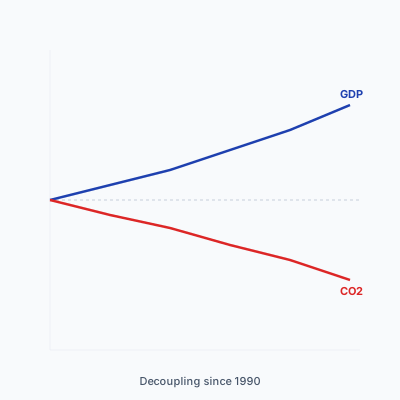
Can a country get richer without cooking the planet? Some have. Most haven't. We tracked GDP growth against CO2 emissions for 30 years — the decoupling story is real, but incomplete.
Carbon Inequality
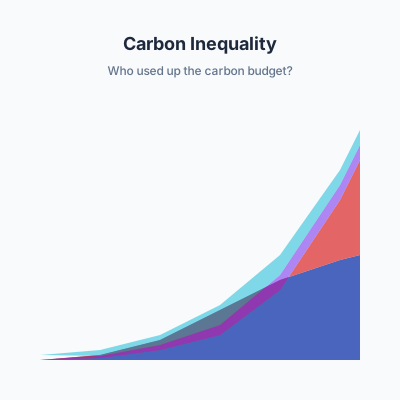
The countries drowning in rising seas didn't cause the flood. We mapped who emitted what, when — and the per-capita gap is staggering.
Corruption Tax
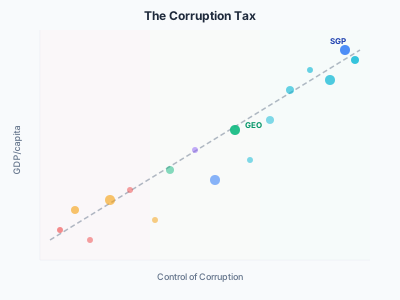
Corruption isn't a moral issue — it's a tax, and we can estimate the rate. Countries with worse governance attract less investment, grow slower, and develop less. The data quantifies the cost.
Who Funds Their Own Defense
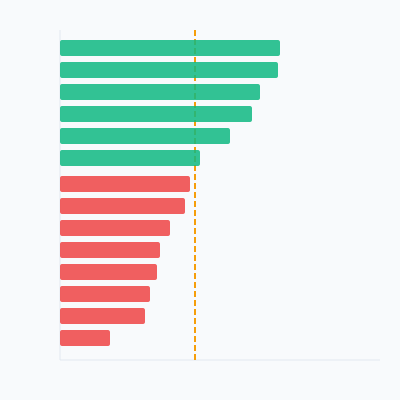
Who's actually paying for Western security? We mapped NATO defense spending against the 2% target. The free-riding is measurable — and the dollar gap is enormous.
Does Democracy Pay?
Democracies are richer — but did democracy make them rich? The relationship between governance and growth is more complicated than any slogan. We let the data speak.
Education Spending vs Innovation Output
Some countries spend billions on education and produce no patents. Others spend less and lead the world in innovation. The missing ingredient isn't money — it's R&D.
Related explainers
Dutch disease
How a resource windfall can hollow out the rest of your economy — and why the real disease is mismanagement.
Capacity factor
Why a country with 10 GW of solar capacity doesn't actually get 10 GW of electricity.

Carbon leakage
When strict climate policy in one country just pushes emissions across the border.
Consumption vs territorial emissions
The accounting trick that lets rich countries claim they're decarbonizing while importing carbon-heavy goods.
Economic sanctions: what they are, what they aren’t, and how they leak
Sanctions are financial plumbing and export controls—not magic. They bite through chokepoints and leak via detours.
Energy intensity
How much energy it takes to produce a dollar of GDP — and why the trend can mislead you.